OCR · GCSE · Physics
Course version: J249 · Version from Sept 2018
Describe how heating a system will change the energy stored within the…
Full specification wording
Changes of state: describe how heating a system will change the energy stored within the system and raise its temperature or produce changes of state
Heating transfers energy to a system, increasing the energy stored in its thermal store.
Checked against the OCR J249 specification (opens in a new tab) on .
- Point 5 of 8
- 4 key terms
Study notes
From the checked teaching notes for this specification point.
The idea
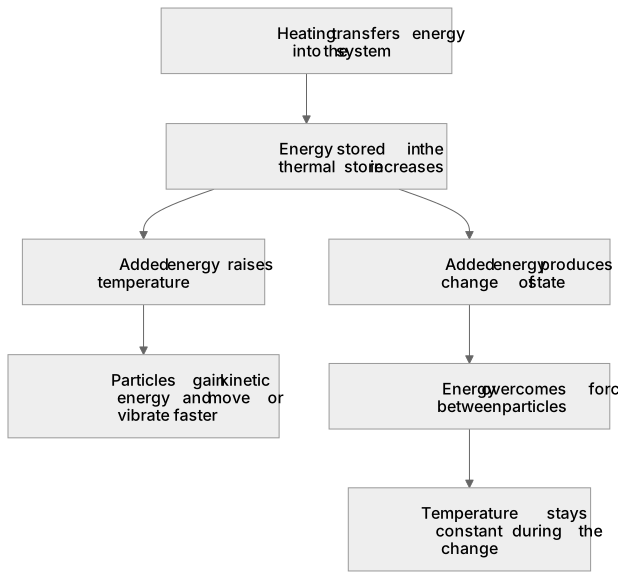
Heating transfers energy to a system, increasing the energy stored in its thermal store. That extra energy can do one of two things. It can raise the temperature, because the particles gain kinetic energy and move or vibrate faster. Alternatively, during a change of state such as melting or boiling, the energy breaks the bonds or overcomes the forces between particles rather than raising the temperature, so the temperature stays constant while the change proceeds. A multiple-choice question may ask which statement correctly links heating to stored energy and to temperature or state change; choose the option that names energy transfer into the system and either a temperature rise or a change of state, and reject options claiming that heating always raises temperature.
What earns the marks
- States that heating transfers energy into the system and increases the energy stored in its thermal store.
- Explains that the added energy raises temperature by increasing the kinetic energy of the particles.
- Recognises that during a change of state the energy overcomes forces between particles and the temperature stays constant.
- Selects the option that correctly links heating to either a temperature rise or a change of state.
Common mistakes and how to put them right
Claims that heating always raises the temperature.
Put it right: Recognise that during melting or boiling the temperature remains constant.
Says energy is destroyed during a change of state.
Put it right: State instead that it is used to overcome forces between particles.
Ignores the energy store and describes only the visible change.
Put it right: Link heating to increased energy stored in the system.
Exam tips
- Identify whether the option describes a temperature rise or a change of state and check it matches the physics.
- Use the phrase energy stored in the thermal store to justify your choice.
- Eliminate options that say temperature rises during melting or boiling.
Try the lesson
The start of the Changes of state: describe how heating a system will change the energy stored within the system and raise its temperature or produce changes of state lesson, made from checked teaching notes for this specification point.
Have a go first
A pan of water is heated on a hob and its temperature rises from 20 °C to 60 °C. What happens to the energy stored in the water as it is heated?
Listen
Heating transfers energy to a system, increasing the energy stored in its thermal store. That extra energy can do one of two things. It can raise the temperature, because the particles gain kinetic energy and move or vibrate faster. Alternatively, during a change of state such as melting or boiling, the energy breaks the bonds or overcomes the forces between particles rather than raising the temperature, so the temperature stays constant while the change proceeds. A multiple-choice question may ask which statement correctly links heating to stored energy and to temperature or state change; choose the option that names energy transfer into the system and either a temperature rise or a change of state, and reject options claiming that heating always raises temperature. A strong answer earns marks for these points. States that heating transfers energy into the system and increases the energy stored in its thermal store. Explains that the added energy raises temperature by increasing the kinetic energy of the particles. Recognises that during a change of state the energy overcomes forces between particles and the temperature stays constant. Selects the option that correctly links heating to either a temperature rise or a change of state. Exam tip: Identify whether the option describes a temperature rise or a change of state and check it matches the physics.
See it
Key words
Say what each word means before you turn the card.
Energy transfer by heating
Try answering aloud or in your head before turning the card.
Energy stored in a system
Try answering aloud or in your head before turning the card.
Temperature change
Try answering aloud or in your head before turning the card.
Changes of state
Try answering aloud or in your head before turning the card.
See every definition
- Energy transfer by heating
- Heating transfers energy into the system and increases the energy stored in its thermal store.
- Energy stored in a system
- The energy stored in the thermal store increases when heating transfers energy into the system.
- Temperature change
- The added energy raises temperature by increasing the kinetic energy of the particles, so they move or vibrate faster.
- Changes of state
- During melting or boiling the energy overcomes forces between particles rather than raising the temperature, so the temperature stays constant.
Label the diagram
Some boxes have lost their names. Pick the right name for each number.
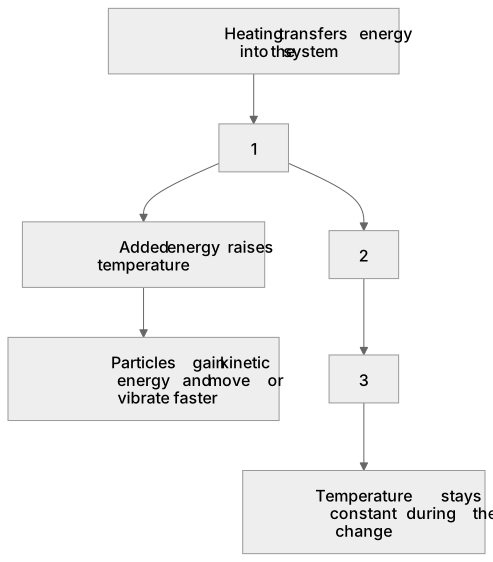
1Box 1
2Box 2
3Box 3
There is more to this lesson
The full lesson goes on to check your understanding and help you earn the marks. Create a free account to carry on, with your progress saved.
A week of Premium from your first lesson · Then the free plan continues · No card, no charge
Test your understanding of Changes of state: describe how heating a system will change the energy stored within the system and raise its temperature or produce changes of state
Active recall beats re-reading. Take an instant quiz now to test what you’ve learned and lock it into long-term memory.
A week of Premium from your first lesson · Then the free plan continues · No card, no charge