OCR · GCSE · Physics
Course version: J249 · Version from Sept 2018
Describe that physical changes differ from chemical changes because the…
Full specification wording
Changes of state: describe that physical changes differ from chemical changes because the material recovers its original properties if the change is reversed
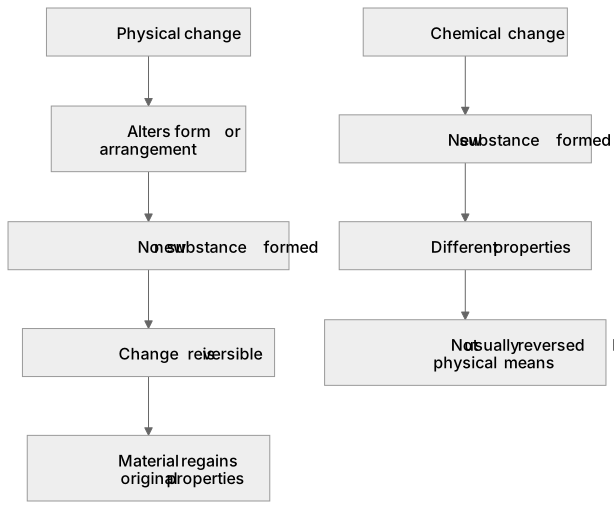
A physical change alters the form or arrangement of a substance without making a new substance, so reversing it restores the material's original properties.
Checked against the OCR J249 specification (opens in a new tab) on .
- Point 4 of 8
- 4 key terms
Study notes
From the checked teaching notes for this specification point.
The idea
A physical change alters the form or arrangement of a substance without making a new substance, so reversing it restores the material's original properties. Melting ice is the standard example: solid ice becomes liquid water, and freezing that water returns ice with the same melting point, density and appearance as before. A chemical change produces a new substance with different properties, and reversing it is generally not possible by simple physical means. In a multiple-choice question, look for the option that names reversibility and recovery of original properties as the distinguishing feature, and reject options that describe only a change of appearance or a change of state without mentioning recovery.
What earns the marks
- Selects the option stating that a physical change is reversible and the material regains its original properties.
- Rejects options that describe a chemical change as easily reversed by physical means.
- Identifies melting and freezing as an example where the original substance is recovered.
- Distinguishes physical change from chemical change by whether a new substance is formed.
Common mistakes and how to put them right
Treats any change of appearance as a chemical change.
Put it right: Check instead whether a new substance forms and whether the original properties return on reversal.
Assumes all changes of state create new substances.
Put it right: Recognise that melting and freezing recover the same material.
Confuses dissolving with a chemical reaction.
Put it right: Note that evaporating the solvent can recover the dissolved solid.
Exam tips
- Read every option before choosing and eliminate those that ignore reversibility.
- Link the chosen option to a named example such as ice melting and refreezing.
- Check that the option mentions recovery of original properties, not just a change of state.
Try the lesson
The start of the Changes of state: describe that physical changes differ from chemical changes because the material recovers its original properties if the change is reversed lesson, made from checked teaching notes for this specification point.
Have a go first
A sample of candle wax is melted and then allowed to cool and solidify. Which statement best explains why melting the wax is a physical change rather than a chemical change?
Listen
A physical change alters the form or arrangement of a substance without making a new substance, so reversing it restores the material's original properties. Melting ice is the standard example: solid ice becomes liquid water, and freezing that water returns ice with the same melting point, density and appearance as before. A chemical change produces a new substance with different properties, and reversing it is generally not possible by simple physical means. In a multiple-choice question, look for the option that names reversibility and recovery of original properties as the distinguishing feature, and reject options that describe only a change of appearance or a change of state without mentioning recovery. A strong answer earns marks for these points. Selects the option stating that a physical change is reversible and the material regains its original properties. Rejects options that describe a chemical change as easily reversed by physical means. Identifies melting and freezing as an example where the original substance is recovered. Distinguishes physical change from chemical change by whether a new substance is formed. Exam tip: Read every option before choosing and eliminate those that ignore reversibility.
See it
Key words
Say what each word means before you turn the card.
Physical versus chemical change
Try answering aloud or in your head before turning the card.
Reversibility
Try answering aloud or in your head before turning the card.
Recovery of original properties
Try answering aloud or in your head before turning the card.
Changes of state
Try answering aloud or in your head before turning the card.
See every definition
- Physical versus chemical change
- A physical change alters the form or arrangement of a substance without making a new substance, while a chemical change produces a new substance with different properties.
- Reversibility
- The distinguishing feature of a physical change, where reversing the change restores the material's original properties.
- Recovery of original properties
- When a physical change is reversed, the material regains its original properties, such as the same melting point, density and appearance as before.
- Changes of state
- Melting and freezing are examples where the original substance is recovered, since melting ice and freezing the water returns the same material.
Label the diagram
Some boxes have lost their names. Pick the right name for each number.
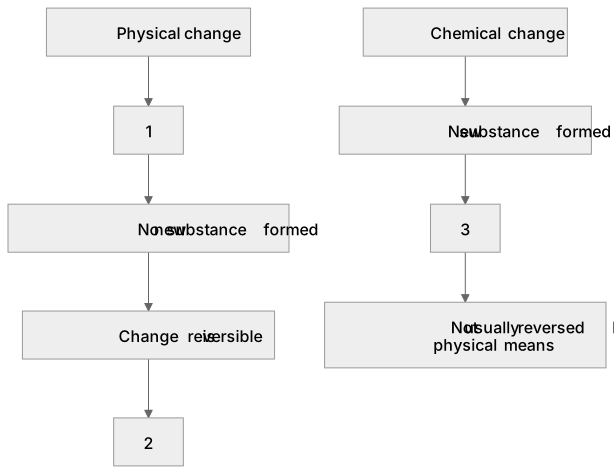
1Box 1
2Box 2
3Box 3
There is more to this lesson
The full lesson goes on to check your understanding and help you earn the marks. Create a free account to carry on, with your progress saved.
A week of Premium from your first lesson · Then the free plan continues · No card, no charge
Test your understanding of Changes of state: describe that physical changes differ from chemical changes because the material recovers its original properties if the change is reversed
Active recall beats re-reading. Take an instant quiz now to test what you’ve learned and lock it into long-term memory.
A week of Premium from your first lesson · Then the free plan continues · No card, no charge