OCR · GCSE · Physics
Course version: J249 · Version from Sept 2018
Describe how mass is conserved when substances melt, freeze, evaporate,…
Full specification wording
Changes of state: describe how mass is conserved when substances melt, freeze, evaporate, condense or sublimate
A change of state rearranges particles but does not create or destroy them, so the total mass stays the same.
Checked against the OCR J249 specification (opens in a new tab) on .
- Point 3 of 8
Study notes
From the checked teaching notes for this specification point.
The idea
A change of state rearranges particles but does not create or destroy them, so the total mass stays the same. Melting turns a solid into a liquid, freezing turns a liquid into a solid, evaporating turns a liquid into a gas, condensing turns a gas into a liquid, and sublimating turns a solid directly into a gas. In each case the same particles are present before and after, only their arrangement and energy change. For example, 100 g of ice melts to give 100 g of water, and the water vapour formed when it evaporates still has a mass of 100 g. In a sealed container the mass reading does not change during any of these processes.
What earns the marks
- States that the total mass stays the same during melting, freezing, evaporation, condensation and sublimation.
- Explains that the same particles are present before and after a change of state, only rearranged.
- Applies conservation of mass to a named change of state such as ice melting to water of equal mass.
- Recognises that mass is conserved because no particles are added or lost in a closed system.
Common mistakes and how to put them right
Claims that mass is lost when a liquid evaporates.
Put it right: Recognise that the particles become a gas and the total mass is unchanged.
Assumes a gas has no mass because it is invisible.
Put it right: State that the gas particles still have mass.
Treats each change of state as a different process with different mass rules.
Put it right: Apply the same conservation of mass to melting, freezing, evaporation, condensation and sublimation.
Forgets sublimation when listing changes of state.
Put it right: Include solid-to-gas sublimation alongside the other four changes.
Exam tips
- Name the change of state in the question and state that the particles are the same before and after.
- Use a simple numerical example such as equal masses of ice and water to show conservation of mass.
- Mention that in a closed container the balance reading stays constant to support your answer.
Try the lesson
The start of the Changes of state: describe how mass is conserved when substances melt, freeze, evaporate, condense or sublimate lesson, made from checked teaching notes for this specification point.
Have a go first
200 g of liquid wax is cooled until it freezes into a solid. What is the mass of the solid wax formed?
Listen
A change of state rearranges particles but does not create or destroy them, so the total mass stays the same. Melting turns a solid into a liquid, freezing turns a liquid into a solid, evaporating turns a liquid into a gas, condensing turns a gas into a liquid, and sublimating turns a solid directly into a gas. In each case the same particles are present before and after, only their arrangement and energy change. For example, 100 g of ice melts to give 100 g of water, and the water vapour formed when it evaporates still has a mass of 100 g. In a sealed container the mass reading does not change during any of these processes. A strong answer earns marks for these points. States that the total mass stays the same during melting, freezing, evaporation, condensation and sublimation. Explains that the same particles are present before and after a change of state, only rearranged. Applies conservation of mass to a named change of state such as ice melting to water of equal mass. Recognises that mass is conserved because no particles are added or lost in a closed system. Exam tip: Name the change of state in the question and state that the particles are the same before and after.
See it
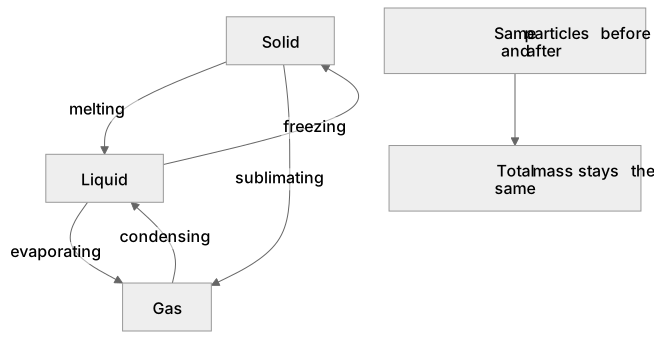
Label the diagram
Some boxes have lost their names. Pick the right name for each number.
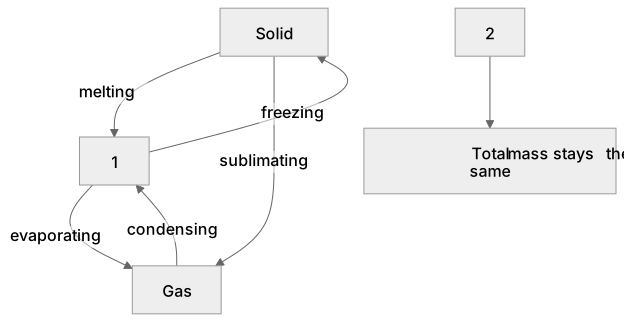
1Box 1
2Box 2
There is more to this lesson
The full lesson goes on to check your understanding and help you earn the marks. Create a free account to carry on, with your progress saved.
A week of Premium from your first lesson · Then the free plan continues · No card, no charge
Test your understanding of Changes of state: describe how mass is conserved when substances melt, freeze, evaporate, condense or sublimate
Active recall beats re-reading. Take an instant quiz now to test what you’ve learned and lock it into long-term memory.
A week of Premium from your first lesson · Then the free plan continues · No card, no charge