OCR · GCSE · Physics
Course version: J249 · Version from Sept 2018
Making observations of the effects of the interaction of electromagnetic…
Full specification wording
Interactions of waves: Making observations of the effects of the interaction of electromagnetic waves with matter.
This practical activity asks you to observe what happens when electromagnetic waves meet different materials, and to record those observations carefully.
Checked against the OCR J249 specification (opens in a new tab) on .
- Point 2 of 2
- 3 key terms
Study notes
From the checked teaching notes for this specification point.
The idea
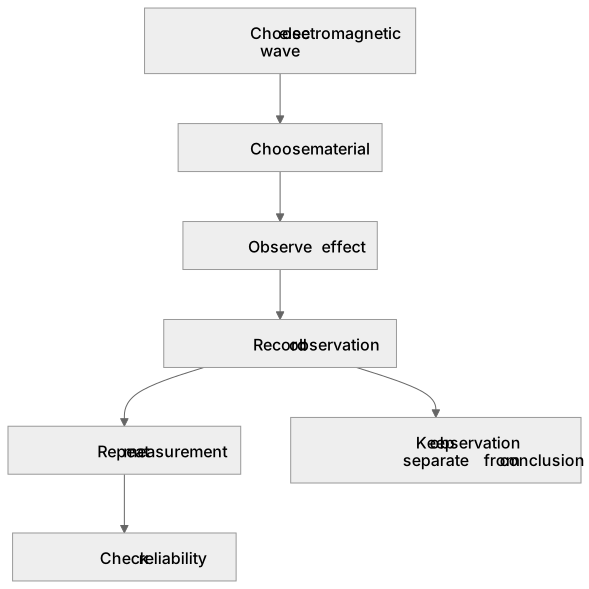
This practical activity asks you to observe what happens when electromagnetic waves meet different materials, and to record those observations carefully. You might shine a torch beam at a transparent block, a translucent sheet and an opaque card, noting how much light passes through and whether a shadow forms. You could direct a ray box at a mirror and at a rough surface and note the reflected beam. You could compare how a white surface and a black surface warm up under a lamp, or observe infrared passing through a filter. For each test, describe the material, the wave used and the effect you see, such as transmission, absorption, reflection or a change in temperature. Record observations as clear descriptions rather than conclusions, and repeat readings where a measurement is taken.
What earns the marks
- Identifies the electromagnetic wave used in the observation, such as visible light from a ray box or infrared from a lamp.
- Describes the material the wave interacts with, such as a transparent block, a translucent sheet or an opaque card.
- Records the observed effect, such as light passing through, a shadow forming, a beam reflecting or a surface warming.
- Distinguishes an observation from a conclusion by stating what is seen before explaining why it happens.
- Repeats a measurement, such as a temperature rise, to check that the observation is reliable.
Common mistakes and how to put them right
States a conclusion such as 'light is absorbed' without describing what was actually seen.
Put it right: Record the observation first, then explain it.
Names the material but not the electromagnetic wave used.
Put it right: State both the wave and the material in each observation.
Treats a single reading as reliable without repeating it.
Put it right: Repeat measurements and note whether results agree.
Exam tips
- Link each observation to a named electromagnetic wave and a named material so the interaction is clear.
- Use precise vocabulary such as transmitted, absorbed, reflected and scattered rather than vague words like 'goes through'.
- Describe what you see before offering an explanation, keeping observation and conclusion separate.
Try the lesson
The start of the Interactions of waves: Making observations of the effects of the interaction of electromagnetic waves with matter. lesson, made from checked teaching notes for this specification point.
Have a go first
A student holds a sheet of black paper and a sheet of shiny metal foil in bright sunlight. Which sheet feels warmer, and why?
Listen
This practical activity asks you to observe what happens when electromagnetic waves meet different materials, and to record those observations carefully. You might shine a torch beam at a transparent block, a translucent sheet and an opaque card, noting how much light passes through and whether a shadow forms. You could direct a ray box at a mirror and at a rough surface and note the reflected beam. You could compare how a white surface and a black surface warm up under a lamp, or observe infrared passing through a filter. For each test, describe the material, the wave used and the effect you see, such as transmission, absorption, reflection or a change in temperature. Record observations as clear descriptions rather than conclusions, and repeat readings where a measurement is taken. A strong answer earns marks for these points. Identifies the electromagnetic wave used in the observation, such as visible light from a ray box or infrared from a lamp. Describes the material the wave interacts with, such as a transparent block, a translucent sheet or an opaque card. Records the observed effect, such as light passing through, a shadow forming, a beam reflecting or a surface warming. Distinguishes an observation from a conclusion by stating what is seen before explaining why it happens. Exam tip: Link each observation to a named electromagnetic wave and a named material so the interaction is clear.
See it
Key words
Say what each word means before you turn the card.
Transmission, absorption and reflection
Try answering aloud or in your head before turning the card.
Observation and recording skills
Try answering aloud or in your head before turning the card.
Reliability through repetition
Try answering aloud or in your head before turning the card.
See every definition
- Transmission, absorption and reflection
- Effects seen when electromagnetic waves meet a material, such as light passing through, a beam reflecting or a surface warming.
- Observation and recording skills
- Recording clear descriptions of what is seen, such as light passing through or a shadow forming, rather than conclusions.
- Reliability through repetition
- Repeating a measurement, such as a temperature rise, to check that the observation is reliable and noting whether results agree.
Label the diagram
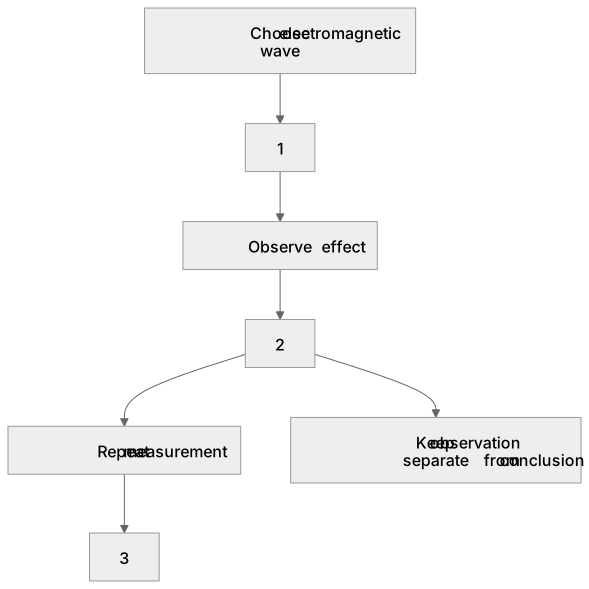
Some boxes have lost their names. Pick the right name for each number.
1Box 1
2Box 2
3Box 3
There is more to this lesson
The full lesson goes on to check your understanding and help you earn the marks. Create a free account to carry on, with your progress saved.
A week of Premium from your first lesson · Then the free plan continues · No card, no charge
Test your understanding of Interactions of waves: Making observations of the effects of the interaction of electromagnetic waves with matter.
Active recall beats re-reading. Take an instant quiz now to test what you’ve learned and lock it into long-term memory.
A week of Premium from your first lesson · Then the free plan continues · No card, no charge