OCR · GCSE · Physics
Course version: J249 · Version from Sept 2018
Making observations of waves in fluids and solids to identify the…
Full specification wording
Interactions of waves: Making observations of waves in fluids and solids to identify the suitability of apparatus to measure the effects of the interaction of waves with matter.
Waves behave differently in fluids (liquids and gases) and in solids, and their interaction with matter can be observed and measured.
Checked against the OCR J249 specification (opens in a new tab) on .
- Point 1 of 2
- 4 key terms
Study notes
From the checked teaching notes for this specification point.
The idea
Waves behave differently in fluids (liquids and gases) and in solids, and their interaction with matter can be observed and measured. In a solid, waves may travel faster and be transmitted; at a boundary they can reflect, refract or be absorbed. In a fluid, waves such as sound or water waves spread and can be reflected or refracted. To measure these effects you choose apparatus suited to the wave and material: a ripple tank for water waves, a signal generator and microphone for sound, a ray box and protractor for light, or an oscilloscope to display a signal. Judging suitability means asking whether the apparatus can detect the wave, resolve the effect and give repeatable readings.
What earns the marks
- Selects apparatus matched to the wave type and the material, such as a ripple tank for water waves or a ray box and protractor for light at a boundary.
- Explains that observations in solids and fluids show effects such as reflection, refraction, transmission or absorption at boundaries.
- Justifies the suitability of apparatus by whether it can detect the wave, resolve the effect and give repeatable measurements.
- Compares observations in a fluid with those in a solid to identify which apparatus measures the interaction reliably.
Common mistakes and how to put them right
Chooses apparatus for the wrong wave type, such as a microphone to measure light.
Put it right: Match the detector to the wave being studied.
Treats any reading as suitable without checking repeatability.
Put it right: Repeat measurements and judge whether the apparatus resolves the effect.
Assumes waves behave identically in solids and fluids.
Put it right: Observe and compare the interaction in each material.
Exam tips
- Link each apparatus to the wave and material it is designed to observe.
- Ask whether the chosen apparatus can actually detect and measure the effect before judging it suitable.
- Use observations of reflection, refraction or absorption to justify why one apparatus is better than another.
Try the lesson
The start of the Interactions of waves: Making observations of waves in fluids and solids to identify the suitability of apparatus to measure the effects of the interaction of waves with matter. lesson, made from checked teaching notes for this specification point.
Have a go first
A student wants to measure the speed of sound travelling through a solid metal rod. Which apparatus is most suitable for detecting the arrival of the sound wave?
Listen
Waves behave differently in fluids (liquids and gases) and in solids, and their interaction with matter can be observed and measured. In a solid, waves may travel faster and be transmitted; at a boundary they can reflect, refract or be absorbed. In a fluid, waves such as sound or water waves spread and can be reflected or refracted. To measure these effects you choose apparatus suited to the wave and material: a ripple tank for water waves, a signal generator and microphone for sound, a ray box and protractor for light, or an oscilloscope to display a signal. Judging suitability means asking whether the apparatus can detect the wave, resolve the effect and give repeatable readings. A strong answer earns marks for these points. Selects apparatus matched to the wave type and the material, such as a ripple tank for water waves or a ray box and protractor for light at a boundary. Explains that observations in solids and fluids show effects such as reflection, refraction, transmission or absorption at boundaries. Justifies the suitability of apparatus by whether it can detect the wave, resolve the effect and give repeatable measurements. Compares observations in a fluid with those in a solid to identify which apparatus measures the interaction reliably. Exam tip: Link each apparatus to the wave and material it is designed to observe.
See it
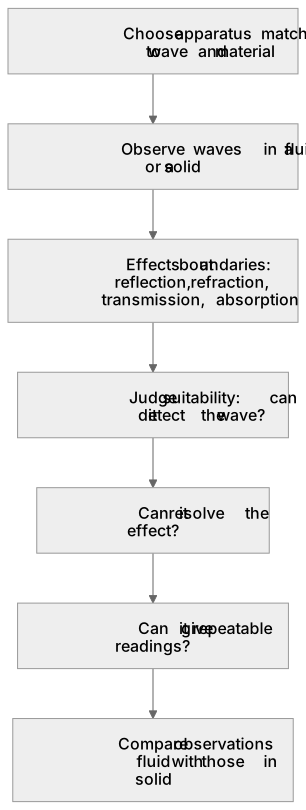
Put it in order
Put these steps in the order they happen.
- 1. Compare observations in fluid with those in solid
- 2. Can it give repeatable readings?
- 3. Effects at boundaries: reflection, refraction, transmission, absorption
- 4. Can it resolve the effect?
- 5. Choose apparatus matched to wave and material
- 6. Observe waves in a fluid or a solid
- 7. Judge suitability: can it detect the wave?
Key words
Say what each word means before you turn the card.
Waves in fluids and solids
Try answering aloud or in your head before turning the card.
Interaction of waves with matter
Try answering aloud or in your head before turning the card.
Choosing suitable measuring apparatus
Try answering aloud or in your head before turning the card.
Judging suitability from observations
Try answering aloud or in your head before turning the card.
See every definition
- Waves in fluids and solids
- Waves behave differently in fluids (liquids and gases) and in solids, and their interaction with matter can be observed and measured.
- Interaction of waves with matter
- At a boundary waves can reflect, refract or be absorbed, and in a fluid waves such as sound or water waves spread and can be reflected or refracted.
- Choosing suitable measuring apparatus
- Apparatus suited to the wave and material is chosen, such as a ripple tank for water waves or a ray box and protractor for light.
- Judging suitability from observations
- Asking whether the apparatus can detect the wave, resolve the effect and give repeatable readings.
Label the diagram
Some boxes have lost their names. Pick the right name for each number.
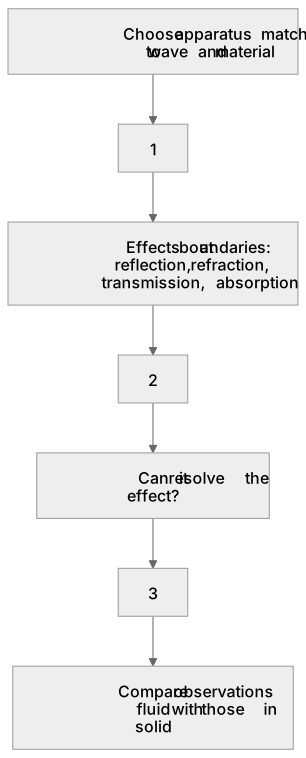
1Box 1
2Box 2
3Box 3
There is more to this lesson
The full lesson goes on to check your understanding and help you earn the marks. Create a free account to carry on, with your progress saved.
A week of Premium from your first lesson · Then the free plan continues · No card, no charge
Test your understanding of Interactions of waves: Making observations of waves in fluids and solids to identify the suitability of apparatus to measure the effects of the interaction of waves with matter.
Active recall beats re-reading. Take an instant quiz now to test what you’ve learned and lock it into long-term memory.
A week of Premium from your first lesson · Then the free plan continues · No card, no charge