OCR · GCSE · Physics
Course version: J249 · Version from Sept 2018
Make calculations using ratios and proportional reasoning to convert units…
Full specification wording
Motion: make calculations using ratios and proportional reasoning to convert units and to compute rates (to include: conversion from non-SI to SI units)
This criterion asks you to use ratios and proportional reasoning in two ways: converting between units and computing rates.
Checked against the OCR J249 specification (opens in a new tab) on .
- Point 7 of 14
- 4 key terms
Study notes
From the checked teaching notes for this specification point.
The idea
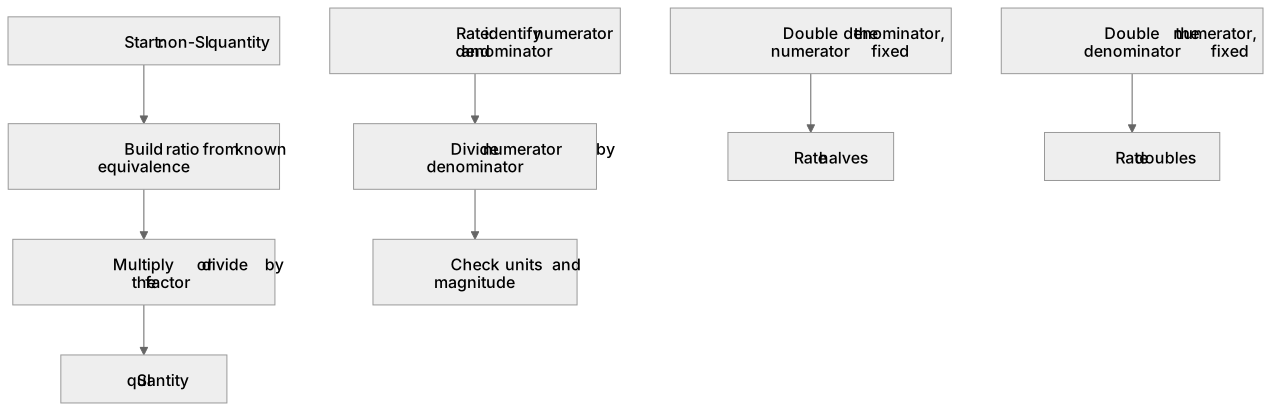
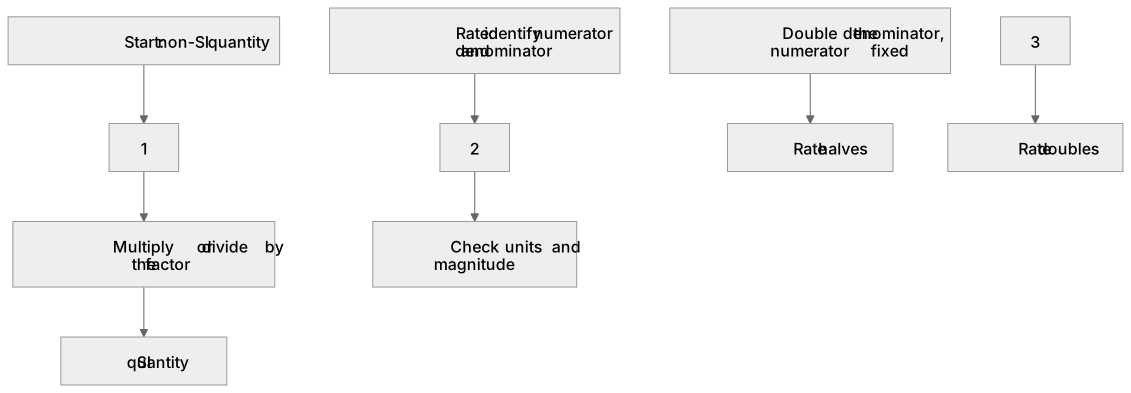
This criterion asks you to use ratios and proportional reasoning in two ways: converting between units and computing rates. For unit conversion, build a ratio from known equivalences, such as 1 km = 1000 m or 1 hour = 3600 s, and multiply or divide by that factor. For example, 72 km/h becomes 72 × 1000 ÷ 3600 = 20 m/s. For rates, identify which quantity is divided by which: speed is distance ÷ time, so doubling the distance while time stays fixed doubles the speed, but doubling the time while distance stays fixed halves the speed. Reason about direction and size before calculating, then check the answer's units and magnitude.
What earns the marks
- Applies the correct conversion factor to change a non-SI quantity such as km/h into SI units such as m/s.
- Identifies the numerator and denominator of a rate before substituting values.
- Predicts correctly that doubling the denominator of a rate while holding the numerator fixed halves the rate.
- Selects the option whose value and unit both follow from consistent proportional reasoning.
Common mistakes and how to put them right
Assumes doubling any quantity in a rate doubles the result.
Put it right: Check whether the quantity is in the numerator or the denominator.
Multiplies by a conversion factor when division is required.
Put it right: Set the ratio so unwanted units cancel.
Mixes units within one calculation, such as kilometres with seconds.
Put it right: Convert to SI first.
Exam tips
- Write the conversion as a fraction with units so you can cancel them and see the direction of the operation.
- State which quantity is divided by which before computing a rate.
- Sanity-check the answer: a speed in m/s should be smaller than the same speed in km/h.
Try the lesson
The start of the Motion: make calculations using ratios and proportional reasoning to convert units and to compute rates (to include: conversion from non-SI to SI units) lesson, made from checked teaching notes for this specification point.
Have a go first
A distance is given as 250 cm. Using the fact that 1 m = 100 cm, what is this distance in metres?
Listen
This criterion asks you to use ratios and proportional reasoning in two ways: converting between units and computing rates. For unit conversion, build a ratio from known equivalences, such as 1 km = 1000 m or 1 hour = 3600 s, and multiply or divide by that factor. For example, 72 km/h becomes 72 × 1000 ÷ 3600 = 20 m/s. For rates, identify which quantity is divided by which: speed is distance ÷ time, so doubling the distance while time stays fixed doubles the speed, but doubling the time while distance stays fixed halves the speed. Reason about direction and size before calculating, then check the answer's units and magnitude. A strong answer earns marks for these points. Applies the correct conversion factor to change a non-SI quantity such as km/h into SI units such as m/s. Identifies the numerator and denominator of a rate before substituting values. Predicts correctly that doubling the denominator of a rate while holding the numerator fixed halves the rate. Selects the option whose value and unit both follow from consistent proportional reasoning. Exam tip: Write the conversion as a fraction with units so you can cancel them and see the direction of the operation.
See it
Key words
Say what each word means before you turn the card.
Ratio and proportional reasoning
Try answering aloud or in your head before turning the card.
Conversion from non-SI to SI units
Try answering aloud or in your head before turning the card.
Computing rates
Try answering aloud or in your head before turning the card.
Checking magnitude and units of an answer
Try answering aloud or in your head before turning the card.
See every definition
- Ratio and proportional reasoning
- Used in two ways: converting between units and computing rates.
- Conversion from non-SI to SI units
- Building a ratio from known equivalences and multiplying or dividing by that factor.
- Computing rates
- Identifying which quantity is divided by which, such as distance divided by time for speed.
- Checking magnitude and units of an answer
- Reasoning about direction and size before calculating, then checking the answer's units and magnitude.
Label the diagram
Some boxes have lost their names. Pick the right name for each number.
1Box 1
2Box 2
3Box 3
There is more to this lesson
The full lesson goes on to check your understanding and help you earn the marks. Create a free account to carry on, with your progress saved.
A week of Premium from your first lesson · Then the free plan continues · No card, no charge
Test your understanding of Motion: make calculations using ratios and proportional reasoning to convert units and to compute rates (to include: conversion from non-SI to SI units)
Active recall beats re-reading. Take an instant quiz now to test what you’ve learned and lock it into long-term memory.
A week of Premium from your first lesson · Then the free plan continues · No card, no charge