OCR · GCSE · Physics
Course version: J249 · Version from Sept 2018
Explain the vector–scalar distinction as it applies to displacement and…
Full specification wording
Motion: explain the vector–scalar distinction as it applies to displacement and distance, velocity and speed
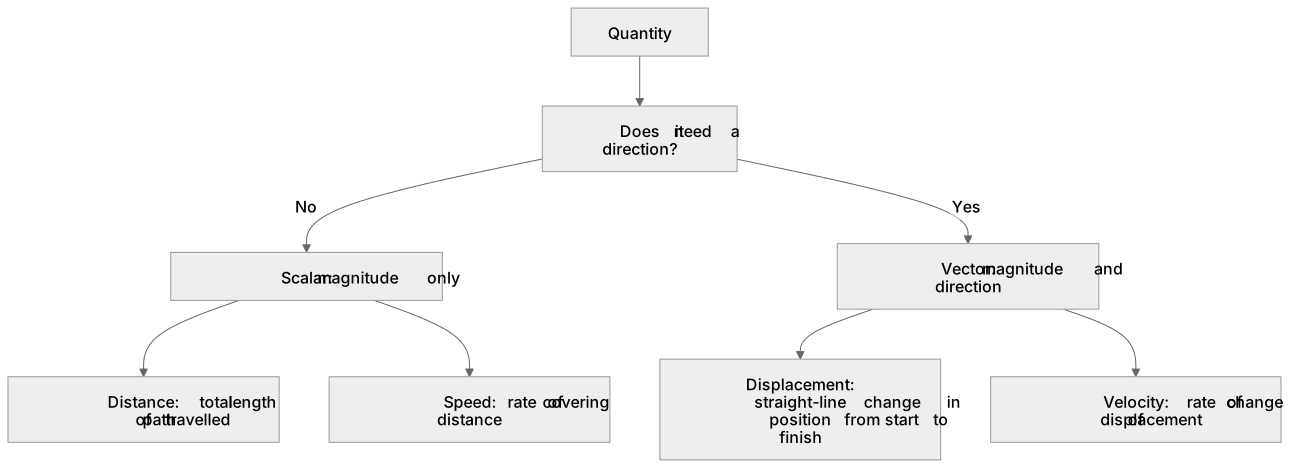
A scalar has magnitude only; a vector has magnitude and direction.
Checked against the OCR J249 specification (opens in a new tab) on .
- Point 8 of 14
- 4 key terms
Study notes
From the checked teaching notes for this specification point.
The idea
A scalar has magnitude only; a vector has magnitude and direction. Distance is the total length of the path travelled and is a scalar, so walking 3 m east then 4 m west gives a distance of 7 m. Displacement is the straight-line change in position from start to finish, with direction, so the same walk gives a displacement of 1 m west. Speed is the scalar rate of covering distance, while velocity is the vector rate of change of displacement, so a car going round a bend at constant speed still changes velocity because its direction changes. In multiple-choice questions, decide first whether the quantity needs a direction, then check the units and wording before choosing the option.
What earns the marks
- Identifies distance and speed as scalars because they have magnitude only.
- Identifies displacement and velocity as vectors because they have both magnitude and direction.
- Explains that displacement measures the straight-line change in position from start to finish, including direction.
- Explains that velocity is the rate of change of displacement and so changes when direction changes even at constant speed.
- Distinguishes a round trip, where distance is non-zero but displacement is zero, from a one-way journey.
Common mistakes and how to put them right
Treats speed and velocity as interchangeable.
Put it right by stating that velocity includes direction while speed does not.
Adds path lengths to find displacement.
Put it right by resolving the journey as a single straight-line change in position with direction.
Assumes a car moving at constant speed round a bend has constant velocity.
Put it right by noting that the changing direction changes the velocity.
Labels distance as a vector.
Put it right by stating that distance is a scalar with magnitude only.
Exam tips
- Ask whether the quantity would be meaningless without a direction; if so, it is a vector.
- Check each option for both magnitude and direction before selecting it.
- Use a short worked journey, such as 3 m east then 4 m west, to test each option quickly.
Try the lesson
The start of the Motion: explain the vector–scalar distinction as it applies to displacement and distance, velocity and speed lesson, made from checked teaching notes for this specification point.
Have a go first
A runner completes one full lap of a 400 m track and stops at the starting point. Which statement correctly describes the distance travelled and the displacement?
Listen
A scalar has magnitude only; a vector has magnitude and direction. Distance is the total length of the path travelled and is a scalar, so walking 3 m east then 4 m west gives a distance of 7 m. Displacement is the straight-line change in position from start to finish, with direction, so the same walk gives a displacement of 1 m west. Speed is the scalar rate of covering distance, while velocity is the vector rate of change of displacement, so a car going round a bend at constant speed still changes velocity because its direction changes. In multiple-choice questions, decide first whether the quantity needs a direction, then check the units and wording before choosing the option. A strong answer earns marks for these points. Identifies distance and speed as scalars because they have magnitude only. Identifies displacement and velocity as vectors because they have both magnitude and direction. Explains that displacement measures the straight-line change in position from start to finish, including direction. Explains that velocity is the rate of change of displacement and so changes when direction changes even at constant speed. A common slip: Treats speed and velocity as interchangeable. Instead, stating that velocity includes direction while speed does not. Exam tip: Ask whether the quantity would be meaningless without a direction; if so, it is a vector.
See it
Key words
Say what each word means before you turn the card.
Scalar
Try answering aloud or in your head before turning the card.
Vector
Try answering aloud or in your head before turning the card.
Displacement
Try answering aloud or in your head before turning the card.
Velocity
Try answering aloud or in your head before turning the card.
See every definition
- Scalar
- A quantity that has magnitude only.
- Vector
- A quantity that has magnitude and direction.
- Displacement
- The straight-line change in position from start to finish, with direction.
- Velocity
- The vector rate of change of displacement, so it changes when direction changes even at constant speed.
Label the diagram
Some boxes have lost their names. Pick the right name for each number.
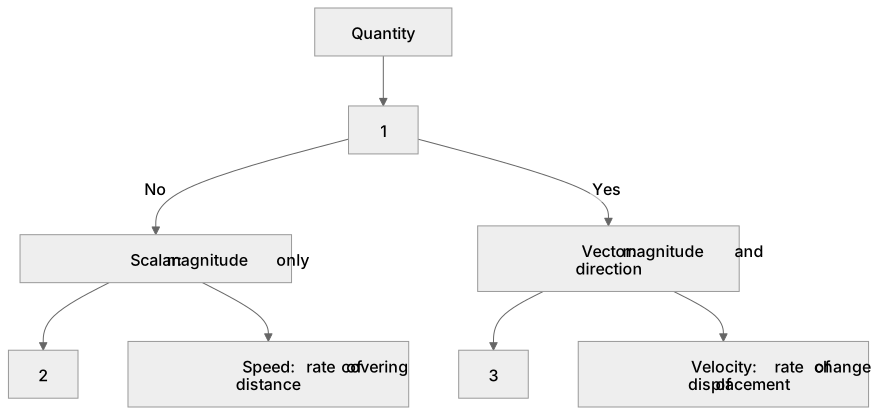
1Box 1
2Box 2
3Box 3
There is more to this lesson
The full lesson goes on to check your understanding and help you earn the marks. Create a free account to carry on, with your progress saved.
A week of Premium from your first lesson · Then the free plan continues · No card, no charge
Test your understanding of Motion: explain the vector–scalar distinction as it applies to displacement and distance, velocity and speed
Active recall beats re-reading. Take an instant quiz now to test what you’ve learned and lock it into long-term memory.
A week of Premium from your first lesson · Then the free plan continues · No card, no charge