OCR · GCSE · Physics
Course version: J249 · Version from Sept 2018
Recall and apply: acceleration (m/s²) = change in velocity (m/s) / time (s)
Full specification wording
Motion: recall and apply: acceleration (m/s²) = change in velocity (m/s) / time (s)
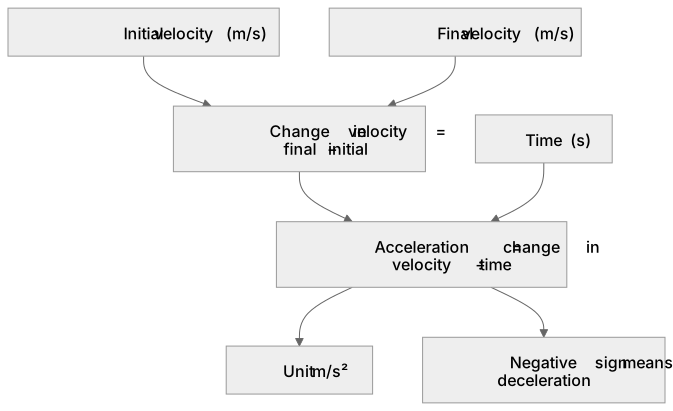
Acceleration measures how quickly velocity changes, so it is the change in velocity divided by the time taken for that change.
Checked against the OCR J249 specification (opens in a new tab) on .
- Point 2 of 14
- 4 key terms
Study notes
From the checked teaching notes for this specification point.
The idea
Acceleration measures how quickly velocity changes, so it is the change in velocity divided by the time taken for that change. Find the change in velocity by subtracting the initial velocity from the final velocity, keeping direction in mind: a car slowing from 20 m/s to 8 m/s in 6 s has a change of 8 − 20 = −12 m/s, giving a = −12 ÷ 6 = −2 m/s², a deceleration. Units follow from the division: (m/s) ÷ s = m/s². Rearranged forms are a × t = Δv and t = Δv ÷ a. In a multiple-choice question, compute the value first, then check the unit and sign before matching an option, since distractors often divide by the wrong quantity or drop the negative sign.
What earns the marks
- Selects the option equal to the change in velocity divided by the time taken, with the unit m/s².
- Calculates the change in velocity by subtracting the initial velocity from the final velocity before dividing.
- Keeps a negative sign when the object slows down and identifies the result as deceleration.
- Rearranges the relationship correctly to find time as change in velocity divided by acceleration.
- Rejects options whose unit is m/s or m, since acceleration is measured in m/s².
Common mistakes and how to put them right
Divides the final velocity by the time without subtracting the initial velocity.
Put it right: Subtract the initial value first to obtain the change.
Drops the negative sign for a slowing object.
Put it right: Retain the sign so the answer shows deceleration.
Uses the unit m/s for acceleration.
Put it right: Write m/s² because velocity is divided by time.
Exam tips
- Write down the values of initial velocity, final velocity and time before touching the options.
- Check the sign of the change in velocity, especially when the object is slowing.
- Confirm the unit of your answer matches m/s² before selecting an option.
Try the lesson
The start of the Motion: recall and apply: acceleration (m/s²) = change in velocity (m/s) / time (s) lesson, made from checked teaching notes for this specification point.
Have a go first
A runner speeds up from 2 m/s to 8 m/s in 2 s. What is the runner's acceleration?
Listen
Acceleration measures how quickly velocity changes, so it is the change in velocity divided by the time taken for that change. Find the change in velocity by subtracting the initial velocity from the final velocity, keeping direction in mind: a car slowing from 20 m/s to 8 m/s in 6 s has a change of 8 − 20 = −12 m/s, giving a = −12 ÷ 6 = −2 m/s², a deceleration. Units follow from the division: (m/s) ÷ s = m/s². Rearranged forms are a × t = Δv and t = Δv ÷ a. In a multiple-choice question, compute the value first, then check the unit and sign before matching an option, since distractors often divide by the wrong quantity or drop the negative sign. A strong answer earns marks for these points. Selects the option equal to the change in velocity divided by the time taken, with the unit m/s². Calculates the change in velocity by subtracting the initial velocity from the final velocity before dividing. Keeps a negative sign when the object slows down and identifies the result as deceleration. Rearranges the relationship correctly to find time as change in velocity divided by acceleration. Exam tip: Write down the values of initial velocity, final velocity and time before touching the options.
See it
Key words
Say what each word means before you turn the card.
Acceleration
Try answering aloud or in your head before turning the card.
Change in velocity
Try answering aloud or in your head before turning the card.
Units of acceleration
Try answering aloud or in your head before turning the card.
Deceleration
Try answering aloud or in your head before turning the card.
See every definition
- Acceleration
- How quickly velocity changes, found as the change in velocity divided by the time taken for that change, measured in m/s².
- Change in velocity
- Found by subtracting the initial velocity from the final velocity, keeping direction in mind.
- Units of acceleration
- Follow from the division of velocity by time: (m/s) ÷ s = m/s².
- Deceleration
- A negative acceleration, kept with its negative sign when the object slows down.
Label the diagram
Some boxes have lost their names. Pick the right name for each number.
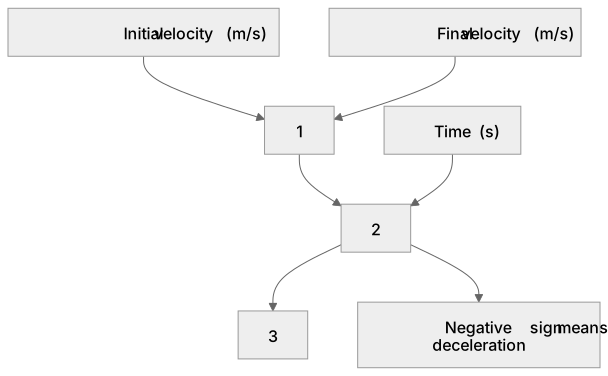
1Box 1
2Box 2
3Box 3
There is more to this lesson
The full lesson goes on to check your understanding and help you earn the marks. Create a free account to carry on, with your progress saved.
A week of Premium from your first lesson · Then the free plan continues · No card, no charge
Test your understanding of Motion: recall and apply: acceleration (m/s²) = change in velocity (m/s) / time (s)
Active recall beats re-reading. Take an instant quiz now to test what you’ve learned and lock it into long-term memory.
A week of Premium from your first lesson · Then the free plan continues · No card, no charge