OCR · GCSE · Physics
Course version: J249 · Version from Sept 2018
Relate changes and differences in motion to appropriate distance-time, and…
Full specification wording
Motion: relate changes and differences in motion to appropriate distance-time, and velocity-time graphs; interpret lines and slopes
Choose the graph that matches the motion described.
Checked against the OCR J249 specification (opens in a new tab) on .
- Point 9 of 14
- 4 key terms
Study notes
From the checked teaching notes for this specification point.
The idea
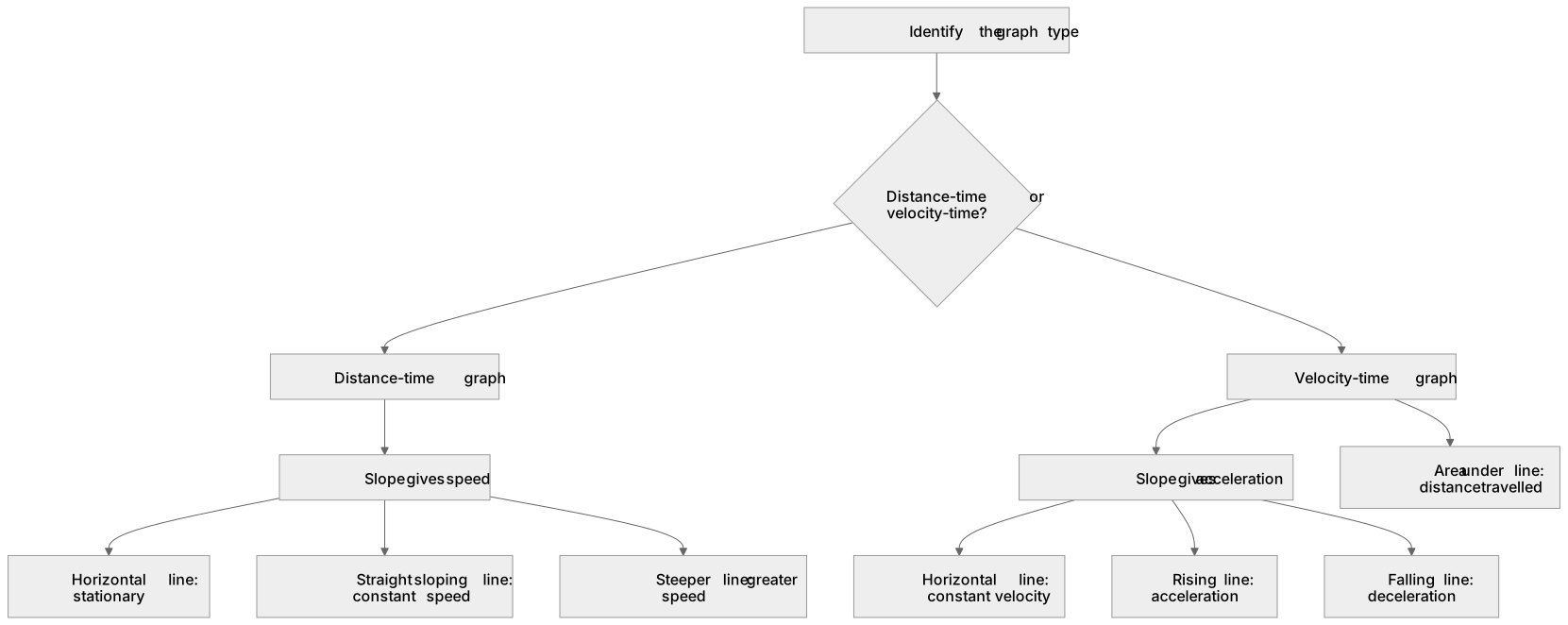
Choose the graph that matches the motion described. On a distance-time graph the slope gives speed: a horizontal line means the object is stationary, a straight sloping line means constant speed, and a steeper line means greater speed. On a velocity-time graph the slope gives acceleration: a horizontal line means constant velocity, a rising line means acceleration and a falling line means deceleration, while the area under the line gives the distance travelled. A curved line on either graph shows changing speed or changing acceleration. In multiple-choice questions, match each feature of the described motion, such as rest, steady speed, speeding up or slowing down, to the correct line shape and slope on the right type of graph.
What earns the marks
- Matches a horizontal line on a distance-time graph to a stationary object.
- Matches the slope of a distance-time graph to speed, with a steeper slope showing greater speed.
- Matches the slope of a velocity-time graph to acceleration, including deceleration for a downward slope.
- Matches a horizontal line on a velocity-time graph to motion at constant velocity.
- Relates the area under a velocity-time graph to the distance travelled.
- Recognises a curved line as showing changing speed or changing acceleration.
Common mistakes and how to put them right
Reads the slope of a distance-time graph as acceleration.
Put it right by stating that the slope of a distance-time graph gives speed.
Reads the slope of a velocity-time graph as speed.
Put it right by stating that the slope of a velocity-time graph gives acceleration.
Treats a horizontal line on a velocity-time graph as a stationary object.
Put it right by stating that it shows constant velocity.
Uses the line height on a distance-time graph as the distance travelled per second.
Put it right by using the slope to find speed.
Exam tips
- Identify the graph type first, because the same line shape means different things on distance-time and velocity-time graphs.
- Check the axis labels and units before interpreting a slope.
- Sketch the described motion quickly, then compare your sketch with each option.
Try the lesson
The start of the Motion: relate changes and differences in motion to appropriate distance-time, and velocity-time graphs; interpret lines and slopes lesson, made from checked teaching notes for this specification point.
Have a go first
On a distance-time graph, a straight horizontal line shows an object that is doing what?
Listen
Choose the graph that matches the motion described. On a distance-time graph the slope gives speed: a horizontal line means the object is stationary, a straight sloping line means constant speed, and a steeper line means greater speed. On a velocity-time graph the slope gives acceleration: a horizontal line means constant velocity, a rising line means acceleration and a falling line means deceleration, while the area under the line gives the distance travelled. A curved line on either graph shows changing speed or changing acceleration. In multiple-choice questions, match each feature of the described motion, such as rest, steady speed, speeding up or slowing down, to the correct line shape and slope on the right type of graph. A strong answer earns marks for these points. Matches a horizontal line on a distance-time graph to a stationary object. Matches the slope of a distance-time graph to speed, with a steeper slope showing greater speed. Matches the slope of a velocity-time graph to acceleration, including deceleration for a downward slope. Matches a horizontal line on a velocity-time graph to motion at constant velocity. A common slip: Reads the slope of a distance-time graph as acceleration. Instead, stating that the slope of a distance-time graph gives speed. Exam tip: Identify the graph type first, because the same line shape means different things on distance-time and velocity-time graphs.
See it
Key words
Say what each word means before you turn the card.
distance-time graph
Try answering aloud or in your head before turning the card.
velocity-time graph
Try answering aloud or in your head before turning the card.
slope
Try answering aloud or in your head before turning the card.
curved line
Try answering aloud or in your head before turning the card.
See every definition
- distance-time graph
- A graph on which the slope gives speed: a horizontal line means the object is stationary, a straight sloping line means constant speed, and a steeper line means greater speed.
- velocity-time graph
- A graph on which the slope gives acceleration: a horizontal line means constant velocity, a rising line means acceleration and a falling line means deceleration, while the area under the line gives the distance travelled.
- slope
- The feature of a line that gives speed on a distance-time graph and acceleration on a velocity-time graph.
- curved line
- A line on either graph that shows changing speed or changing acceleration.
Label the diagram
Some boxes have lost their names. Pick the right name for each number.
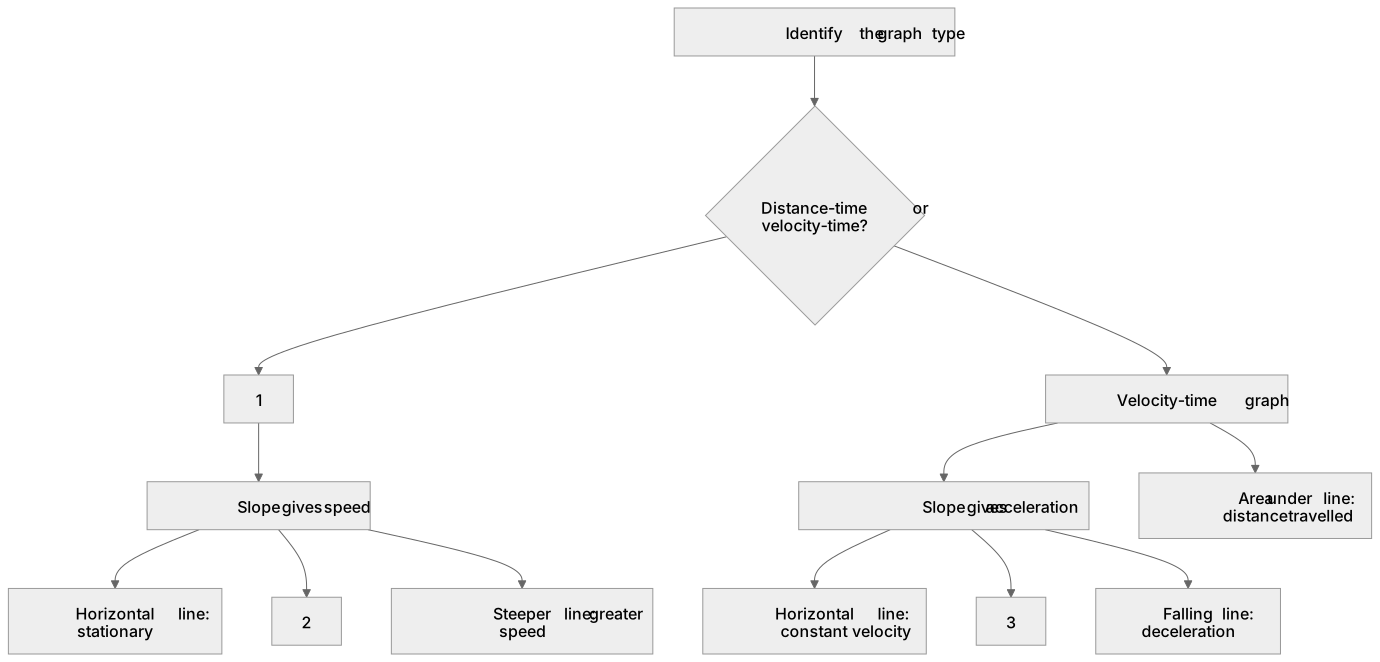
1Box 1
2Box 2
3Box 3
There is more to this lesson
The full lesson goes on to check your understanding and help you earn the marks. Create a free account to carry on, with your progress saved.
A week of Premium from your first lesson · Then the free plan continues · No card, no charge
Test your understanding of Motion: relate changes and differences in motion to appropriate distance-time, and velocity-time graphs; interpret lines and slopes
Active recall beats re-reading. Take an instant quiz now to test what you’ve learned and lock it into long-term memory.
A week of Premium from your first lesson · Then the free plan continues · No card, no charge