OCR · GCSE · Physics
Course version: J249 · Version from Sept 2018
Apply formulae relating force, mass, velocity and acceleration to explain…
Full specification wording
Newton's laws: apply formulae relating force, mass, velocity and acceleration to explain how the changes involved are inter-related (content found only in the physics separate science qualification)
This separate-science criterion asks you to use formulae that link force, mass, velocity and acceleration, and to explain how a change in one quantity affects the others.
Checked against the OCR J249 specification (opens in a new tab) on .
- Point 15 of 20
- 3 key terms
Study notes
From the checked teaching notes for this specification point.
The idea
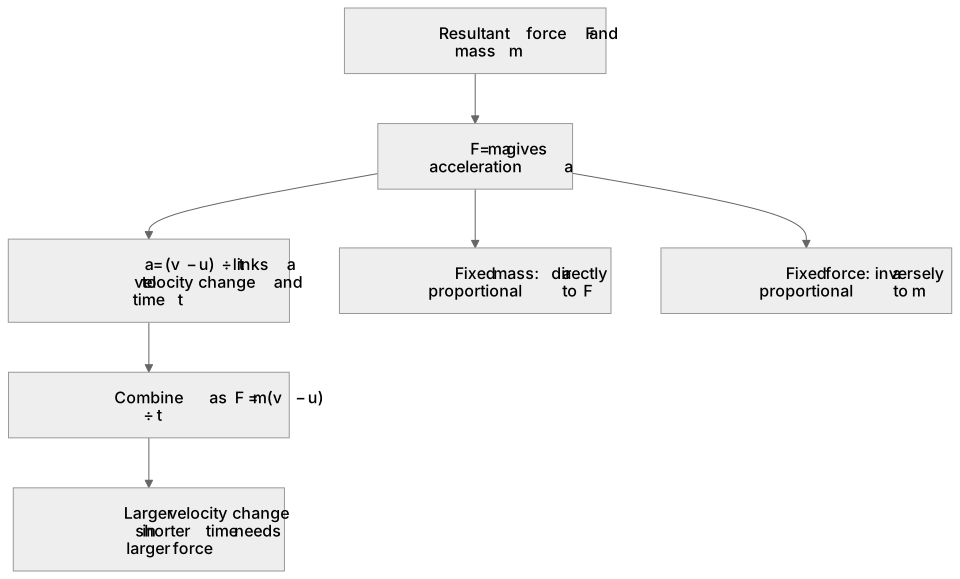
This separate-science criterion asks you to use formulae that link force, mass, velocity and acceleration, and to explain how a change in one quantity affects the others. Start from F = ma: a resultant force on a mass produces acceleration in the direction of that force, so doubling the force on a fixed mass doubles the acceleration, while doubling the mass under a fixed force halves it. Then connect acceleration to velocity change using a = (v − u) ÷ t, where u is initial velocity, v is final velocity and t is the time taken. Combining these gives F = m(v − u) ÷ t, which shows that a larger velocity change in a shorter time needs a larger force. Use consistent SI units: force in newtons (N), mass in kilograms (kg), velocity in metres per second (m/s) and acceleration in metres per second squared (m/s²).
What earns the marks
- Selects the relationship F = ma and substitutes force in newtons and mass in kilograms to obtain acceleration in m/s².
- Uses a = (v − u) ÷ t to find the change in velocity per unit time and keeps the direction of the change consistent.
- Combines the two relationships as F = m(v − u) ÷ t to explain why a shorter stopping or contact time raises the force for the same velocity change.
- Explains that acceleration is directly proportional to resultant force for a fixed mass and inversely proportional to mass for a fixed force.
- Keeps all quantities in consistent SI units and states the unit of the answer with its quantity.
Common mistakes and how to put them right
Uses the weight formula and treats mass in kilograms as a force in newtons.
Put it right: Multiply mass by gravitational field strength to obtain weight in newtons before applying F = ma.
Divides by the time in the wrong place and mixes up velocity and acceleration.
Put it right: Divide the velocity change by time to obtain acceleration, then multiply by mass to obtain force.
Ignores direction and treats a deceleration as a positive acceleration without comment.
Put it right: State the direction of the velocity change and the direction of the resultant force.
Exam tips
- Write down the formula, then list the known values with units before substituting, so a unit slip is visible.
- Check whether the question gives a velocity change and a time rather than an acceleration, and combine formulae only when needed.
- Sanity-check the size and unit of your answer against the physical situation described.
Try the lesson
The start of the Newton's laws: apply formulae relating force, mass, velocity and acceleration to explain how the changes involved are inter-related (content found only in the physics separate science qualification) lesson, made from checked teaching notes for this specification point.
Have a go first
A cyclist and bicycle of total mass 80 kg experience a resultant force of 160 N. Calculate the acceleration and the velocity reached after 5.0 s from rest.
Listen
This separate-science criterion asks you to use formulae that link force, mass, velocity and acceleration, and to explain how a change in one quantity affects the others. Start from F = ma: a resultant force on a mass produces acceleration in the direction of that force, so doubling the force on a fixed mass doubles the acceleration, while doubling the mass under a fixed force halves it. Then connect acceleration to velocity change using a = (v − u) ÷ t, where u is initial velocity, v is final velocity and t is the time taken. Combining these gives F = m(v − u) ÷ t, which shows that a larger velocity change in a shorter time needs a larger force. Use consistent SI units: force in newtons (N), mass in kilograms (kg), velocity in metres per second (m/s) and acceleration in metres per second squared (m/s²). A strong answer earns marks for these points. Selects the relationship F = ma and substitutes force in newtons and mass in kilograms to obtain acceleration in m/s². Uses a = (v − u) ÷ t to find the change in velocity per unit time and keeps the direction of the change consistent. Combines the two relationships as F = m(v − u) ÷ t to explain why a shorter stopping or contact time raises the force for the same velocity change. Explains that acceleration is directly proportional to resultant force for a fixed mass and inversely proportional to mass for a fixed force. Exam tip: Write down the formula, then list the known values with units before substituting, so a unit slip is visible.
See it
Key words
Say what each word means before you turn the card.
Newton's second law
Try answering aloud or in your head before turning the card.
Force, mass and acceleration proportionality
Try answering aloud or in your head before turning the card.
Velocity change over time
Try answering aloud or in your head before turning the card.
See every definition
- Newton's second law
- A resultant force on a mass produces acceleration in the direction of that force, and acceleration is directly proportional to resultant force for a fixed mass and inversely proportional to mass for a fixed force.
- Force, mass and acceleration proportionality
- Doubling the force on a fixed mass doubles the acceleration, while doubling the mass under a fixed force halves it.
- Velocity change over time
- Acceleration is found using a = (v − u) ÷ t, where u is initial velocity, v is final velocity and t is the time taken.
Label the diagram
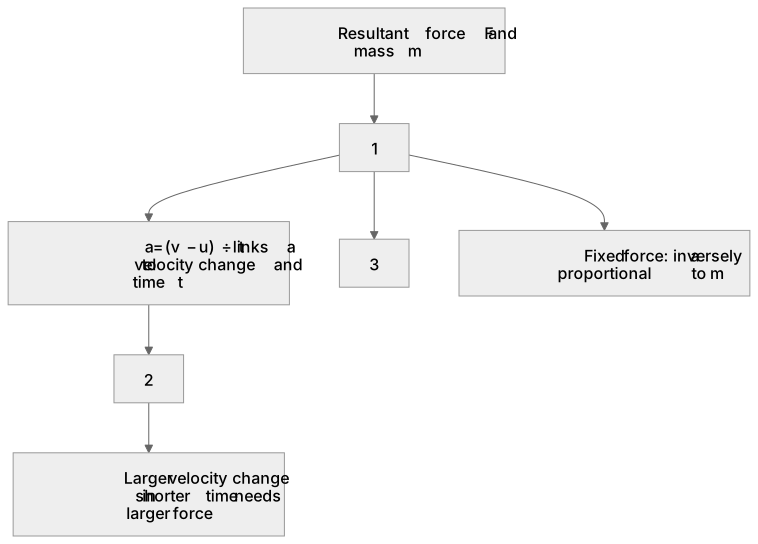
Some boxes have lost their names. Pick the right name for each number.
1Box 1
2Box 2
3Box 3
There is more to this lesson
The full lesson goes on to check your understanding and help you earn the marks. Create a free account to carry on, with your progress saved.
A week of Premium from your first lesson · Then the free plan continues · No card, no charge
Test your understanding of Newton's laws: apply formulae relating force, mass, velocity and acceleration to explain how the changes involved are inter-related (content found only in the physics separate science qualification)
Active recall beats re-reading. Take an instant quiz now to test what you’ve learned and lock it into long-term memory.
A week of Premium from your first lesson · Then the free plan continues · No card, no charge