OCR · GCSE · Physics
Course version: J249 · Version from Sept 2018
Use the relationship between work done, force, and distance moved along…
Full specification wording
Newton's laws: use the relationship between work done, force, and distance moved along the line of action of the force and describe the energy transfer involved
This criterion asks you to calculate work done with W = F × s, where F is the force in newtons and s is the distance moved in metres along the line of action of that force, giving work done in…
Checked against the OCR J249 specification (opens in a new tab) on .
- Point 16 of 20
- 4 key terms
Study notes
From the checked teaching notes for this specification point.
The idea
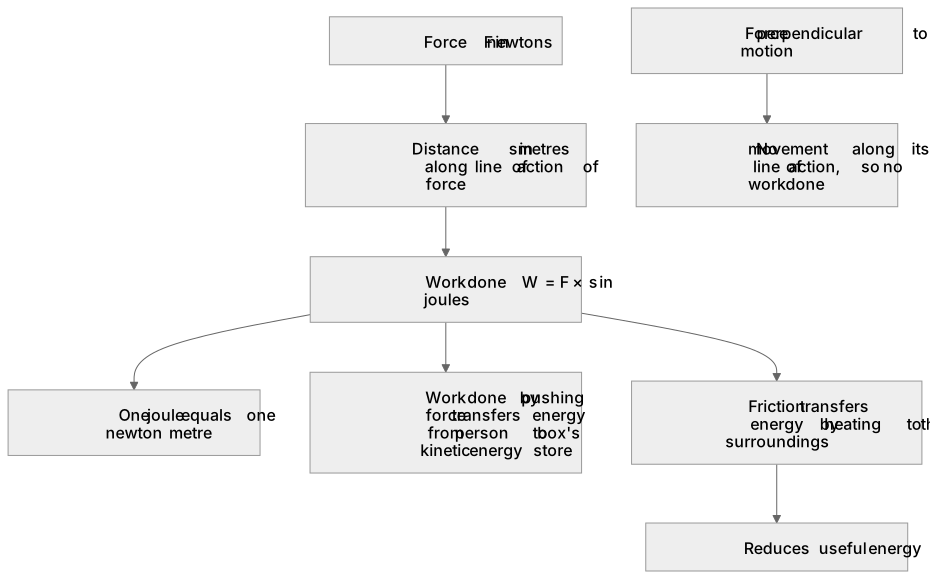
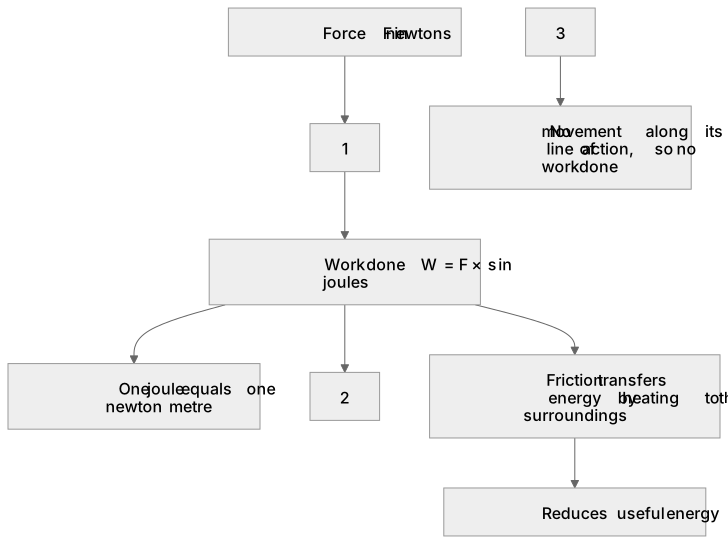
This criterion asks you to calculate work done with W = F × s, where F is the force in newtons and s is the distance moved in metres along the line of action of that force, giving work done in joules (J). The distance must be measured in the same direction as the force: a force pushing a box 3 m across a floor does 60 J of work if the force is 20 N along the motion, but a force at right angles to the motion does no work because there is no movement along its line of action. Describe the energy transfer too: the work done by the pushing force transfers energy from the person to the box's kinetic energy store, and friction transfers energy by heating to the surroundings. One joule equals one newton metre, so 20 N × 3 m = 60 J.
What earns the marks
- Selects W = F × s and substitutes force in newtons and distance in metres to obtain work done in joules.
- Measures the distance along the line of action of the force and explains that a force perpendicular to the motion does no work.
- Describes the energy transfer from the source of the force to the object's kinetic or gravitational potential energy store.
- Identifies friction or air resistance as transferring energy by heating to the surroundings and reducing useful energy.
- States that one joule equals one newton metre and keeps units consistent throughout the calculation.
Common mistakes and how to put them right
Uses the total distance travelled rather than the distance along the line of action of the force.
Put it right: Resolve the force or measure the component of displacement in the force's direction.
Adds force and distance instead of multiplying them.
Put it right: Multiply the force by the distance moved along its line of action.
Describes energy as used up rather than transferred.
Put it right: State which store energy moves from and which store it moves to.
Exam tips
- Identify the force and the displacement along its line of action before substituting into W = F × s.
- Write the energy transfer as a chain from one store to another, naming any heating to the surroundings.
- Check the unit of the answer is the joule and that the value is sensible for the force and distance given.
Try the lesson
The start of the Newton's laws: use the relationship between work done, force, and distance moved along the line of action of the force and describe the energy transfer involved lesson, made from checked teaching notes for this specification point.
Have a go first
A force of 8 N moves an object 5 m in the same direction as the force. What is the work done?
Listen
This criterion asks you to calculate work done with W = F × s, where F is the force in newtons and s is the distance moved in metres along the line of action of that force, giving work done in joules (J). The distance must be measured in the same direction as the force: a force pushing a box 3 m across a floor does 60 J of work if the force is 20 N along the motion, but a force at right angles to the motion does no work because there is no movement along its line of action. Describe the energy transfer too: the work done by the pushing force transfers energy from the person to the box's kinetic energy store, and friction transfers energy by heating to the surroundings. One joule equals one newton metre, so 20 N × 3 m = 60 J. A strong answer earns marks for these points. Selects W = F × s and substitutes force in newtons and distance in metres to obtain work done in joules. Measures the distance along the line of action of the force and explains that a force perpendicular to the motion does no work. Describes the energy transfer from the source of the force to the object's kinetic or gravitational potential energy store. Identifies friction or air resistance as transferring energy by heating to the surroundings and reducing useful energy. Exam tip: Identify the force and the displacement along its line of action before substituting into W = F × s.
See it
Key words
Say what each word means before you turn the card.
Work done
Try answering aloud or in your head before turning the card.
Line of action of a force
Try answering aloud or in your head before turning the card.
Energy transfer between stores
Try answering aloud or in your head before turning the card.
Friction and heating to surroundings
Try answering aloud or in your head before turning the card.
See every definition
- Work done
- Calculated with W = F × s, where force is in newtons and distance moved in metres along the line of action of that force, giving the answer in joules (J).
- Line of action of a force
- The distance must be measured in the same direction as the force, and a force at right angles to the motion does no work because there is no movement along it.
- Energy transfer between stores
- The work done by the pushing force transfers energy from the person to the box's kinetic energy store, and friction transfers energy by heating to the surroundings.
- Friction and heating to surroundings
- Friction or air resistance transfers energy by heating to the surroundings and reduces useful energy.
Label the diagram
Some boxes have lost their names. Pick the right name for each number.
1Box 1
2Box 2
3Box 3
There is more to this lesson
The full lesson goes on to check your understanding and help you earn the marks. Create a free account to carry on, with your progress saved.
A week of Premium from your first lesson · Then the free plan continues · No card, no charge
Test your understanding of Newton's laws: use the relationship between work done, force, and distance moved along the line of action of the force and describe the energy transfer involved
Active recall beats re-reading. Take an instant quiz now to test what you’ve learned and lock it into long-term memory.
A week of Premium from your first lesson · Then the free plan continues · No card, no charge