OCR · GCSE · Physics
Course version: J249 · Version from Sept 2018
Calculate relevant values of stored energy and energy transfers; convert…
Full specification wording
Newton's laws: calculate relevant values of stored energy and energy transfers; convert between newton-metres and joules
This criterion asks you to do two linked things.
Checked against the OCR J249 specification (opens in a new tab) on .
- Point 17 of 20
- 4 key terms
Study notes
From the checked teaching notes for this specification point.
The idea
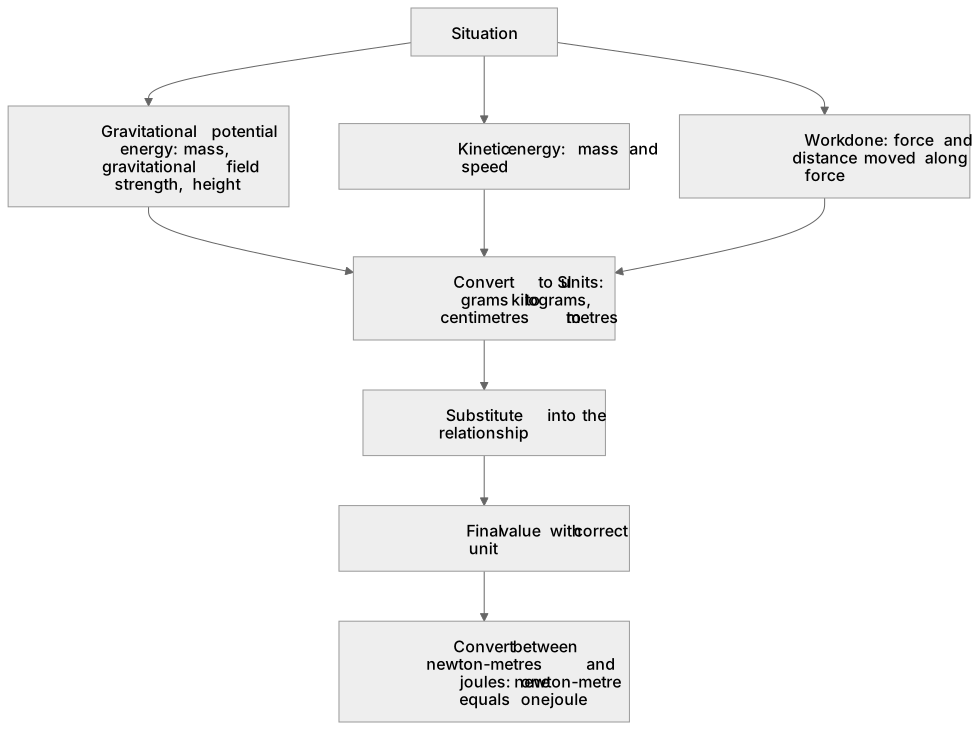
This criterion asks you to do two linked things. First, calculate stored energy and energy transferred in a range of situations, choosing the right relationship for the context: gravitational potential energy from mass, gravitational field strength and height; kinetic energy from mass and speed; and work done by a force from force and distance moved along the force. Second, convert between newton-metres and joules. The key idea is that one newton-metre equals one joule, because a force of 1 N moving its point of application 1 m along its own line transfers 1 J. So a work-done answer of 240 N m is 240 J, and a stored energy of 0.75 J may be written as 0.75 N m. Keep units consistent, square the speed before halving and multiplying by mass, and check whether the question wants the value in joules or newton-metres.
What earns the marks
- Selects the relationship that matches the situation, using mass, gravitational field strength and height for gravitational potential energy, mass and speed for kinetic energy, and force and distance for work done.
- Squares the speed before multiplying by half the mass when calculating kinetic energy, so doubling the speed quadruples the value.
- Converts between newton-metres and joules using the equality that one newton-metre equals one joule, keeping the numerical value unchanged.
- Keeps units consistent throughout, converting grams to kilograms and centimetres to metres before substituting into a relationship.
- States the final value with the correct unit, choosing joules or newton-metres as the question requires.
Common mistakes and how to put them right
Multiplies mass by speed without squaring it in a kinetic energy calculation.
Put it right: Square the speed first, then multiply by half the mass.
Treats newton-metres and joules as different-sized units and applies a numerical factor.
Put it right: Recognise that one newton-metre equals one joule, so the number stays the same.
Substitutes a height in centimetres or a mass in grams directly into a relationship.
Put it right: Convert to metres and kilograms before calculating.
Uses the total distance travelled rather than the distance moved along the line of the force when finding work done.
Put it right: Use the displacement along the force.
Exam tips
- Write down the relationship you are using before substituting numbers, so the examiner can see your method.
- Convert all quantities to SI units first, then substitute, to avoid unit slips.
- Check whether the answer is required in joules or newton-metres and label it accordingly.
- Sanity-check the size of your answer: a small mass lifted a modest height gives a few joules, not thousands.
Try the lesson
The start of the Newton's laws: calculate relevant values of stored energy and energy transfers; convert between newton-metres and joules lesson, made from checked teaching notes for this specification point.
Have a go first
A force does 45 N m of work on an object. How many joules of energy are transferred?
Listen
This criterion asks you to do two linked things. First, calculate stored energy and energy transferred in a range of situations, choosing the right relationship for the context: gravitational potential energy from mass, gravitational field strength and height; kinetic energy from mass and speed; and work done by a force from force and distance moved along the force. Second, convert between newton-metres and joules. The key idea is that one newton-metre equals one joule, because a force of 1 N moving its point of application 1 m along its own line transfers 1 J. So a work-done answer of 240 N m is 240 J, and a stored energy of 0.75 J may be written as 0.75 N m. Keep units consistent, square the speed before halving and multiplying by mass, and check whether the question wants the value in joules or newton-metres. A strong answer earns marks for these points. Selects the relationship that matches the situation, using mass, gravitational field strength and height for gravitational potential energy, mass and speed for kinetic energy, and force and distance for work done. Squares the speed before multiplying by half the mass when calculating kinetic energy, so doubling the speed quadruples the value. Converts between newton-metres and joules using the equality that one newton-metre equals one joule, keeping the numerical value unchanged. Keeps units consistent throughout, converting grams to kilograms and centimetres to metres before substituting into a relationship. Exam tip: Write down the relationship you are using before substituting numbers, so the examiner can see your method.
See it
Key words
Say what each word means before you turn the card.
Gravitational potential energy
Try answering aloud or in your head before turning the card.
Kinetic energy
Try answering aloud or in your head before turning the card.
Work done by a force
Try answering aloud or in your head before turning the card.
Unit equivalence between newton-metres and joules
Try answering aloud or in your head before turning the card.
See every definition
- Gravitational potential energy
- Stored energy calculated from mass, gravitational field strength and height.
- Kinetic energy
- Stored energy calculated from mass and speed, squaring the speed before multiplying by half the mass.
- Work done by a force
- Energy transferred, calculated from force and distance moved along the force.
- Unit equivalence between newton-metres and joules
- One newton-metre equals one joule, so the numerical value stays unchanged when converting.
Label the diagram
Some boxes have lost their names. Pick the right name for each number.
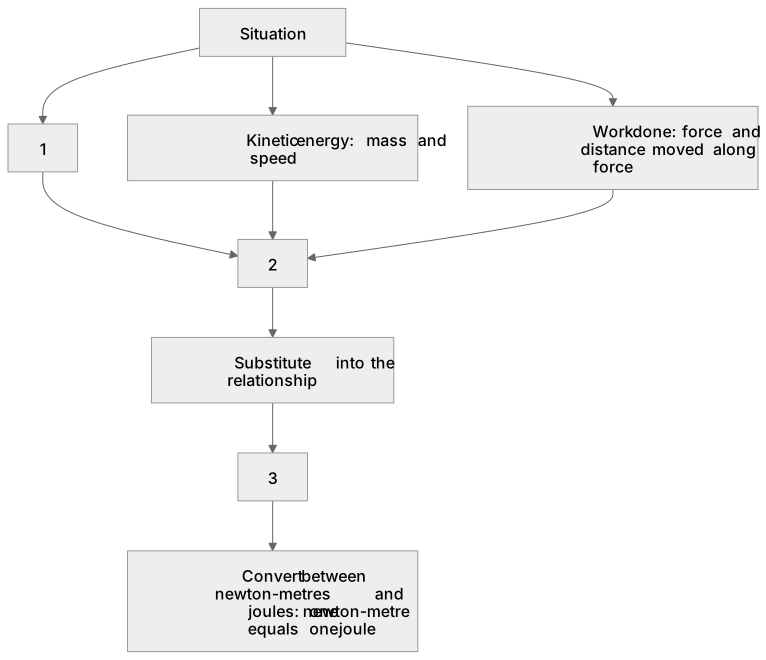
1Box 1
2Box 2
3Box 3
There is more to this lesson
The full lesson goes on to check your understanding and help you earn the marks. Create a free account to carry on, with your progress saved.
A week of Premium from your first lesson · Then the free plan continues · No card, no charge
Test your understanding of Newton's laws: calculate relevant values of stored energy and energy transfers; convert between newton-metres and joules
Active recall beats re-reading. Take an instant quiz now to test what you’ve learned and lock it into long-term memory.
A week of Premium from your first lesson · Then the free plan continues · No card, no charge