OCR · GCSE · Physics
Course version: J249 · Version from Sept 2018
Estimate, for everyday road transport, the speed, accelerations and forces…
Full specification wording
Physics on the move: estimate, for everyday road transport, the speed, accelerations and forces involved in large accelerations (content found only in the physics separate science qualification)
This separate-science criterion asks you to make order-of-magnitude estimates for everyday road transport, covering three linked quantities: speed, acceleration and the force needed for a large…
Checked against the OCR J249 specification (opens in a new tab) on .
- Point 8 of 8
- 4 key terms
Study notes
From the checked teaching notes for this specification point.
The idea
This separate-science criterion asks you to make order-of-magnitude estimates for everyday road transport, covering three linked quantities: speed, acceleration and the force needed for a large acceleration. Start from familiar speeds: a car on a motorway travels at roughly 30 m/s (about 70 mph), and a town speed of 30 mph is about 13 m/s. For a large acceleration, take a car reaching 27 m/s from rest in about 9 s, giving a ≈ 3 m/s². Then use F = ma with a mass near 1200 kg to get F ≈ 3600 N, roughly 4 kN. Check units: m/s for speed, m/s² for acceleration, N for force. Round to one significant figure and state your assumptions, because an estimate is judged on sensible values and clear reasoning, not on a single exact answer.
What earns the marks
- Selects a realistic everyday road speed such as about 13 m/s in town or about 30 m/s on a motorway.
- Calculates acceleration from a chosen change in speed and time using a = Δv ÷ t with consistent units.
- Applies F = ma with a sensible vehicle mass to estimate the force for a large acceleration.
- Rounds estimates to one or two significant figures and states the assumptions behind them.
- Keeps units consistent, quoting speed in m/s, acceleration in m/s² and force in N or kN.
Common mistakes and how to put them right
Uses a speed in mph directly in a calculation.
Put it right: Convert to m/s first, for example 30 mph ≈ 13 m/s.
Forgets to square or misapplies units for acceleration.
Put it right: Acceleration is measured in m/s², not m/s.
Omits the vehicle mass when estimating force.
Put it right: State a mass such as 1200 kg before applying F = ma.
Exam tips
- Write down your assumed values before calculating so the examiner can follow your reasoning.
- Round to one significant figure for an estimate and say 'approximately' with the unit.
- Sanity-check the answer: a few kN is a reasonable force for a family car accelerating hard.
Try the lesson
The start of the Physics on the move: estimate, for everyday road transport, the speed, accelerations and forces involved in large accelerations (content found only in the physics separate science qualification) lesson, made from checked teaching notes for this specification point.
Have a go first
A car on a public road speeds up from 0 m/s to 20 m/s in 5 s. Calculate its acceleration.
Listen
This separate-science criterion asks you to make order-of-magnitude estimates for everyday road transport, covering three linked quantities: speed, acceleration and the force needed for a large acceleration. Start from familiar speeds: a car on a motorway travels at roughly 30 m/s (about 70 mph), and a town speed of 30 mph is about 13 m/s. For a large acceleration, take a car reaching 27 m/s from rest in about 9 s, giving a ≈ 3 m/s². Then use F = ma with a mass near 1200 kg to get F ≈ 3600 N, roughly 4 kN. Check units: m/s for speed, m/s² for acceleration, N for force. Round to one significant figure and state your assumptions, because an estimate is judged on sensible values and clear reasoning, not on a single exact answer. A strong answer earns marks for these points. Selects a realistic everyday road speed such as about 13 m/s in town or about 30 m/s on a motorway. Calculates acceleration from a chosen change in speed and time using a = Δv ÷ t with consistent units. Applies F = ma with a sensible vehicle mass to estimate the force for a large acceleration. Rounds estimates to one or two significant figures and states the assumptions behind them. Exam tip: Write down your assumed values before calculating so the examiner can follow your reasoning.
See it
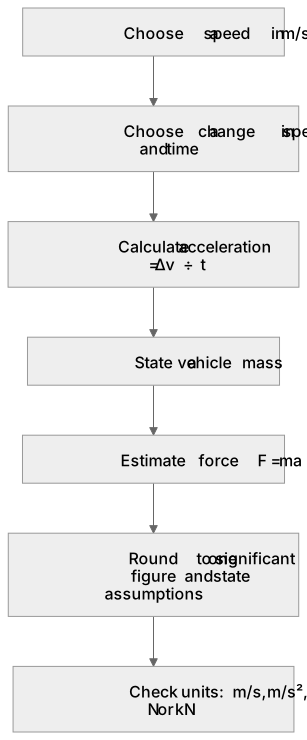
Put it in order
Put these steps in the order they happen.
- 1. Check units: m/s, m/s², N or kN
- 2. Round to one significant figure and state assumptions
- 3. Calculate acceleration a = Δv ÷ t
- 4. Estimate force F = ma
- 5. Choose a speed in m/s
- 6. Choose a change in speed and time
- 7. State a vehicle mass
Key words
Say what each word means before you turn the card.
speed
Try answering aloud or in your head before turning the card.
acceleration
Try answering aloud or in your head before turning the card.
force
Try answering aloud or in your head before turning the card.
significant figures
Try answering aloud or in your head before turning the card.
See every definition
- speed
- A quantity measured in m/s, such as about 13 m/s in town or about 30 m/s on a motorway.
- acceleration
- Found from a chosen change in speed and time using a = Δv ÷ t, and measured in m/s².
- force
- Estimated by applying F = ma with a sensible vehicle mass, and quoted in N or kN.
- significant figures
- Estimates are rounded to one or two of these, with the assumptions behind them stated.
Label the diagram
Some boxes have lost their names. Pick the right name for each number.
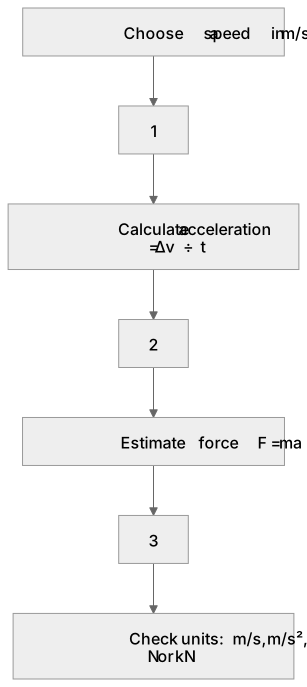
1Box 1
2Box 2
3Box 3
There is more to this lesson
The full lesson goes on to check your understanding and help you earn the marks. Create a free account to carry on, with your progress saved.
A week of Premium from your first lesson · Then the free plan continues · No card, no charge
Test your understanding of Physics on the move: estimate, for everyday road transport, the speed, accelerations and forces involved in large accelerations (content found only in the physics separate science qualification)
Active recall beats re-reading. Take an instant quiz now to test what you’ve learned and lock it into long-term memory.
A week of Premium from your first lesson · Then the free plan continues · No card, no charge