OCR · GCSE · Physics
Course version: J249 · Version from Sept 2018
Estimate the forces involved in typical situations on a public road…
Full specification wording
Physics on the move: estimate the forces involved in typical situations on a public road (content found only in the physics separate science qualification) (Higher tier only)
This statement applies only to the separate physics qualification and only at Higher tier.
Checked against the OCR J249 specification (opens in a new tab) on .
- Point 7 of 8
Study notes
From the checked teaching notes for this specification point.
The idea
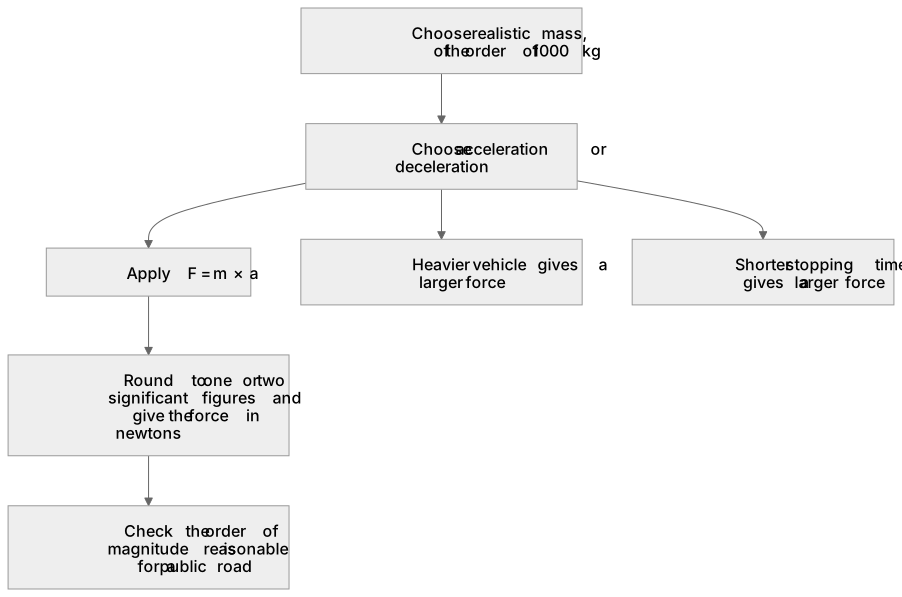
This statement applies only to the separate physics qualification and only at Higher tier. Learners estimate the forces in everyday road situations by using F = m × a, choosing sensible values for mass and acceleration or deceleration. For a car of about 1000 kg braking from 20 m/s to rest in 4 s, the deceleration is 20 ÷ 4 = 5 m/s², so the force is about 1000 × 5 = 5000 N. Estimates should be rounded to one or two significant figures and stated with units. Learners should recognise that a heavier vehicle or a shorter stopping time gives a larger force, and should judge whether an answer is of a reasonable order of magnitude for a public road.
What earns the marks
- Selects realistic values for mass and for acceleration or deceleration in a road situation.
- Applies F = m × a correctly to the chosen values.
- Rounds the estimated force to a sensible number of significant figures and gives the unit in newtons.
- Compares estimates and explains why a heavier vehicle or shorter stopping time gives a larger force.
Common mistakes and how to put them right
Uses an unrealistic mass such as 10 kg for a car.
Put it right: Choose a value of the order of 1000 kg.
Forgets to convert a stopping time or speed into consistent units.
Put it right: Keep seconds and metres per second throughout.
Gives an answer without a unit.
Put it right: State the force in newtons and round to a sensible number of significant figures.
Exam tips
- Write down the values you choose for mass and acceleration before substituting them into F = m × a.
- Show the substitution and the arithmetic so the estimate can be followed.
- Check the order of magnitude of your answer against everyday experience of road vehicles.
Try the lesson
The start of the Physics on the move: estimate the forces involved in typical situations on a public road (content found only in the physics separate science qualification) (Higher tier only) lesson, made from checked teaching notes for this specification point.
Have a go first
A car of mass 1200 kg travelling on a public road brakes and decelerates at about 6 m/s². Estimate the braking force on the car.
Listen
This statement applies only to the separate physics qualification and only at Higher tier. Learners estimate the forces in everyday road situations by using F = m × a, choosing sensible values for mass and acceleration or deceleration. For a car of about 1000 kg braking from 20 m/s to rest in 4 s, the deceleration is 20 ÷ 4 = 5 m/s², so the force is about 1000 × 5 = 5000 N. Estimates should be rounded to one or two significant figures and stated with units. Learners should recognise that a heavier vehicle or a shorter stopping time gives a larger force, and should judge whether an answer is of a reasonable order of magnitude for a public road. A strong answer earns marks for these points. Selects realistic values for mass and for acceleration or deceleration in a road situation. Applies F = m × a correctly to the chosen values. Rounds the estimated force to a sensible number of significant figures and gives the unit in newtons. Compares estimates and explains why a heavier vehicle or shorter stopping time gives a larger force. Exam tip: Write down the values you choose for mass and acceleration before substituting them into F = m × a.
See it
Label the diagram
Some boxes have lost their names. Pick the right name for each number.
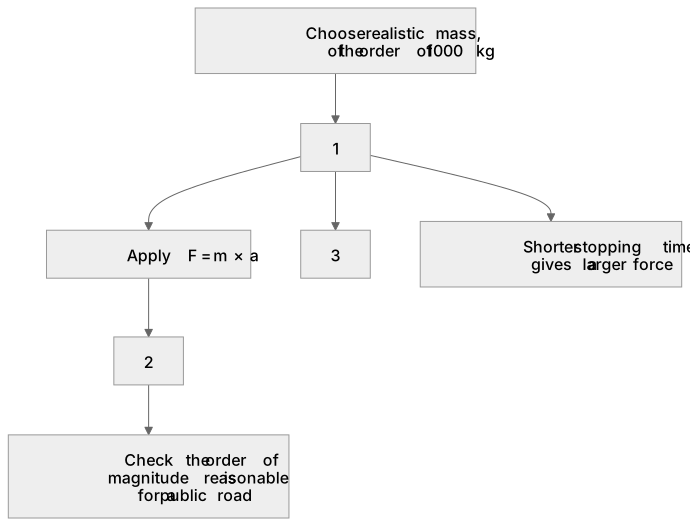
1Box 1
2Box 2
3Box 3
There is more to this lesson
The full lesson goes on to check your understanding and help you earn the marks. Create a free account to carry on, with your progress saved.
A week of Premium from your first lesson · Then the free plan continues · No card, no charge
Test your understanding of Physics on the move: estimate the forces involved in typical situations on a public road (content found only in the physics separate science qualification) (Higher tier only)
Active recall beats re-reading. Take an instant quiz now to test what you’ve learned and lock it into long-term memory.
A week of Premium from your first lesson · Then the free plan continues · No card, no charge