OCR · GCSE · Physics
Course version: J249 · Version from Sept 2018
Explain methods of measuring human reaction times and recall typical results
Full specification wording
Physics on the move: explain methods of measuring human reaction times and recall typical results
Human reaction time is the delay between a stimulus and a response.
Checked against the OCR J249 specification (opens in a new tab) on .
- Point 4 of 8
- 4 key terms
Study notes
From the checked teaching notes for this specification point.
The idea
Human reaction time is the delay between a stimulus and a response. A common method uses a ruler drop: one person holds a ruler vertically while a second person places a thumb and finger either side of the lower end without touching it; the holder releases the ruler without warning and the catcher closes the fingers to trap it. The distance the ruler falls is read from the scale, and a conversion table or the equation for free fall links drop distance to reaction time. Repeating the test and averaging reduces random error. Typical human reaction times are around 0.2 s to 0.3 s, with the ruler dropping roughly 20 cm to 45 cm. A second method uses a computer or stopwatch to time a response to a visual or sound signal, though a stopwatch adds the timer's own reaction delay.
What earns the marks
- Describes the ruler-drop method with one person holding and releasing the ruler and another catching it between thumb and finger.
- Explains how the drop distance is converted to a reaction time using a table or the free-fall relationship.
- States that repeating the measurement and averaging improves reliability by reducing random error.
- Recalls that typical human reaction times are of the order of 0.2 s to 0.3 s.
Common mistakes and how to put them right
Claims the ruler measures time directly.
Put it right: Read the drop distance and convert it to a reaction time.
Omits the need for the catcher to be unprepared.
Put it right: A warned catcher gives an unrealistically short time.
Gives a typical reaction time of several seconds.
Put it right: Human reaction times are around 0.2 s to 0.3 s.
Exam tips
- Name both roles in the ruler-drop test and say the ruler is released without warning.
- Explain that the distance fallen, not the time, is what is read from the scale.
- Quote a typical value with its unit, such as about 0.25 s, to show recall.
Try the lesson
The start of the Physics on the move: explain methods of measuring human reaction times and recall typical results lesson, made from checked teaching notes for this specification point.
Have a go first
In the ruler-drop test, what does the distance the ruler falls before it is caught represent?
Listen
Human reaction time is the delay between a stimulus and a response. A common method uses a ruler drop: one person holds a ruler vertically while a second person places a thumb and finger either side of the lower end without touching it; the holder releases the ruler without warning and the catcher closes the fingers to trap it. The distance the ruler falls is read from the scale, and a conversion table or the equation for free fall links drop distance to reaction time. Repeating the test and averaging reduces random error. Typical human reaction times are around 0.2 s to 0.3 s, with the ruler dropping roughly 20 cm to 45 cm. A second method uses a computer or stopwatch to time a response to a visual or sound signal, though a stopwatch adds the timer's own reaction delay. A strong answer earns marks for these points. Describes the ruler-drop method with one person holding and releasing the ruler and another catching it between thumb and finger. Explains how the drop distance is converted to a reaction time using a table or the free-fall relationship. States that repeating the measurement and averaging improves reliability by reducing random error. Recalls that typical human reaction times are of the order of 0.2 s to 0.3 s. Exam tip: Name both roles in the ruler-drop test and say the ruler is released without warning.
See it
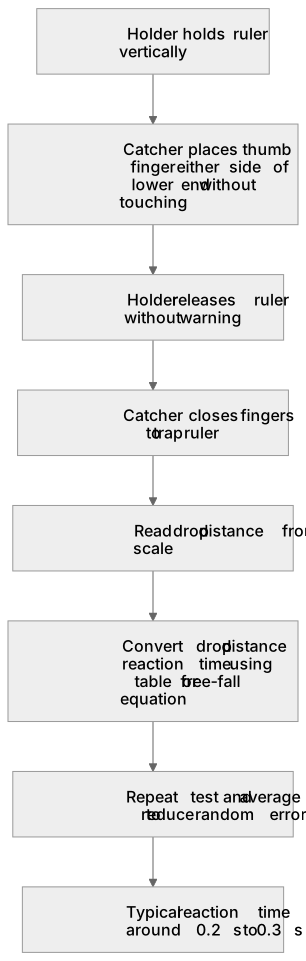
Put it in order
Put these steps in the order they happen.
- 1. Read drop distance from scale
- 2. Typical reaction time around 0.2 s to 0.3 s
- 3. Convert drop distance to reaction time using table or free-fall equation
- 4. Holder holds ruler vertically
- 5. Catcher places thumb and finger either side of lower end without touching
- 6. Repeat test and average to reduce random error
- 7. Holder releases ruler without warning
- 8. Catcher closes fingers to trap ruler
Key words
Say what each word means before you turn the card.
Reaction time
Try answering aloud or in your head before turning the card.
Experimental method
Try answering aloud or in your head before turning the card.
Reliability and repeats
Try answering aloud or in your head before turning the card.
Typical values
Try answering aloud or in your head before turning the card.
See every definition
- Reaction time
- The delay between a stimulus and a response, measured in humans using methods such as the ruler drop.
- Experimental method
- A procedure in which one person holds a ruler vertically and releases it without warning while another catches it between thumb and finger.
- Reliability and repeats
- Repeating the test and averaging reduces random error.
- Typical values
- Human reaction times are around 0.2 s to 0.3 s, with the ruler dropping roughly 20 cm to 45 cm.
Label the diagram
Some boxes have lost their names. Pick the right name for each number.
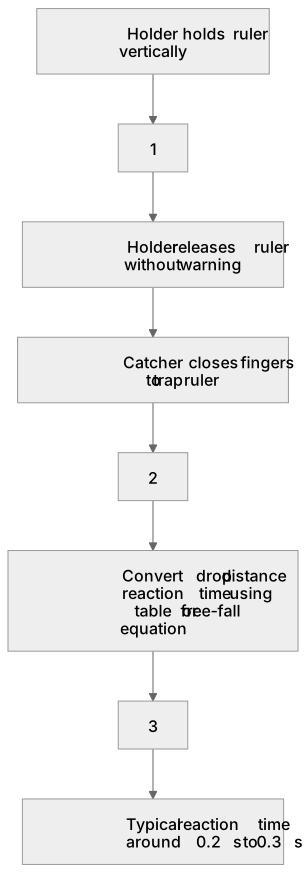
1Box 1
2Box 2
3Box 3
There is more to this lesson
The full lesson goes on to check your understanding and help you earn the marks. Create a free account to carry on, with your progress saved.
A week of Premium from your first lesson · Then the free plan continues · No card, no charge
Test your understanding of Physics on the move: explain methods of measuring human reaction times and recall typical results
Active recall beats re-reading. Take an instant quiz now to test what you’ve learned and lock it into long-term memory.
A week of Premium from your first lesson · Then the free plan continues · No card, no charge