OCR · GCSE · Physics
Course version: J249 · Version from Sept 2018
Estimate how the distances required for road vehicles to stop in an…
Full specification wording
Physics on the move: estimate how the distances required for road vehicles to stop in an emergency, varies over a range of typical speeds (content found only in the physics separate science qualification)
Stopping distance is the total distance a vehicle travels from the moment the driver decides to brake until the vehicle stops.
Checked against the OCR J249 specification (opens in a new tab) on .
- Point 5 of 8
- 4 key terms
Study notes
From the checked teaching notes for this specification point.
The idea
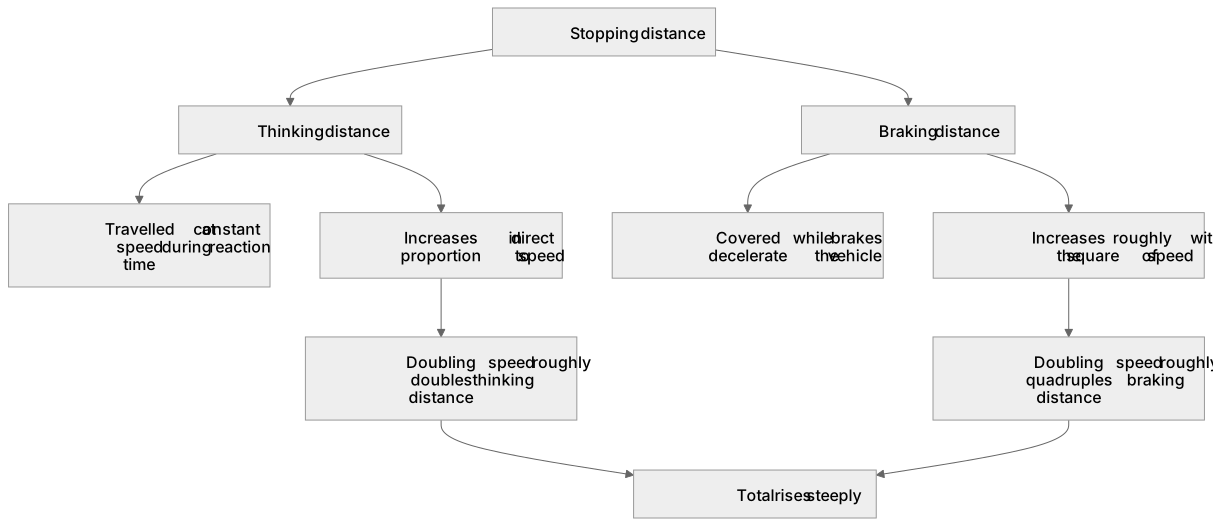
Stopping distance is the total distance a vehicle travels from the moment the driver decides to brake until the vehicle stops. It has two parts: thinking distance, travelled at constant speed during the driver's reaction time, and braking distance, covered while the brakes decelerate the vehicle. Thinking distance grows in direct proportion to speed, because distance = speed × reaction time. Braking distance grows much faster, roughly with the square of the speed, because the kinetic energy that must be removed depends on speed squared. So doubling the speed roughly doubles thinking distance but roughly quadruples braking distance, and the total rises steeply. A typical reaction time of about 0.7 s gives a thinking distance of roughly 21 m at 30 m/s. Estimating means using sensible values and rounding, not quoting exact figures.
What earns the marks
- States that stopping distance equals thinking distance plus braking distance.
- Explains that thinking distance increases in proportion to speed because it equals speed multiplied by reaction time.
- Explains that braking distance increases roughly with the square of speed because kinetic energy depends on speed squared.
- Estimates that doubling speed roughly doubles thinking distance but roughly quadruples braking distance.
- Uses a typical reaction time and a chosen speed to estimate a thinking distance numerically.
Common mistakes and how to put them right
Treats stopping distance as only the braking distance.
Put it right: Add the thinking distance travelled during the reaction time.
Assumes braking distance doubles when speed doubles.
Put it right: Recognise that it rises roughly with the square of speed.
Uses a reaction time of zero.
Put it right: Choose a realistic value such as about 0.7 s.
Adds speeds rather than distances when combining the two parts.
Put it right: Add the two distances.
Exam tips
- Write the relationship stopping distance = thinking distance + braking distance before substituting any numbers.
- Show the estimate step by step: pick a reaction time, calculate speed × time, then state how braking distance scales with speed squared.
- Round sensibly and state that the answer is an estimate, since reaction time and braking vary between drivers and vehicles.
- Check the trend: at higher speed the total stopping distance should rise faster than the speed itself.
Try the lesson
The start of the Physics on the move: estimate how the distances required for road vehicles to stop in an emergency, varies over a range of typical speeds (content found only in the physics separate science qualification) lesson, made from checked teaching notes for this specification point.
Have a go first
A car's braking distance is 12 m at 10 m/s. Using the idea that braking distance rises with the square of speed, estimate the braking distance at 20 m/s.
Listen
Stopping distance is the total distance a vehicle travels from the moment the driver decides to brake until the vehicle stops. It has two parts: thinking distance, travelled at constant speed during the driver's reaction time, and braking distance, covered while the brakes decelerate the vehicle. Thinking distance grows in direct proportion to speed, because distance = speed × reaction time. Braking distance grows much faster, roughly with the square of the speed, because the kinetic energy that must be removed depends on speed squared. So doubling the speed roughly doubles thinking distance but roughly quadruples braking distance, and the total rises steeply. A typical reaction time of about 0.7 s gives a thinking distance of roughly 21 m at 30 m/s. Estimating means using sensible values and rounding, not quoting exact figures. A strong answer earns marks for these points. States that stopping distance equals thinking distance plus braking distance. Explains that thinking distance increases in proportion to speed because it equals speed multiplied by reaction time. Explains that braking distance increases roughly with the square of speed because kinetic energy depends on speed squared. Estimates that doubling speed roughly doubles thinking distance but roughly quadruples braking distance. Exam tip: Write the relationship stopping distance = thinking distance + braking distance before substituting any numbers.
See it
Key words
Say what each word means before you turn the card.
stopping distance
Try answering aloud or in your head before turning the card.
thinking distance
Try answering aloud or in your head before turning the card.
braking distance
Try answering aloud or in your head before turning the card.
estimating
Try answering aloud or in your head before turning the card.
See every definition
- stopping distance
- The total distance a vehicle travels from the moment the driver decides to brake until the vehicle stops.
- thinking distance
- The distance travelled at constant speed during the driver's reaction time.
- braking distance
- The distance covered while the brakes decelerate the vehicle.
- estimating
- Using sensible values and rounding, not quoting exact figures.
Label the diagram
Some boxes have lost their names. Pick the right name for each number.
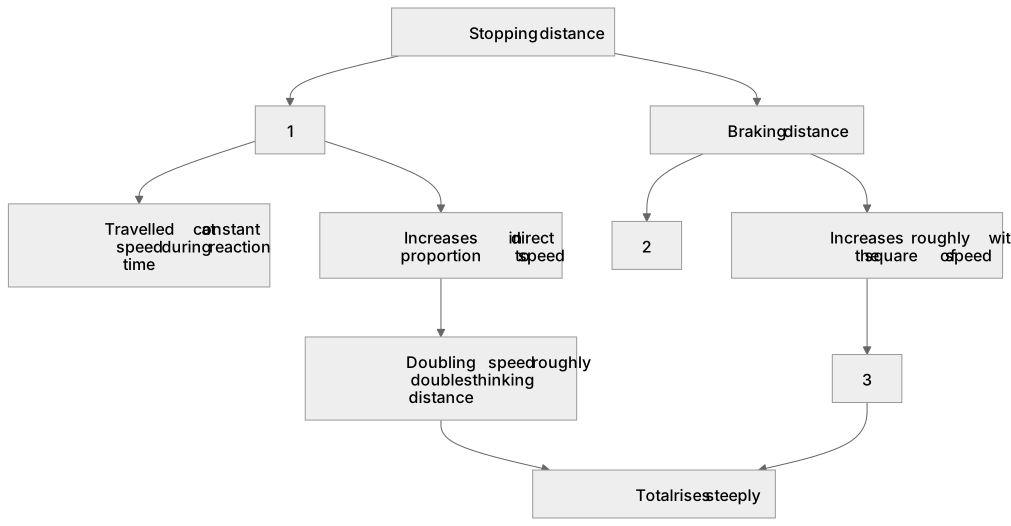
1Box 1
2Box 2
3Box 3
There is more to this lesson
The full lesson goes on to check your understanding and help you earn the marks. Create a free account to carry on, with your progress saved.
A week of Premium from your first lesson · Then the free plan continues · No card, no charge
Test your understanding of Physics on the move: estimate how the distances required for road vehicles to stop in an emergency, varies over a range of typical speeds (content found only in the physics separate science qualification)
Active recall beats re-reading. Take an instant quiz now to test what you’ve learned and lock it into long-term memory.
A week of Premium from your first lesson · Then the free plan continues · No card, no charge