OCR · GCSE · Physics
Course version: J249 · Version from Sept 2018
Describe, with examples, the process by which energy is dissipated, so…
Full specification wording
Power and efficiency: describe, with examples, the process by which energy is dissipated, so that it is stored in less useful ways
Dissipation is the spreading of energy into the surroundings, usually by heating, so that it becomes stored in less useful ways and is harder to recover for a intended purpose.
Checked against the OCR J249 specification (opens in a new tab) on .
- Point 2 of 8
- 4 key terms
Study notes
From the checked teaching notes for this specification point.
The idea
Dissipation is the spreading of energy into the surroundings, usually by heating, so that it becomes stored in less useful ways and is harder to recover for a intended purpose. When a device transfers energy, some is always lost to the environment. A filament lamp, for example, transfers most of its electrical input as thermal energy to the air rather than as light; a moving car transfers energy by friction and air resistance, warming the brakes, tyres and surrounding air. In each case the energy is not destroyed but becomes spread out among many particles, raising their temperature slightly. Because it is dispersed over a large area at a low temperature, it is described as stored in a less useful way and cannot easily be harnessed to do useful work again.
What earns the marks
- Describes dissipation as energy spreading to the surroundings, typically by heating.
- Explains that dissipated energy becomes stored in less useful ways and is difficult to recover.
- Gives a relevant example, such as a lamp heating its surroundings or friction warming brakes and air.
- Recognises that total energy is conserved even though useful energy decreases.
Common mistakes and how to put them right
Claims dissipated energy is destroyed.
Put it right: State that it is transferred to the surroundings and stored less usefully.
Describes dissipation without an example.
Put it right: Add a named device or process such as friction or a lamp.
Says dissipated energy can be fully recovered easily.
Put it right: Explain that it is spread out and hard to reuse.
Exam tips
- Name a specific device or process and say where the energy goes to secure the example mark.
- Use the phrase 'stored in less useful ways' to match the specification wording.
- Link dissipation to energy conservation to show the energy still exists but is spread out.
Try the lesson
The start of the Power and efficiency: describe, with examples, the process by which energy is dissipated, so that it is stored in less useful ways lesson, made from checked teaching notes for this specification point.
Have a go first
A hot cup of tea cools down on a table. How is energy dissipated in this process?
Listen
Dissipation is the spreading of energy into the surroundings, usually by heating, so that it becomes stored in less useful ways and is harder to recover for a intended purpose. When a device transfers energy, some is always lost to the environment. A filament lamp, for example, transfers most of its electrical input as thermal energy to the air rather than as light; a moving car transfers energy by friction and air resistance, warming the brakes, tyres and surrounding air. In each case the energy is not destroyed but becomes spread out among many particles, raising their temperature slightly. Because it is dispersed over a large area at a low temperature, it is described as stored in a less useful way and cannot easily be harnessed to do useful work again. A strong answer earns marks for these points. Describes dissipation as energy spreading to the surroundings, typically by heating. Explains that dissipated energy becomes stored in less useful ways and is difficult to recover. Gives a relevant example, such as a lamp heating its surroundings or friction warming brakes and air. Recognises that total energy is conserved even though useful energy decreases. Exam tip: Name a specific device or process and say where the energy goes to secure the example mark.
See it
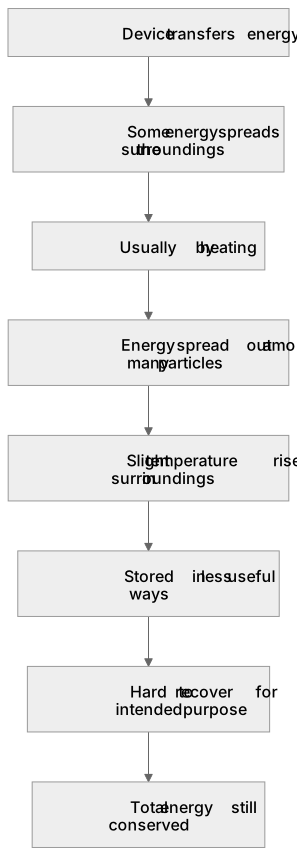
Put it in order
Put these steps in the order they happen.
- 1. Slight temperature rise in surroundings
- 2. Total energy still conserved
- 3. Stored in less useful ways
- 4. Device transfers energy
- 5. Some energy spreads to the surroundings
- 6. Hard to recover for intended purpose
- 7. Usually by heating
- 8. Energy spread out among many particles
Key words
Say what each word means before you turn the card.
Energy dissipation
Try answering aloud or in your head before turning the card.
Conservation of energy
Try answering aloud or in your head before turning the card.
Heating and friction
Try answering aloud or in your head before turning the card.
Useful versus less useful energy stores
Try answering aloud or in your head before turning the card.
See every definition
- Energy dissipation
- The spreading of energy into the surroundings, usually by heating, so that it becomes stored in less useful ways.
- Conservation of energy
- Total energy is conserved even though useful energy decreases, because dissipated energy is not destroyed but transferred to the surroundings.
- Heating and friction
- A moving car transfers energy by friction and air resistance, warming the brakes, tyres and surrounding air.
- Useful versus less useful energy stores
- Energy dispersed over a large area at a low temperature is stored in a less useful way and cannot easily be harnessed to do useful work again.
Label the diagram
Some boxes have lost their names. Pick the right name for each number.
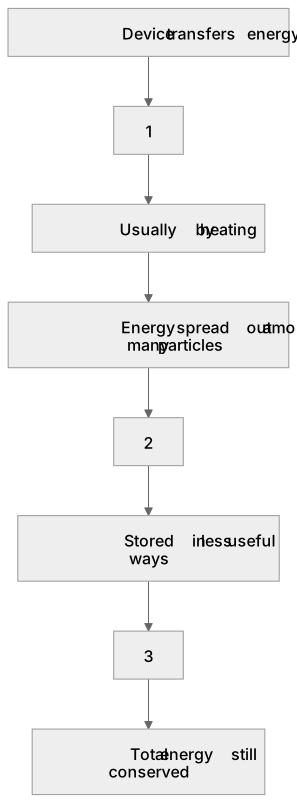
1Box 1
2Box 2
3Box 3
There is more to this lesson
The full lesson goes on to check your understanding and help you earn the marks. Create a free account to carry on, with your progress saved.
A week of Premium from your first lesson · Then the free plan continues · No card, no charge
Test your understanding of Power and efficiency: describe, with examples, the process by which energy is dissipated, so that it is stored in less useful ways
Active recall beats re-reading. Take an instant quiz now to test what you’ve learned and lock it into long-term memory.
A week of Premium from your first lesson · Then the free plan continues · No card, no charge