OCR · GCSE · Physics
Course version: J249 · Version from Sept 2018
Explain the difference between direct and alternating voltage
Full specification wording
Powering Earth: explain the difference between direct and alternating voltage
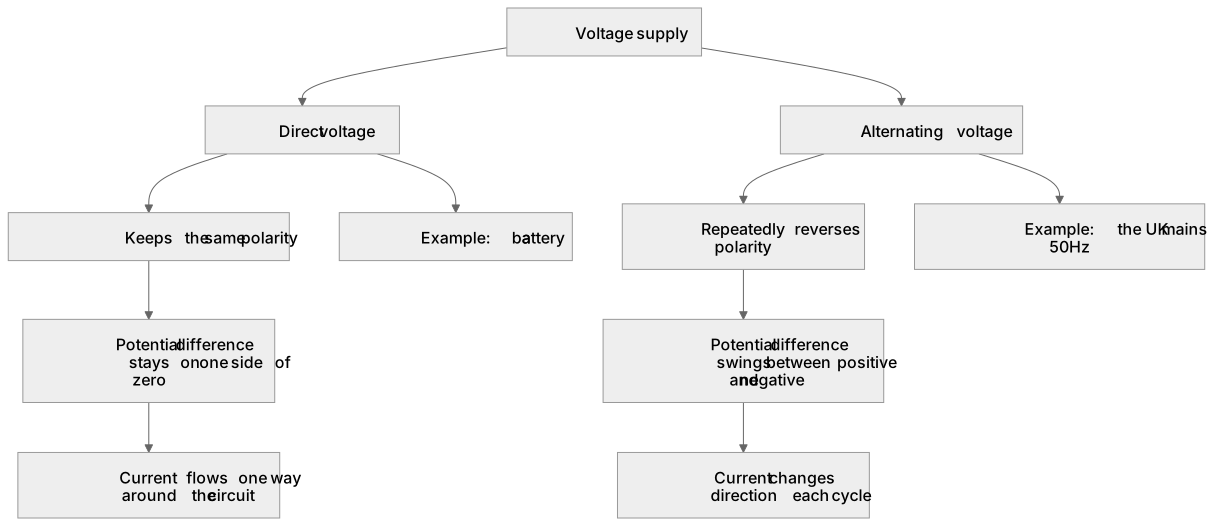
A direct voltage keeps the same polarity, so the potential difference stays on one side of zero and current flows one way around the circuit; a battery gives this kind of supply.
Checked against the OCR J249 specification (opens in a new tab) on .
- Point 7 of 9
- 4 key terms
Study notes
From the checked teaching notes for this specification point.
The idea
A direct voltage keeps the same polarity, so the potential difference stays on one side of zero and current flows one way around the circuit; a battery gives this kind of supply. An alternating voltage repeatedly reverses polarity, so the potential difference swings between positive and negative values and the current changes direction each cycle; the UK mains at 50 Hz is an example. The key contrast is direction: d.c. is unidirectional and steady in sign, while a.c. changes direction periodically. A good answer links the voltage behaviour to the resulting current direction and can name a source of each type. When choosing an option, check that it captures the reversal of an alternating supply and the one-way nature of a direct supply, and reject options that confuse voltage with frequency or claim a.c. never changes value.
What earns the marks
- States that a direct voltage keeps a constant polarity so current flows in one direction.
- States that an alternating voltage reverses polarity periodically so current changes direction.
- Links the type of voltage to an everyday source, such as a battery for direct and the mains for alternating.
- Rejects options that misdescribe alternating voltage as steady or direct voltage as reversing.
Common mistakes and how to put them right
Claims that alternating voltage stays constant.
Put it right: It reverses direction each cycle.
Describes direct voltage as changing direction.
Put it right: Direct voltage keeps one polarity.
Confuses the size of the voltage with its type.
Put it right: The difference is about direction, not magnitude.
Exam tips
- Focus on the word 'direction' when comparing the two, since that is the central difference.
- Match each type to a familiar source to confirm your choice.
- Rule out any option that says an alternating supply is steady or a direct supply reverses.
Try the lesson
The start of the Powering Earth: explain the difference between direct and alternating voltage lesson, made from checked teaching notes for this specification point.
Have a go first
On a graph of voltage against time, what does an alternating voltage look like?
Listen
A direct voltage keeps the same polarity, so the potential difference stays on one side of zero and current flows one way around the circuit; a battery gives this kind of supply. An alternating voltage repeatedly reverses polarity, so the potential difference swings between positive and negative values and the current changes direction each cycle; the UK mains at 50 Hz is an example. The key contrast is direction: d.c. is unidirectional and steady in sign, while a.c. changes direction periodically. A good answer links the voltage behaviour to the resulting current direction and can name a source of each type. When choosing an option, check that it captures the reversal of an alternating supply and the one-way nature of a direct supply, and reject options that confuse voltage with frequency or claim a.c. never changes value. A strong answer earns marks for these points. States that a direct voltage keeps a constant polarity so current flows in one direction. States that an alternating voltage reverses polarity periodically so current changes direction. Links the type of voltage to an everyday source, such as a battery for direct and the mains for alternating. Rejects options that misdescribe alternating voltage as steady or direct voltage as reversing. Exam tip: Focus on the word 'direction' when comparing the two, since that is the central difference.
See it
Key words
Say what each word means before you turn the card.
Direct voltage
Try answering aloud or in your head before turning the card.
Alternating voltage
Try answering aloud or in your head before turning the card.
Battery
Try answering aloud or in your head before turning the card.
UK mains
Try answering aloud or in your head before turning the card.
See every definition
- Direct voltage
- Keeps the same polarity, so the potential difference stays on one side of zero and current flows one way around the circuit.
- Alternating voltage
- Repeatedly reverses polarity, so the potential difference swings between positive and negative values and the current changes direction each cycle.
- Battery
- A source that gives a direct voltage.
- UK mains
- An example of an alternating voltage supply, at 50 Hz.
Label the diagram
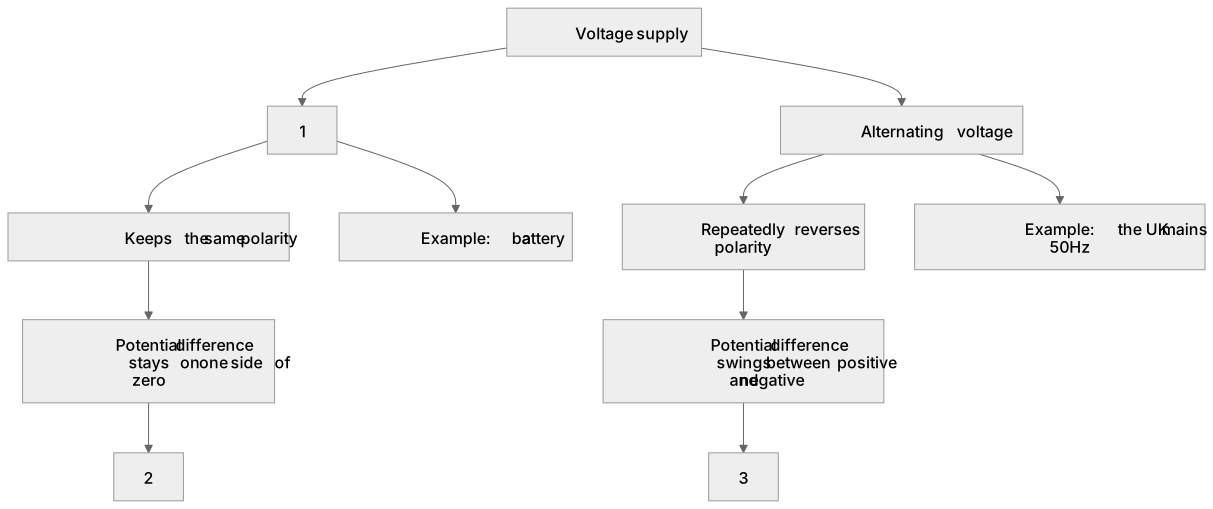
Some boxes have lost their names. Pick the right name for each number.
1Box 1
2Box 2
3Box 3
There is more to this lesson
The full lesson goes on to check your understanding and help you earn the marks. Create a free account to carry on, with your progress saved.
A week of Premium from your first lesson · Then the free plan continues · No card, no charge
Test your understanding of Powering Earth: explain the difference between direct and alternating voltage
Active recall beats re-reading. Take an instant quiz now to test what you’ve learned and lock it into long-term memory.
A week of Premium from your first lesson · Then the free plan continues · No card, no charge