OCR · GCSE · Physics
Course version: J249 · Version from Sept 2018
Recall that the domestic supply in the UK is a.c. at 50 Hz and about 230…
Full specification wording
Powering Earth: recall that the domestic supply in the UK is a.c. at 50 Hz and about 230 volts
The mains electricity delivered to UK homes is an alternating supply.
Checked against the OCR J249 specification (opens in a new tab) on .
- Point 6 of 9
- 4 key terms
Study notes
From the checked teaching notes for this specification point.
The idea
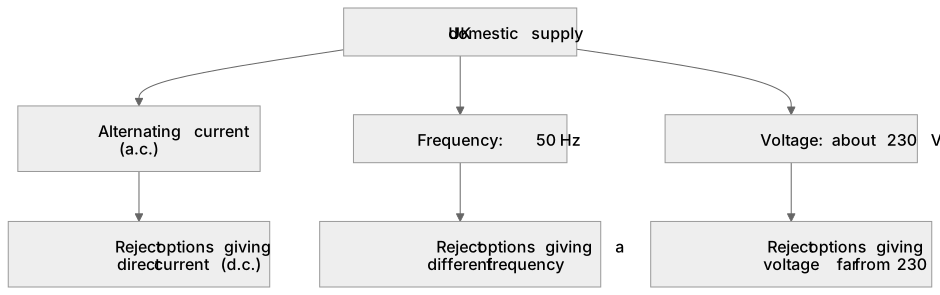
The mains electricity delivered to UK homes is an alternating supply. Its voltage repeatedly reverses direction, so the potential difference swings positive and negative many times each second. The frequency of that reversal is 50 Hz, meaning 50 complete cycles every second, so the direction changes 100 times per second. The stated voltage is about 230 V; the word 'about' matters because the actual value drifts slightly around that figure. A learner should be able to pick out all three facts together: alternating current, 50 Hz and roughly 230 V. A useful check is to reject any option that gives a direct (d.c.) supply, a frequency such as 60 Hz, or a voltage far from 230 V, since each of those contradicts one clause of the specification statement.
What earns the marks
- Selects the option stating that the UK domestic supply is alternating current.
- Identifies 50 Hz as the frequency of the UK domestic supply.
- Recognises that the UK domestic voltage is about 230 V.
- Rejects options that describe the domestic supply as direct current or give a frequency or voltage that contradicts the stated values.
Common mistakes and how to put them right
Confuses the domestic supply with a direct supply.
Put it right: UK mains is alternating.
Gives the frequency as 60 Hz.
Put it right: The UK value is 50 Hz.
Exam tips
- Read all three parts of the statement before choosing, because a single option must satisfy current type, frequency and voltage together.
- Eliminate any option that names direct current first, since that alone rules it out.
- Check the frequency and voltage figures against 50 Hz and about 230 V rather than guessing from memory of other countries.
Try the lesson
The start of the Powering Earth: recall that the domestic supply in the UK is a.c. at 50 Hz and about 230 volts lesson, made from checked teaching notes for this specification point.
Have a go first
What is the approximate potential difference of the UK domestic mains supply?
Listen
The mains electricity delivered to UK homes is an alternating supply. Its voltage repeatedly reverses direction, so the potential difference swings positive and negative many times each second. The frequency of that reversal is 50 Hz, meaning 50 complete cycles every second, so the direction changes 100 times per second. The stated voltage is about 230 V; the word 'about' matters because the actual value drifts slightly around that figure. A learner should be able to pick out all three facts together: alternating current, 50 Hz and roughly 230 V. A useful check is to reject any option that gives a direct (d.c.) supply, a frequency such as 60 Hz, or a voltage far from 230 V, since each of those contradicts one clause of the specification statement. A strong answer earns marks for these points. Selects the option stating that the UK domestic supply is alternating current. Identifies 50 Hz as the frequency of the UK domestic supply. Recognises that the UK domestic voltage is about 230 V. Rejects options that describe the domestic supply as direct current or give a frequency or voltage that contradicts the stated values. Exam tip: Read all three parts of the statement before choosing, because a single option must satisfy current type, frequency and voltage together.
See it
Key words
Say what each word means before you turn the card.
Alternating current in the home
Try answering aloud or in your head before turning the card.
Frequency of the UK mains supply
Try answering aloud or in your head before turning the card.
Voltage of the UK mains supply
Try answering aloud or in your head before turning the card.
Recognising correct values among distractors
Try answering aloud or in your head before turning the card.
See every definition
- Alternating current in the home
- The domestic supply in the UK is a.c., so its voltage repeatedly reverses direction, swinging positive and negative many times each second.
- Frequency of the UK mains supply
- The frequency of that reversal is 50 Hz, meaning 50 complete cycles every second, so the direction changes 100 times per second.
- Voltage of the UK mains supply
- The stated voltage is about 230 V; the word 'about' matters because the actual value drifts slightly around that figure.
- Recognising correct values among distractors
- A useful check is to reject any option that gives a direct supply, a frequency such as 60 Hz, or a voltage far from 230 V.
Label the diagram
Some boxes have lost their names. Pick the right name for each number.
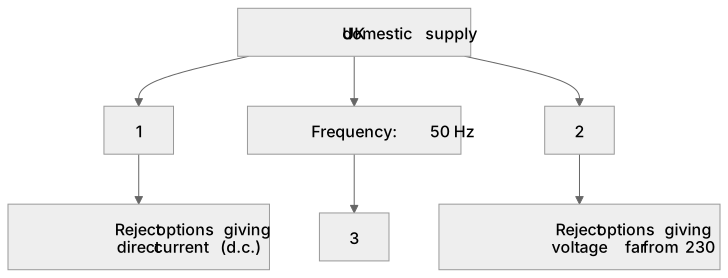
1Box 1
2Box 2
3Box 3
There is more to this lesson
The full lesson goes on to check your understanding and help you earn the marks. Create a free account to carry on, with your progress saved.
A week of Premium from your first lesson · Then the free plan continues · No card, no charge
Test your understanding of Powering Earth: recall that the domestic supply in the UK is a.c. at 50 Hz and about 230 volts
Active recall beats re-reading. Take an instant quiz now to test what you’ve learned and lock it into long-term memory.
A week of Premium from your first lesson · Then the free plan continues · No card, no charge