OCR · GCSE · Physics
Course version: J249 · Version from Sept 2018
Apply: for a given mass of gas at a constant temperature: pressure (Pa) ×…
Full specification wording
Pressure: apply: for a given mass of gas at a constant temperature: pressure (Pa) × volume (m³) = constant (content found only in the physics separate science qualification)
For a fixed mass of gas kept at constant temperature, pressure multiplied by volume stays constant.
Checked against the OCR J249 specification (opens in a new tab) on .
- Point 1 of 12
- 4 key terms
Study notes
From the checked teaching notes for this specification point.
The idea
For a fixed mass of gas kept at constant temperature, pressure multiplied by volume stays constant. This is written p × V = constant, or p₁ × V₁ = p₂ × V₂, where pressure is in pascals (Pa) and volume in cubic metres (m³). If the volume is halved, the pressure doubles, because the same number of particles hits a smaller area more often. To apply it, list the initial pressure and volume, then the final pressure or volume, and solve for the unknown. For example, a gas at 1.0 × 10⁵ Pa in 2.0 m³ compressed to 1.0 m³ gives p₂ = (1.0 × 10⁵ × 2.0) ÷ 1.0 = 2.0 × 10⁵ Pa. Convert volumes to m³ (1 m³ = 1000 dm³) and keep temperature and mass fixed. This content appears only in the physics separate science qualification.
What earns the marks
- States that pressure multiplied by volume is constant for a fixed mass of gas at constant temperature.
- Uses p₁ × V₁ = p₂ × V₂ to find an unknown pressure or volume.
- Recognises that halving the volume doubles the pressure when temperature and mass are unchanged.
- Converts volumes to cubic metres before substituting into the relationship.
- Keeps pressure in pascals and volume in cubic metres so the constant has consistent units.
Common mistakes and how to put them right
Uses the relationship when temperature or mass changes.
Put it right: Apply it only when both are held constant.
Leaves volume in cubic decimetres or litres.
Put it right: Convert to cubic metres first so units match.
Adds pressures or volumes instead of multiplying.
Put it right: Multiply pressure by volume to obtain the constant.
Inverts the ratio so pressure falls as volume falls.
Put it right: Expect pressure to rise when volume decreases.
Exam tips
- Write p₁ × V₁ = p₂ × V₂ and fill in the three known values before rearranging.
- Convert every volume to m³ and every pressure to Pa so the units are consistent.
- Check the direction of change: a smaller volume should give a larger pressure.
Try the lesson
The start of the Pressure: apply: for a given mass of gas at a constant temperature: pressure (Pa) × volume (m³) = constant (content found only in the physics separate science qualification) lesson, made from checked teaching notes for this specification point.
Have a go first
A fixed mass of gas at constant temperature has a pressure of 100 000 Pa and a volume of 0.20 m³. The gas is compressed until its volume is 0.10 m³. Calculate the new pressure.
Listen
For a fixed mass of gas kept at constant temperature, pressure multiplied by volume stays constant. This is written p × V = constant, or p₁ × V₁ = p₂ × V₂, where pressure is in pascals (Pa) and volume in cubic metres (m³). If the volume is halved, the pressure doubles, because the same number of particles hits a smaller area more often. To apply it, list the initial pressure and volume, then the final pressure or volume, and solve for the unknown. For example, a gas at 1.0 × 10⁵ Pa in 2.0 m³ compressed to 1.0 m³ gives p₂ = (1.0 × 10⁵ × 2.0) ÷ 1.0 = 2.0 × 10⁵ Pa. Convert volumes to m³ (1 m³ = 1000 dm³) and keep temperature and mass fixed. This content appears only in the physics separate science qualification. A strong answer earns marks for these points. States that pressure multiplied by volume is constant for a fixed mass of gas at constant temperature. Uses p₁ × V₁ = p₂ × V₂ to find an unknown pressure or volume. Recognises that halving the volume doubles the pressure when temperature and mass are unchanged. Converts volumes to cubic metres before substituting into the relationship. Exam tip: Write p₁ × V₁ = p₂ × V₂ and fill in the three known values before rearranging.
See it
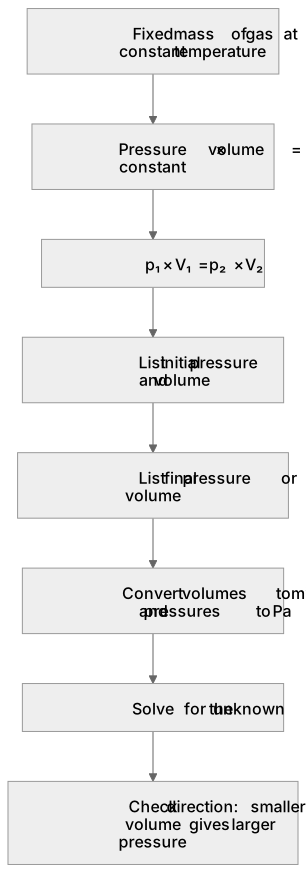
Put it in order
Put these steps in the order they happen.
- 1. List final pressure or volume
- 2. Check direction: smaller volume gives larger pressure
- 3. Convert volumes to m³ and pressures to Pa
- 4. Fixed mass of gas at constant temperature
- 5. Pressure × volume = constant
- 6. Solve for the unknown
- 7. p₁ × V₁ = p₂ × V₂
- 8. List initial pressure and volume
Key words
Say what each word means before you turn the card.
Gas pressure and volume
Try answering aloud or in your head before turning the card.
Constant temperature and fixed mass
Try answering aloud or in your head before turning the card.
Inverse relationship between pressure and volume
Try answering aloud or in your head before turning the card.
Unit consistency in gas calculations
Try answering aloud or in your head before turning the card.
See every definition
- Gas pressure and volume
- For a fixed mass of gas at constant temperature, pressure multiplied by volume stays constant, written p × V = constant.
- Constant temperature and fixed mass
- The relationship applies only when both temperature and mass are held constant.
- Inverse relationship between pressure and volume
- If the volume is halved, the pressure doubles, because the same number of particles hits a smaller area more often.
- Unit consistency in gas calculations
- Pressure is kept in pascals and volume in cubic metres, converting volumes to m³ first, so the constant has consistent units.
Label the diagram
Some boxes have lost their names. Pick the right name for each number.
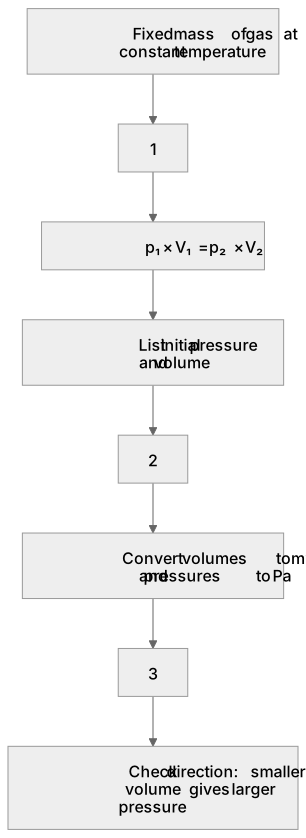
1Box 1
2Box 2
3Box 3
There is more to this lesson
The full lesson goes on to check your understanding and help you earn the marks. Create a free account to carry on, with your progress saved.
A week of Premium from your first lesson · Then the free plan continues · No card, no charge
Test your understanding of Pressure: apply: for a given mass of gas at a constant temperature: pressure (Pa) × volume (m³) = constant (content found only in the physics separate science qualification)
Active recall beats re-reading. Take an instant quiz now to test what you’ve learned and lock it into long-term memory.
A week of Premium from your first lesson · Then the free plan continues · No card, no charge