OCR · GCSE · Physics
Course version: J249 · Version from Sept 2018
Apply: pressure due to a column of liquid (Pa) = height of column (m) ×…
Full specification wording
Pressure: apply: pressure due to a column of liquid (Pa) = height of column (m) × density of liquid (kg/m³) × gravitational field strength (N/kg) (content found only in the physics separate science qualification) (Higher tier only)
This Higher tier, separate-science relationship gives the pressure created at the base of a vertical column of liquid: p = h × ρ × g.
Checked against the OCR J249 specification (opens in a new tab) on .
- Point 2 of 12
- 4 key terms
Study notes
From the checked teaching notes for this specification point.
The idea
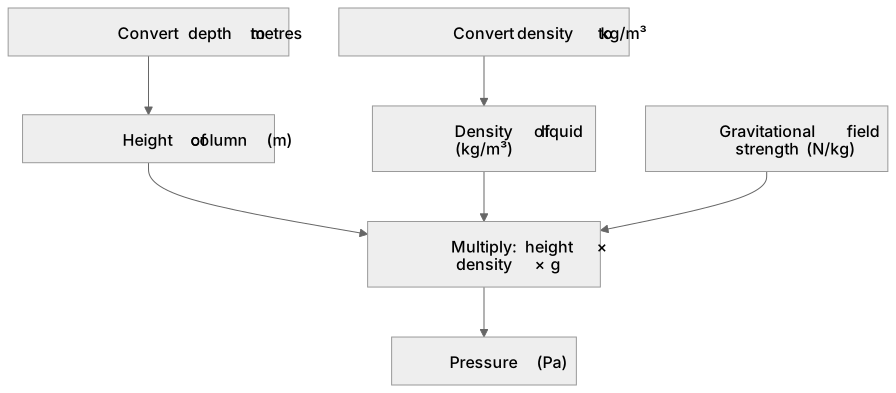
This Higher tier, separate-science relationship gives the pressure created at the base of a vertical column of liquid: p = h × ρ × g. Height h is measured in metres, density ρ in kilograms per cubic metre and gravitational field strength g in newtons per kilogram, so the product comes out in pascals (N/m²). A worked case: a column 2.0 m deep of water with density 1000 kg/m³ and g = 9.8 N/kg gives p = 2.0 × 1000 × 9.8 = 19 600 Pa, about 2.0 × 10⁴ Pa. Notice that the pressure depends on depth, density and g, not on the cross-sectional area or the total volume of the container. Convert depths to metres and densities to kg/m³ before multiplying, and keep units consistent throughout.
What earns the marks
- Selects the relationship p = h × ρ × g and substitutes height in metres, density in kg/m³ and gravitational field strength in N/kg.
- Converts a depth given in centimetres or millimetres to metres before substituting into the equation.
- Calculates the product of height, density and gravitational field strength and states the pressure in pascals.
- Recognises that the pressure at a given depth depends on depth, density and g rather than on the cross-sectional area or volume of the container.
- Rearranges the relationship to find an unknown height, density or gravitational field strength when the pressure is given.
Common mistakes and how to put them right
Substitutes a depth in centimetres directly into the equation.
Put it right: Convert the depth to metres first so the pressure comes out in pascals.
Treats the pressure as increasing with the width or volume of the container.
Put it right: Base the calculation only on depth, density and gravitational field strength.
Omits the gravitational field strength term and multiplies only height by density.
Put it right: Include g so the result carries the correct units of pressure.
Mixes units, for example using grams per cubic centimetre with metres.
Put it right: Convert density to kilograms per cubic metre before multiplying.
Exam tips
- Write the equation first, then list the values with their units, converting any depth to metres before you substitute.
- Check the unit of your answer: height in m times density in kg/m³ times g in N/kg gives pascals.
- Use g = 9.8 N/kg unless the question states another value, and keep the same value throughout the calculation.
Try the lesson
The start of the Pressure: apply: pressure due to a column of liquid (Pa) = height of column (m) × density of liquid (kg/m³) × gravitational field strength (N/kg) (content found only in the physics separate science qualification) (Higher tier only) lesson, made from checked teaching notes for this specification point.
Have a go first
A measuring cylinder holds a liquid of density 1200 kg/m³ to a depth of 0.50 m. Taking g = 10 N/kg, calculate the pressure at the bottom due to the liquid.
Listen
This Higher tier, separate-science relationship gives the pressure created at the base of a vertical column of liquid: p = h × ρ × g. Height h is measured in metres, density ρ in kilograms per cubic metre and gravitational field strength g in newtons per kilogram, so the product comes out in pascals (N/m²). A worked case: a column 2.0 m deep of water with density 1000 kg/m³ and g = 9.8 N/kg gives p = 2.0 × 1000 × 9.8 = 19 600 Pa, about 2.0 × 10⁴ Pa. Notice that the pressure depends on depth, density and g, not on the cross-sectional area or the total volume of the container. Convert depths to metres and densities to kg/m³ before multiplying, and keep units consistent throughout. A strong answer earns marks for these points. Selects the relationship p = h × ρ × g and substitutes height in metres, density in kg/m³ and gravitational field strength in N/kg. Converts a depth given in centimetres or millimetres to metres before substituting into the equation. Calculates the product of height, density and gravitational field strength and states the pressure in pascals. Recognises that the pressure at a given depth depends on depth, density and g rather than on the cross-sectional area or volume of the container. Exam tip: Write the equation first, then list the values with their units, converting any depth to metres before you substitute.
See it
Key words
Say what each word means before you turn the card.
Pressure in a liquid column
Try answering aloud or in your head before turning the card.
Density and depth
Try answering aloud or in your head before turning the card.
Gravitational field strength
Try answering aloud or in your head before turning the card.
Unit conversion and calculation
Try answering aloud or in your head before turning the card.
See every definition
- Pressure in a liquid column
- The pressure created at the base of a vertical column of liquid, calculated as height of column in metres × density of liquid in kg/m³ × gravitational field strength in N/kg.
- Density and depth
- The pressure at a given depth depends on depth, density and g rather than on the cross-sectional area or volume of the container.
- Gravitational field strength
- Measured in newtons per kilogram, this term is included in the calculation so the result carries the correct units of pressure.
- Unit conversion and calculation
- Convert depths to metres and densities to kg/m³ before multiplying, and keep units consistent throughout so the pressure comes out in pascals.
Label the diagram
Some boxes have lost their names. Pick the right name for each number.
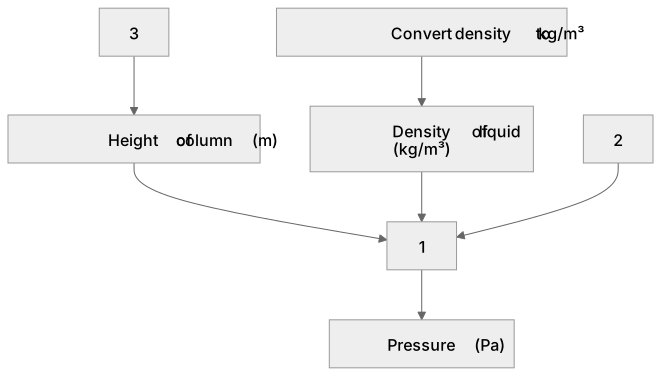
1Box 1
2Box 2
3Box 3
There is more to this lesson
The full lesson goes on to check your understanding and help you earn the marks. Create a free account to carry on, with your progress saved.
A week of Premium from your first lesson · Then the free plan continues · No card, no charge
Test your understanding of Pressure: apply: pressure due to a column of liquid (Pa) = height of column (m) × density of liquid (kg/m³) × gravitational field strength (N/kg) (content found only in the physics separate science qualification) (Higher tier only)
Active recall beats re-reading. Take an instant quiz now to test what you’ve learned and lock it into long-term memory.
A week of Premium from your first lesson · Then the free plan continues · No card, no charge