OCR · GCSE · Physics
Course version: J249 · Version from Sept 2018
Explain the relationship between the temperature of a gas and its pressure…
Full specification wording
Pressure: explain the relationship between the temperature of a gas and its pressure at constant volume (qualitative only)
At constant volume, the number of gas particles and the space they occupy stay fixed.
Checked against the OCR J249 specification (opens in a new tab) on .
- Point 4 of 12
- 4 key terms
Study notes
From the checked teaching notes for this specification point.
The idea
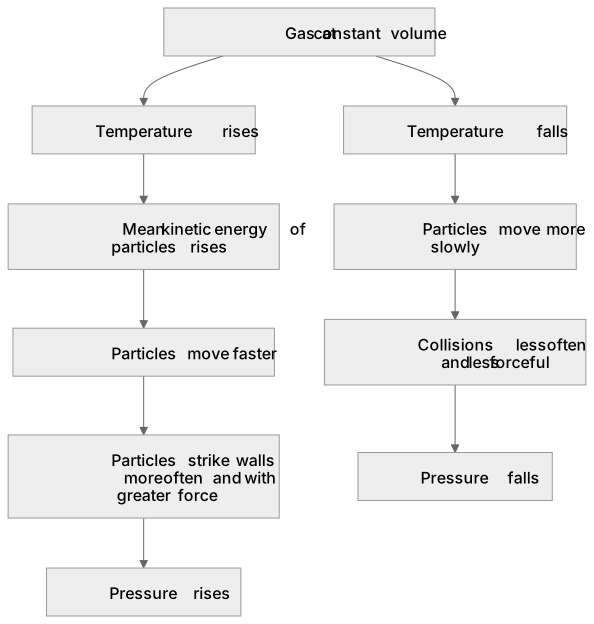
At constant volume, the number of gas particles and the space they occupy stay fixed. Heating the gas transfers energy to the particles, so their mean kinetic energy rises and they move faster. Faster particles strike the container walls more often and with greater force per collision, so the total force on a fixed area of wall increases and the pressure rises. Cooling reverses this: particles move more slowly, collide less often and less forcefully, and the pressure falls. The relationship is qualitative here, so you explain the direction of change and the particle reason rather than calculating values. A sealed rigid metal can heated on a bench is a useful picture: its volume cannot change, yet the pressure inside climbs as the temperature climbs.
What earns the marks
- States that at constant volume the particles keep the same space to move in, so only their speed and collision behaviour change.
- Explains that raising the temperature increases the mean kinetic energy of the particles, so they move faster.
- States that faster particles hit the container walls more frequently and with greater force, raising the pressure.
- Describes the reverse case, in which cooling slows the particles and lowers the pressure at fixed volume.
Common mistakes and how to put them right
Claims that heating a fixed-volume gas makes the particles expand.
Put it right by saying the particles speed up while the container volume stays the same.
Says pressure rises because there are more particles after heating.
Put it right by noting the number of particles is unchanged at constant volume.
Treats the link as proportional and calculates values.
Put it right by giving a qualitative explanation of direction and particle behaviour only.
Exam tips
- Anchor every answer in the particle model: name the change in particle speed, then the change in collision frequency and force on the walls.
- Check that your explanation keeps volume constant; if you mention the gas expanding, you have left the stated condition.
- Use the words temperature, kinetic energy, collisions and pressure so the chain of reasoning is visible to the examiner.
Try the lesson
The start of the Pressure: explain the relationship between the temperature of a gas and its pressure at constant volume (qualitative only) lesson, made from checked teaching notes for this specification point.
Have a go first
A gas is trapped in a strong glass flask whose volume cannot change. The flask is gently heated. What happens to the pressure of the trapped gas?
Listen
At constant volume, the number of gas particles and the space they occupy stay fixed. Heating the gas transfers energy to the particles, so their mean kinetic energy rises and they move faster. Faster particles strike the container walls more often and with greater force per collision, so the total force on a fixed area of wall increases and the pressure rises. Cooling reverses this: particles move more slowly, collide less often and less forcefully, and the pressure falls. The relationship is qualitative here, so you explain the direction of change and the particle reason rather than calculating values. A sealed rigid metal can heated on a bench is a useful picture: its volume cannot change, yet the pressure inside climbs as the temperature climbs. A strong answer earns marks for these points. States that at constant volume the particles keep the same space to move in, so only their speed and collision behaviour change. Explains that raising the temperature increases the mean kinetic energy of the particles, so they move faster. States that faster particles hit the container walls more frequently and with greater force, raising the pressure. Describes the reverse case, in which cooling slows the particles and lowers the pressure at fixed volume. A common slip: Claims that heating a fixed-volume gas makes the particles expand. Instead, saying the particles speed up while the container volume stays the same. Exam tip: Anchor every answer in the particle model: name the change in particle speed, then the change in collision frequency and force on the walls.
See it
Key words
Say what each word means before you turn the card.
Particle model of gases
Try answering aloud or in your head before turning the card.
Kinetic energy and temperature
Try answering aloud or in your head before turning the card.
Collisions with container walls
Try answering aloud or in your head before turning the card.
Pressure at constant volume
Try answering aloud or in your head before turning the card.
See every definition
- Particle model of gases
- The model in which gas particles move and strike the container walls, used to explain how temperature changes affect pressure at constant volume.
- Kinetic energy and temperature
- Heating the gas transfers energy to the particles, so their mean kinetic energy rises and they move faster; cooling reverses this.
- Collisions with container walls
- Faster particles strike the walls more often and with greater force per collision, so the total force on a fixed area of wall increases.
- Pressure at constant volume
- With the number of particles and the space they occupy fixed, rising temperature raises the pressure and cooling lowers it.
Label the diagram
Some boxes have lost their names. Pick the right name for each number.
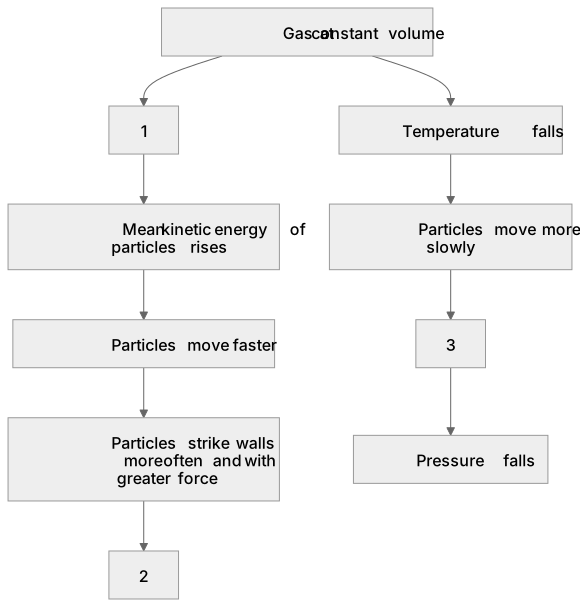
1Box 1
2Box 2
3Box 3
There is more to this lesson
The full lesson goes on to check your understanding and help you earn the marks. Create a free account to carry on, with your progress saved.
A week of Premium from your first lesson · Then the free plan continues · No card, no charge
Test your understanding of Pressure: explain the relationship between the temperature of a gas and its pressure at constant volume (qualitative only)
Active recall beats re-reading. Take an instant quiz now to test what you’ve learned and lock it into long-term memory.
A week of Premium from your first lesson · Then the free plan continues · No card, no charge