OCR · GCSE · Physics
Course version: J249 · Version from Sept 2018
Recall that gases can be compressed or expanded by pressure changes and…
Full specification wording
Pressure: recall that gases can be compressed or expanded by pressure changes and that the pressure produces a net force at right angles to any surface (content found only in the physics separate science qualification)
This statement is assessed only in the physics separate science qualification, so treat it as separate-science content even though it sits in a section shared with the combined route.
Checked against the OCR J249 specification (opens in a new tab) on .
- Point 5 of 12
- 4 key terms
Study notes
From the checked teaching notes for this specification point.
The idea
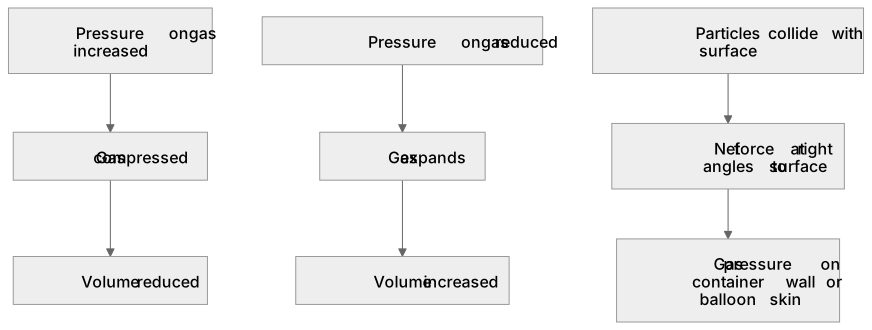
This statement is assessed only in the physics separate science qualification, so treat it as separate-science content even though it sits in a section shared with the combined route. Gases are compressible: applying extra pressure squeezes the particles into a smaller volume, and reducing the external pressure lets a fixed mass of gas expand into a larger volume. In both cases the particles keep moving and colliding with the container walls. Each collision exerts a tiny push on the wall, and because the particles arrive from all directions inside the gas, the combined effect is a net force acting at right angles (perpendicular) to every surface the gas touches. That perpendicular force spread over an area is what we call gas pressure, which is why a balloon pushes evenly outward on all of its skin.
What earns the marks
- States that a gas can be compressed when the pressure on it is increased, reducing its volume.
- States that a gas can expand when the pressure on it is reduced, increasing its volume.
- Explains that particle collisions with a surface produce a net force acting at right angles to that surface.
- Applies the perpendicular-force idea to a named surface, such as the inside wall of a container or a balloon skin.
Common mistakes and how to put them right
Says the net force from gas pressure acts along the surface.
Put it right by stating it acts at right angles to the surface.
Claims a gas cannot be compressed because particles are already touching.
Put it right by noting the large gaps between gas particles allow compression.
Describes expansion as particles themselves growing larger.
Put it right by saying the same particles spread into a greater volume.
Exam tips
- Remember this content belongs to the physics separate science qualification, so revise it only if you are entered for that route.
- Pair each change of volume with the pressure change that causes it: more pressure compresses, less pressure allows expansion.
- When asked about direction of force, write 'at right angles to the surface' rather than 'along' or 'towards the centre'.
Try the lesson
The start of the Pressure: recall that gases can be compressed or expanded by pressure changes and that the pressure produces a net force at right angles to any surface (content found only in the physics separate science qualification) lesson, made from checked teaching notes for this specification point.
Have a go first
A gas is trapped in a cylinder with a movable piston. The piston is pushed in so the volume of the gas becomes smaller. What has happened to the gas?
Listen
This statement is assessed only in the physics separate science qualification, so treat it as separate-science content even though it sits in a section shared with the combined route. Gases are compressible: applying extra pressure squeezes the particles into a smaller volume, and reducing the external pressure lets a fixed mass of gas expand into a larger volume. In both cases the particles keep moving and colliding with the container walls. Each collision exerts a tiny push on the wall, and because the particles arrive from all directions inside the gas, the combined effect is a net force acting at right angles (perpendicular) to every surface the gas touches. That perpendicular force spread over an area is what we call gas pressure, which is why a balloon pushes evenly outward on all of its skin. A strong answer earns marks for these points. States that a gas can be compressed when the pressure on it is increased, reducing its volume. States that a gas can expand when the pressure on it is reduced, increasing its volume. Explains that particle collisions with a surface produce a net force acting at right angles to that surface. Applies the perpendicular-force idea to a named surface, such as the inside wall of a container or a balloon skin. A common slip: Says the net force from gas pressure acts along the surface. Instead, stating it acts at right angles to the surface. Exam tip: Remember this content belongs to the physics separate science qualification, so revise it only if you are entered for that route.
See it
Key words
Say what each word means before you turn the card.
Compressibility of gases
Try answering aloud or in your head before turning the card.
Expansion and compression by pressure change
Try answering aloud or in your head before turning the card.
Particle collisions and force
Try answering aloud or in your head before turning the card.
Force perpendicular to surfaces
Try answering aloud or in your head before turning the card.
See every definition
- Compressibility of gases
- Gases can be compressed when the pressure on them is increased, reducing their volume.
- Expansion and compression by pressure change
- A gas can expand when the pressure on it is reduced, increasing its volume, and can be compressed when the pressure is increased.
- Particle collisions and force
- Particles keep moving and colliding with the container walls, and each collision exerts a tiny push on the wall.
- Force perpendicular to surfaces
- Because particles arrive from all directions inside the gas, the combined effect is a net force acting at right angles to every surface the gas touches.
Label the diagram
Some boxes have lost their names. Pick the right name for each number.
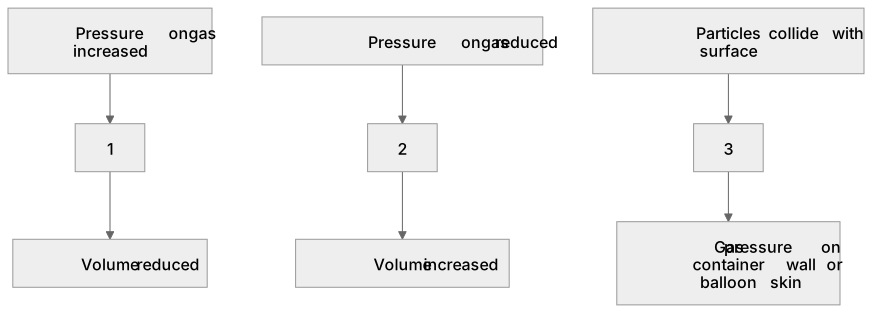
1Box 1
2Box 2
3Box 3
There is more to this lesson
The full lesson goes on to check your understanding and help you earn the marks. Create a free account to carry on, with your progress saved.
A week of Premium from your first lesson · Then the free plan continues · No card, no charge
Test your understanding of Pressure: recall that gases can be compressed or expanded by pressure changes and that the pressure produces a net force at right angles to any surface (content found only in the physics separate science qualification)
Active recall beats re-reading. Take an instant quiz now to test what you’ve learned and lock it into long-term memory.
A week of Premium from your first lesson · Then the free plan continues · No card, no charge