OCR · GCSE · Physics
Course version: J249 · Version from Sept 2018
Explain why pressure in a liquid varies with depth and density and how…
Full specification wording
Pressure: explain why pressure in a liquid varies with depth and density and how this leads to an upwards force on a partially submerged object (content found only in the physics separate science qualification) (Higher tier only)
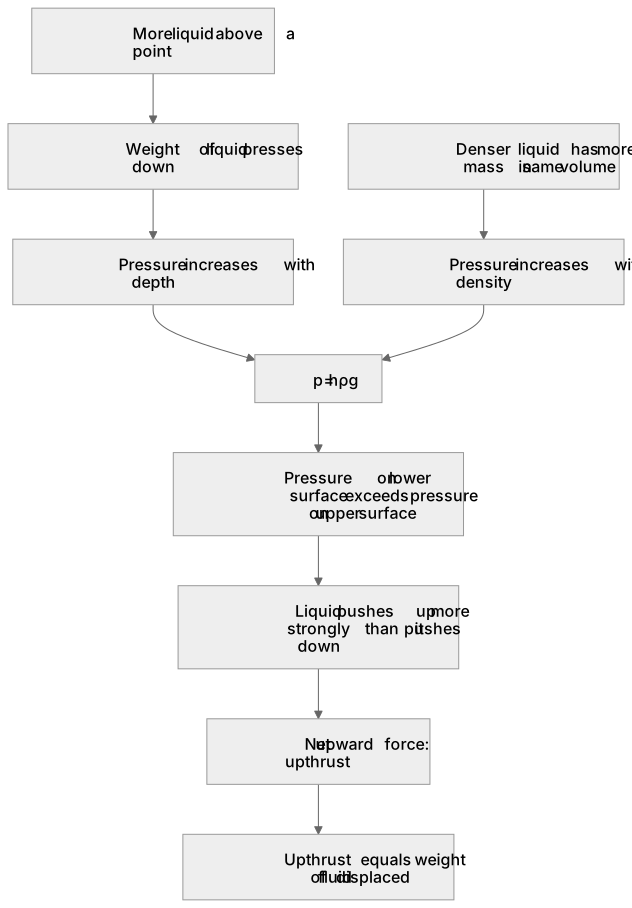
Pressure in a liquid increases with depth because more liquid lies above and its weight presses down; it also increases with density because a denser liquid has more mass in the same volume.
Checked against the OCR J249 specification (opens in a new tab) on .
- Point 11 of 12
- 4 key terms
Study notes
From the checked teaching notes for this specification point.
The idea
Pressure in a liquid increases with depth because more liquid lies above and its weight presses down; it also increases with density because a denser liquid has more mass in the same volume. The pressure at a point is given by p = hρg, where h is depth, ρ is density and g is gravitational field strength. On a partially submerged object, the pressure on the lower surface exceeds the pressure on the upper surface, so the liquid pushes up more strongly than it pushes down. This net upward force is upthrust, and it equals the weight of fluid displaced.
What earns the marks
- Explains that pressure increases with depth because the weight of liquid above a point increases.
- Explains that pressure increases with density because a denser liquid has more mass in the same volume.
- Applies p = hρg to relate pressure to depth, density and gravitational field strength.
- Explains that greater pressure on the lower surface than the upper surface produces a net upward force, the upthrust.
Common mistakes and how to put them right
States that pressure depends only on depth and ignores density.
Put it right: Include density in the relationship p = hρg.
Claims the upward force comes from the object's own weight.
Put it right: Attribute upthrust to the greater pressure on the lower surface.
Treats pressure as the same at all depths.
Put it right: Recognise that pressure rises as depth increases.
Exam tips
- Use p = hρg and identify each symbol before substituting values.
- Compare pressure on the upper and lower surfaces to justify the direction of the net force.
- Link the net upward force to the weight of fluid displaced when explaining upthrust.
Try the lesson
The start of the Pressure: explain why pressure in a liquid varies with depth and density and how this leads to an upwards force on a partially submerged object (content found only in the physics separate science qualification) (Higher tier only) lesson, made from checked teaching notes for this specification point.
Have a go first
Two containers are filled to the same depth, one with water and one with a denser liquid. How does the pressure at the bottom of the containers compare?
Listen
Pressure in a liquid increases with depth because more liquid lies above and its weight presses down; it also increases with density because a denser liquid has more mass in the same volume. The pressure at a point is given by p = hρg, where h is depth, ρ is density and g is gravitational field strength. On a partially submerged object, the pressure on the lower surface exceeds the pressure on the upper surface, so the liquid pushes up more strongly than it pushes down. This net upward force is upthrust, and it equals the weight of fluid displaced. A strong answer earns marks for these points. Explains that pressure increases with depth because the weight of liquid above a point increases. Explains that pressure increases with density because a denser liquid has more mass in the same volume. Applies p = hρg to relate pressure to depth, density and gravitational field strength. Explains that greater pressure on the lower surface than the upper surface produces a net upward force, the upthrust. Exam tip: Use p = hρg and identify each symbol before substituting values.
See it
Key words
Say what each word means before you turn the card.
Pressure increasing with depth
Try answering aloud or in your head before turning the card.
Pressure increasing with density
Try answering aloud or in your head before turning the card.
The relationship p = hρg
Try answering aloud or in your head before turning the card.
Net upward force on a submerged surface
Try answering aloud or in your head before turning the card.
See every definition
- Pressure increasing with depth
- Pressure in a liquid increases with depth because more liquid lies above and its weight presses down.
- Pressure increasing with density
- Pressure increases with density because a denser liquid has more mass in the same volume.
- The relationship p = hρg
- The pressure at a point is given by p = hρg, where h is depth, ρ is density and g is gravitational field strength.
- Net upward force on a submerged surface
- The pressure on the lower surface exceeds the pressure on the upper surface, so the liquid pushes up more strongly than it pushes down.
Label the diagram
Some boxes have lost their names. Pick the right name for each number.
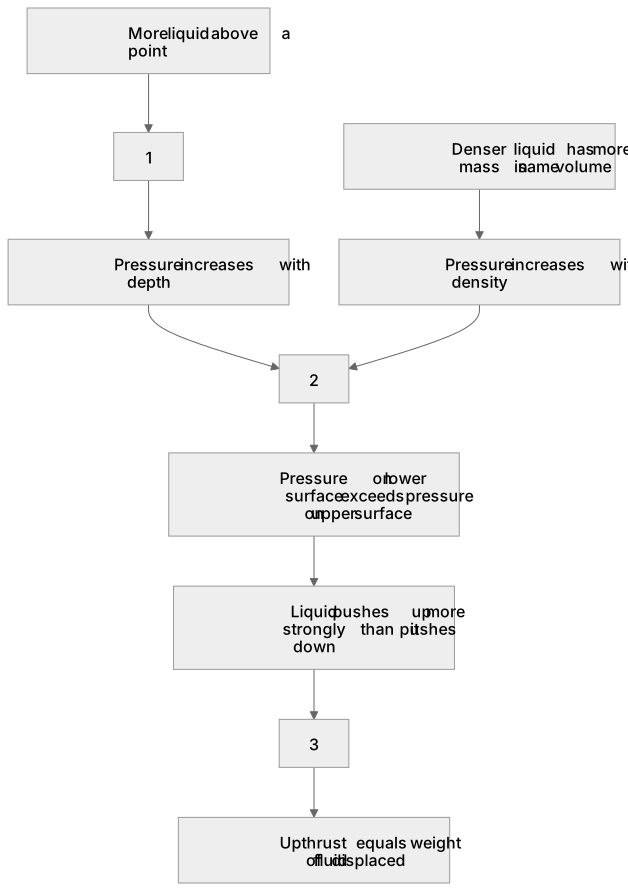
1Box 1
2Box 2
3Box 3
There is more to this lesson
The full lesson goes on to check your understanding and help you earn the marks. Create a free account to carry on, with your progress saved.
A week of Premium from your first lesson · Then the free plan continues · No card, no charge
Test your understanding of Pressure: explain why pressure in a liquid varies with depth and density and how this leads to an upwards force on a partially submerged object (content found only in the physics separate science qualification) (Higher tier only)
Active recall beats re-reading. Take an instant quiz now to test what you’ve learned and lock it into long-term memory.
A week of Premium from your first lesson · Then the free plan continues · No card, no charge