OCR · GCSE · Physics
Course version: J249 · Version from Sept 2018
Describe the factors which influence floating and sinking (content found…
Full specification wording
Pressure: describe the factors which influence floating and sinking (content found only in the physics separate science qualification) (Higher tier only)
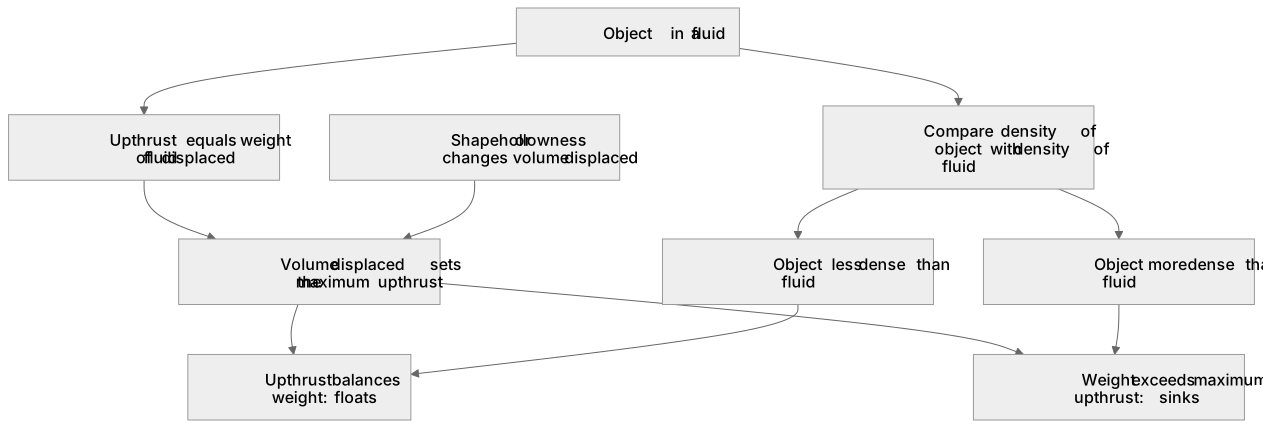
An object floats when the upthrust on it balances its weight; it sinks when its weight exceeds the maximum upthrust the fluid can supply.
Checked against the OCR J249 specification (opens in a new tab) on .
- Point 10 of 12
- 4 key terms
Study notes
From the checked teaching notes for this specification point.
The idea
An object floats when the upthrust on it balances its weight; it sinks when its weight exceeds the maximum upthrust the fluid can supply. Upthrust equals the weight of fluid displaced, so the outcome depends on the object's weight compared with the weight of fluid it could displace. Density is the key factor: an object less dense than the fluid floats, one more dense sinks. Shape matters because it sets the volume displaced when fully submerged, so a hollow steel hull floats while a solid steel block sinks. Overall density, not material alone, decides the result.
What earns the marks
- States that an object floats when upthrust equals its weight and sinks when its weight exceeds the maximum upthrust available.
- Identifies the density of the object relative to the density of the fluid as a deciding factor.
- Explains that upthrust equals the weight of fluid displaced, so the volume displaced sets the maximum upthrust.
- Recognises that shape or hollowness changes the volume displaced and therefore whether a given mass floats.
Common mistakes and how to put them right
Claims that heavy objects always sink regardless of density.
Put it right: Compare the object's density with the fluid's density instead.
Confuses mass with density when predicting floating.
Put it right: Use density, the mass per unit volume, as the deciding comparison.
Assumes upthrust depends only on the object's weight.
Put it right: Relate upthrust to the weight of fluid displaced.
Exam tips
- Compare the density of the object with the density of the fluid before deciding float or sink.
- Link upthrust to the weight of fluid displaced rather than to the object's mass alone.
- Use a hollow-hull example to show how shape changes the volume displaced.
Try the lesson
The start of the Pressure: describe the factors which influence floating and sinking (content found only in the physics separate science qualification) (Higher tier only) lesson, made from checked teaching notes for this specification point.
Have a go first
A solid block floats in water. Which quantity must be equal to the weight of the block for it to float in equilibrium?
Listen
An object floats when the upthrust on it balances its weight; it sinks when its weight exceeds the maximum upthrust the fluid can supply. Upthrust equals the weight of fluid displaced, so the outcome depends on the object's weight compared with the weight of fluid it could displace. Density is the key factor: an object less dense than the fluid floats, one more dense sinks. Shape matters because it sets the volume displaced when fully submerged, so a hollow steel hull floats while a solid steel block sinks. Overall density, not material alone, decides the result. A strong answer earns marks for these points. States that an object floats when upthrust equals its weight and sinks when its weight exceeds the maximum upthrust available. Identifies the density of the object relative to the density of the fluid as a deciding factor. Explains that upthrust equals the weight of fluid displaced, so the volume displaced sets the maximum upthrust. Recognises that shape or hollowness changes the volume displaced and therefore whether a given mass floats. Exam tip: Compare the density of the object with the density of the fluid before deciding float or sink.
See it
Key words
Say what each word means before you turn the card.
Upthrust and weight balance
Try answering aloud or in your head before turning the card.
Density comparison
Try answering aloud or in your head before turning the card.
Weight of fluid displaced
Try answering aloud or in your head before turning the card.
Effect of shape and hollowness
Try answering aloud or in your head before turning the card.
See every definition
- Upthrust and weight balance
- An object floats when the upthrust on it balances its weight, and sinks when its weight exceeds the maximum upthrust the fluid can supply.
- Density comparison
- An object less dense than the fluid floats, one more dense sinks, so overall density rather than material alone decides the result.
- Weight of fluid displaced
- Upthrust equals the weight of fluid displaced, so the volume displaced sets the maximum upthrust available.
- Effect of shape and hollowness
- Shape sets the volume displaced when fully submerged, so a hollow steel hull floats while a solid steel block sinks.
Label the diagram
Some boxes have lost their names. Pick the right name for each number.
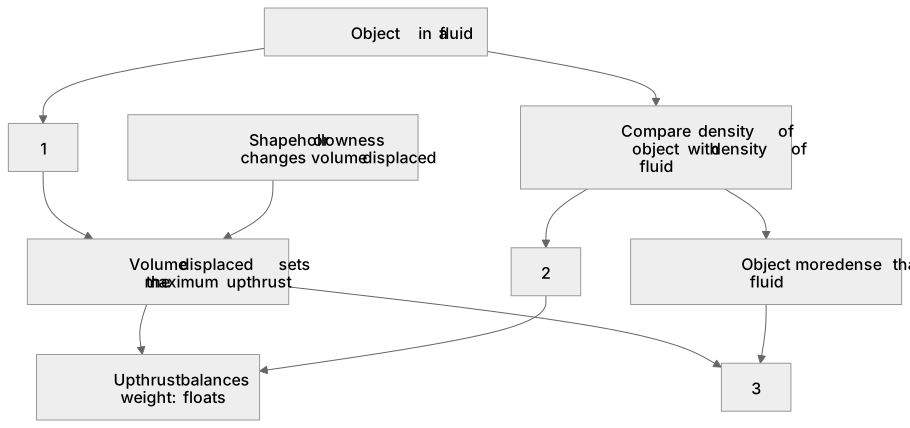
1Box 1
2Box 2
3Box 3
There is more to this lesson
The full lesson goes on to check your understanding and help you earn the marks. Create a free account to carry on, with your progress saved.
A week of Premium from your first lesson · Then the free plan continues · No card, no charge
Test your understanding of Pressure: describe the factors which influence floating and sinking (content found only in the physics separate science qualification) (Higher tier only)
Active recall beats re-reading. Take an instant quiz now to test what you’ve learned and lock it into long-term memory.
A week of Premium from your first lesson · Then the free plan continues · No card, no charge