OCR · GCSE · Physics
Course version: J249 · Version from Sept 2018
Calculate the net decline, expressed as a ratio, during radioactive…
Full specification wording
Radioactive emissions: calculate the net decline, expressed as a ratio, during radioactive emission after a given (integral) number of half-lives (to include: half-life graphs) (Higher tier only)
After each half-life the number of undecayed nuclei, and so the activity, halves.
Checked against the OCR J249 specification (opens in a new tab) on .
- Point 11 of 12
Study notes
From the checked teaching notes for this specification point.
The idea
After each half-life the number of undecayed nuclei, and so the activity, halves. After n whole half-lives the fraction remaining is (1/2)ⁿ, so the net decline expressed as a ratio is the remaining fraction compared with the original, written as 1 : 2ⁿ. For example, after 3 half-lives the fraction remaining is (1/2)³ = 1/8, so the ratio of remaining to original is 1 : 8, and the decline itself is 7/8 of the original. Read the number of half-lives from a half-life graph by counting successive halvings of the activity on the vertical axis, or divide the elapsed time by the half-life to find n, then apply the power.
What earns the marks
- Raises one half to the power of the number of half-lives to give the fraction remaining.
- Expresses the net decline as a ratio of remaining to original activity, such as 1 : 2ⁿ.
- Divides the elapsed time by the half-life to obtain the whole number of half-lives.
- Reads successive halvings of activity from a half-life graph to count the half-lives.
- States whether the ratio describes the fraction remaining or the fraction that has decayed.
Common mistakes and how to put them right
Multiplies the original activity by the number of half-lives instead of halving repeatedly.
Put it right: Apply the power of one half to the count of half-lives.
Writes the ratio as 2ⁿ.
Put it right: 1 rather than 1 : 2ⁿ; keep the remaining amount as the first term.
Uses a fractional or non-integral number of half-lives when the question specifies a whole number.
Put it right: Count only complete half-lives.
Confuses the fraction remaining with the fraction decayed.
Put it right: State which quantity the ratio represents.
Exam tips
- Count the half-lives first, then substitute into (1/2)ⁿ before writing the ratio.
- Show the fraction remaining and the ratio separately so the examiner can follow your reasoning.
- Check the direction of the ratio by asking whether the first term is smaller than the second for a decline.
Try the lesson
The start of the Radioactive emissions: calculate the net decline, expressed as a ratio, during radioactive emission after a given (integral) number of half-lives (to include: half-life graphs) (Higher tier only) lesson, made from checked teaching notes for this specification point.
Have a go first
On a half-life graph, a sample's activity starts at 9600 Bq and falls to 600 Bq. How many half-lives have passed, and what is the ratio of final to initial activity?
Listen
After each half-life the number of undecayed nuclei, and so the activity, halves. After n whole half-lives the fraction remaining is (1/2)ⁿ, so the net decline expressed as a ratio is the remaining fraction compared with the original, written as 1 : 2ⁿ. For example, after 3 half-lives the fraction remaining is (1/2)³ = 1/8, so the ratio of remaining to original is 1 : 8, and the decline itself is 7/8 of the original. Read the number of half-lives from a half-life graph by counting successive halvings of the activity on the vertical axis, or divide the elapsed time by the half-life to find n, then apply the power. A strong answer earns marks for these points. Raises one half to the power of the number of half-lives to give the fraction remaining. Expresses the net decline as a ratio of remaining to original activity, such as 1 : 2ⁿ. Divides the elapsed time by the half-life to obtain the whole number of half-lives. Reads successive halvings of activity from a half-life graph to count the half-lives. Exam tip: Count the half-lives first, then substitute into (1/2)ⁿ before writing the ratio.
See it
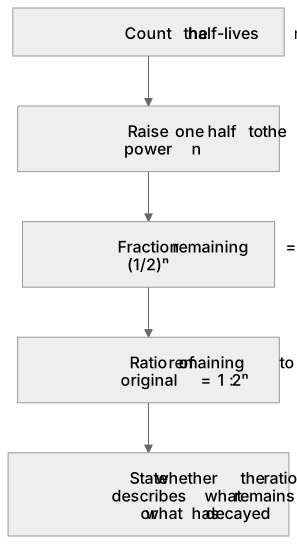
Put it in order
Put these steps in the order they happen.
- 1. Raise one half to the power n
- 2. Fraction remaining = (1/2)ⁿ
- 3. Count the half-lives n
- 4. State whether the ratio describes what remains or what has decayed
- 5. Ratio of remaining to original = 1 : 2ⁿ
Label the diagram
Some boxes have lost their names. Pick the right name for each number.
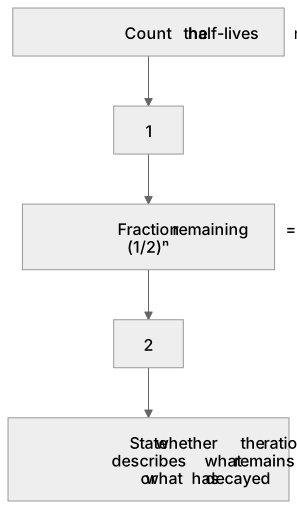
1Box 1
2Box 2
There is more to this lesson
The full lesson goes on to check your understanding and help you earn the marks. Create a free account to carry on, with your progress saved.
A week of Premium from your first lesson · Then the free plan continues · No card, no charge
Test your understanding of Radioactive emissions: calculate the net decline, expressed as a ratio, during radioactive emission after a given (integral) number of half-lives (to include: half-life graphs) (Higher tier only)
Active recall beats re-reading. Take an instant quiz now to test what you’ve learned and lock it into long-term memory.
A week of Premium from your first lesson · Then the free plan continues · No card, no charge