OCR · GCSE · Physics
Course version: J249 · Version from Sept 2018
Recall that changes in atoms and nuclei can also generate and absorb…
Full specification wording
Radioactive emissions: recall that changes in atoms and nuclei can also generate and absorb radiations over a wide frequency range (to include: an understanding that these types of radiation may be from any part of the electromagnetic spectrum which includes gamma rays)
Atoms and nuclei are not fixed, silent objects: when their internal arrangement changes, energy can leave as radiation or be taken in from radiation already present.
Checked against the OCR J249 specification (opens in a new tab) on .
- Point 9 of 12
- 4 key terms
Study notes
From the checked teaching notes for this specification point.
The idea
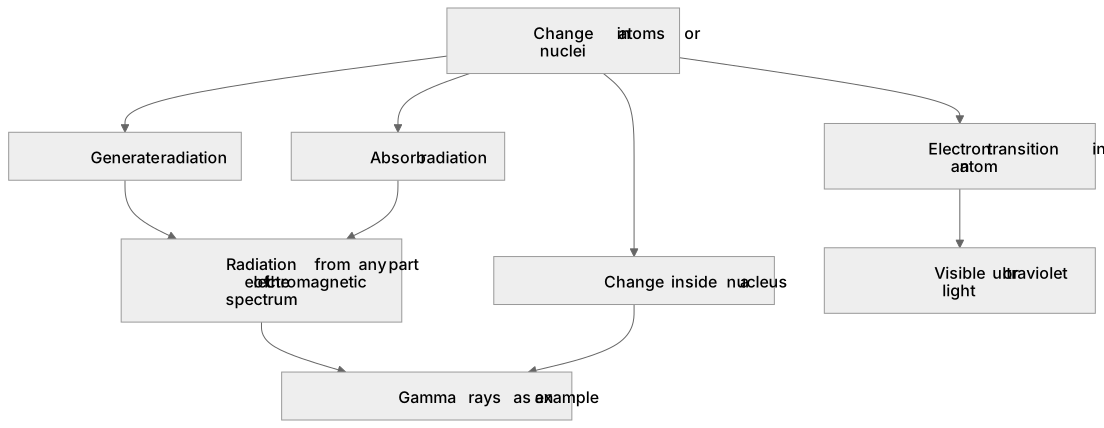
Atoms and nuclei are not fixed, silent objects: when their internal arrangement changes, energy can leave as radiation or be taken in from radiation already present. The key idea is that these changes are not limited to one band of the electromagnetic spectrum. A rearrangement of electrons in an atom, for example an electron dropping to a lower energy level, can emit visible or ultraviolet light, while a change inside a nucleus can emit gamma radiation. Absorption works the other way: incoming radiation of a suitable frequency can be taken up and change the atom or nucleus. So the radiation linked to atomic and nuclear changes may come from any part of the electromagnetic spectrum, and gamma rays are one important example. When answering, link the change (atomic or nuclear) to the radiation produced or absorbed, and remember the spectrum is wider than just gamma.
What earns the marks
- Identifies that changes in atoms and nuclei can both generate and absorb radiation.
- States that the radiation involved may come from any part of the electromagnetic spectrum.
- Recognises gamma rays as one example of radiation produced by nuclear change.
- Links a specific change, such as an electron transition or a nuclear change, to the radiation emitted or absorbed.
Common mistakes and how to put them right
Assumes only gamma rays come from atoms and nuclei.
Put it right: Accept that radiation may be from any part of the electromagnetic spectrum, including visible and ultraviolet.
Treats absorption as impossible for atomic and nuclear changes.
Put it right: Accept that these changes can absorb radiation as well as generate it.
Confuses the source of the radiation with the detector.
Put it right: Keep the focus on the atom or nucleus as the origin of the change.
Exam tips
- Read the question stem for the words generate and absorb, because a correct option must fit both directions where asked.
- Reject any option that limits the radiation to gamma rays alone, since the specification includes any part of the spectrum.
- Match each option to a named change (atomic or nuclear) before choosing, rather than judging by the radiation name alone.
Try the lesson
The start of the Radioactive emissions: recall that changes in atoms and nuclei can also generate and absorb radiations over a wide frequency range (to include: an understanding that these types of radiation may be from any part of the electromagnetic spectrum which includes gamma rays) lesson, made from checked teaching notes for this specification point.
Have a go first
A nucleus rearranges itself into a lower energy state and releases a photon. Which region of the electromagnetic spectrum could this photon belong to?
Listen
Atoms and nuclei are not fixed, silent objects: when their internal arrangement changes, energy can leave as radiation or be taken in from radiation already present. The key idea is that these changes are not limited to one band of the electromagnetic spectrum. A rearrangement of electrons in an atom, for example an electron dropping to a lower energy level, can emit visible or ultraviolet light, while a change inside a nucleus can emit gamma radiation. Absorption works the other way: incoming radiation of a suitable frequency can be taken up and change the atom or nucleus. So the radiation linked to atomic and nuclear changes may come from any part of the electromagnetic spectrum, and gamma rays are one important example. When answering, link the change (atomic or nuclear) to the radiation produced or absorbed, and remember the spectrum is wider than just gamma. A strong answer earns marks for these points. Identifies that changes in atoms and nuclei can both generate and absorb radiation. States that the radiation involved may come from any part of the electromagnetic spectrum. Recognises gamma rays as one example of radiation produced by nuclear change. Links a specific change, such as an electron transition or a nuclear change, to the radiation emitted or absorbed. Exam tip: Read the question stem for the words generate and absorb, because a correct option must fit both directions where asked.
See it
Key words
Say what each word means before you turn the card.
Atomic and nuclear changes
Try answering aloud or in your head before turning the card.
Emission and absorption of electromagnetic radiation
Try answering aloud or in your head before turning the card.
The wide frequency range of the electromagnetic spectrum
Try answering aloud or in your head before turning the card.
Gamma rays as an example of nuclear radiation
Try answering aloud or in your head before turning the card.
See every definition
- Atomic and nuclear changes
- Changes in atoms and nuclei can generate and absorb radiations over a wide frequency range.
- Emission and absorption of electromagnetic radiation
- Incoming radiation of a suitable frequency can be taken up and change the atom or nucleus, while changes can also generate radiation.
- The wide frequency range of the electromagnetic spectrum
- The radiation linked to atomic and nuclear changes may come from any part of the electromagnetic spectrum.
- Gamma rays as an example of nuclear radiation
- A change inside a nucleus can emit gamma radiation, which is one important example.
Label the diagram
Some boxes have lost their names. Pick the right name for each number.
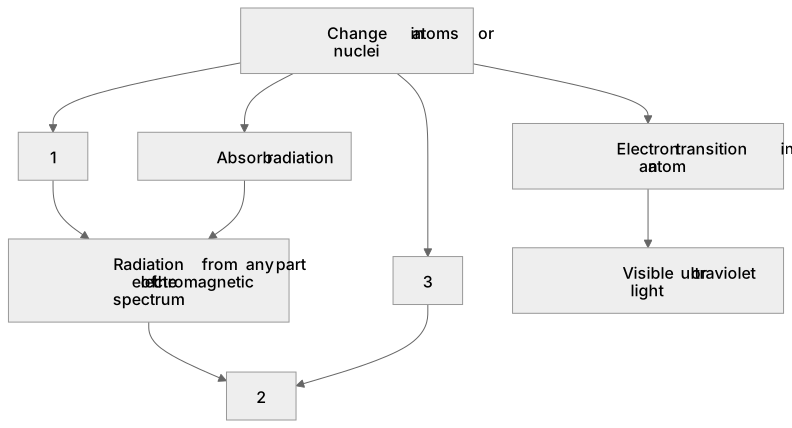
1Box 1
2Box 2
3Box 3
There is more to this lesson
The full lesson goes on to check your understanding and help you earn the marks. Create a free account to carry on, with your progress saved.
A week of Premium from your first lesson · Then the free plan continues · No card, no charge
Test your understanding of Radioactive emissions: recall that changes in atoms and nuclei can also generate and absorb radiations over a wide frequency range (to include: an understanding that these types of radiation may be from any part of the electromagnetic spectrum which includes gamma rays)
Active recall beats re-reading. Take an instant quiz now to test what you’ve learned and lock it into long-term memory.
A week of Premium from your first lesson · Then the free plan continues · No card, no charge