OCR · GCSE · Physics
Course version: J249 · Version from Sept 2018
Explain that for some resistors the value of R remains constant but that…
Full specification wording
Simple circuits: explain that for some resistors the value of R remains constant but that in others it can change as the current changes
This criterion asks you to explain, not just state, why resistance can stay the same or change.
Checked against the OCR J249 specification (opens in a new tab) on .
- Point 8 of 14
- 4 key terms
Study notes
From the checked teaching notes for this specification point.
The idea
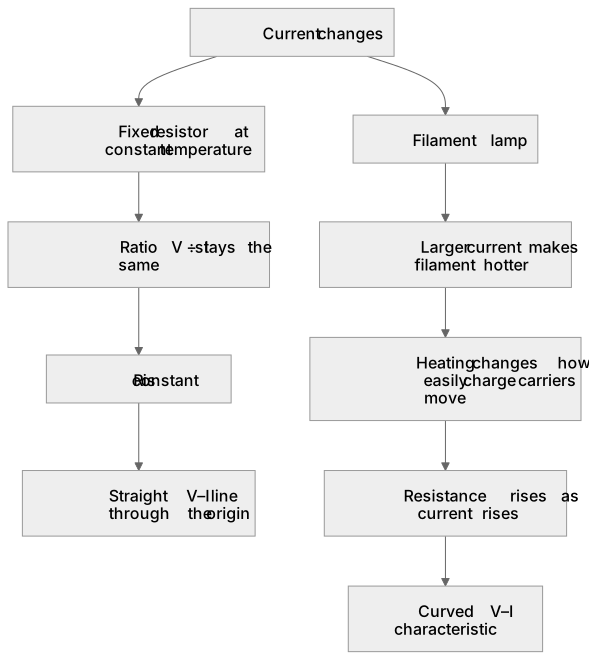
This criterion asks you to explain, not just state, why resistance can stay the same or change. For a fixed resistor at constant temperature, the ratio V ÷ I stays the same as current changes, so its V–I graph is a straight line through the origin and R is constant. In a filament lamp, a larger current makes the filament hotter, which increases its resistance, so the graph curves and R rises as current rises. A thermistor's resistance falls as its temperature rises. Explain the mechanism: heating changes how easily charge carriers move through the material, altering resistance. Link the shape of the graph to whether R is constant or changing.
What earns the marks
- Explains that a fixed resistor keeps a constant resistance because the ratio of potential difference to current stays the same.
- Explains that in some components a changing current alters temperature, which changes the resistance.
- Links a straight V–I line through the origin to a constant resistance.
- Links a curved V–I characteristic to a resistance that changes as current changes.
Common mistakes and how to put them right
Describes the graph shape without explaining why resistance changes.
Put it right: Link the shape to the heating mechanism.
Claims resistance always stays constant for every component.
Put it right: Explain that some components change resistance as current changes.
Says a filament lamp's resistance falls as current rises.
Put it right: Explain that heating raises its resistance.
Exam tips
- Use the word 'because' to connect the observation to the mechanism.
- Refer to the gradient or ratio of the V–I graph when explaining constant resistance.
- Name the component and the physical change, such as heating, that alters resistance.
Try the lesson
The start of the Simple circuits: explain that for some resistors the value of R remains constant but that in others it can change as the current changes lesson, made from checked teaching notes for this specification point.
Have a go first
Which statement describes a component whose resistance changes as the current through it changes?
Listen
This criterion asks you to explain, not just state, why resistance can stay the same or change. For a fixed resistor at constant temperature, the ratio V ÷ I stays the same as current changes, so its V–I graph is a straight line through the origin and R is constant. In a filament lamp, a larger current makes the filament hotter, which increases its resistance, so the graph curves and R rises as current rises. A thermistor's resistance falls as its temperature rises. Explain the mechanism: heating changes how easily charge carriers move through the material, altering resistance. Link the shape of the graph to whether R is constant or changing. A strong answer earns marks for these points. Explains that a fixed resistor keeps a constant resistance because the ratio of potential difference to current stays the same. Explains that in some components a changing current alters temperature, which changes the resistance. Links a straight V–I line through the origin to a constant resistance. Links a curved V–I characteristic to a resistance that changes as current changes. Exam tip: Use the word 'because' to connect the observation to the mechanism.
See it
Key words
Say what each word means before you turn the card.
Constant resistance
Try answering aloud or in your head before turning the card.
Heating effect on resistance
Try answering aloud or in your head before turning the card.
V–I characteristic graphs
Try answering aloud or in your head before turning the card.
Explaining mechanisms
Try answering aloud or in your head before turning the card.
See every definition
- Constant resistance
- A fixed resistor keeps this because the ratio of potential difference to current stays the same as current changes.
- Heating effect on resistance
- A larger current makes the filament hotter, which increases its resistance, so resistance rises as current rises.
- V–I characteristic graphs
- A straight line through the origin shows constant resistance, while a curved graph shows resistance that changes as current changes.
- Explaining mechanisms
- Heating changes how easily charge carriers move through the material, altering resistance, so the shape of the graph is linked to whether resistance is constant or changing.
Label the diagram
Some boxes have lost their names. Pick the right name for each number.
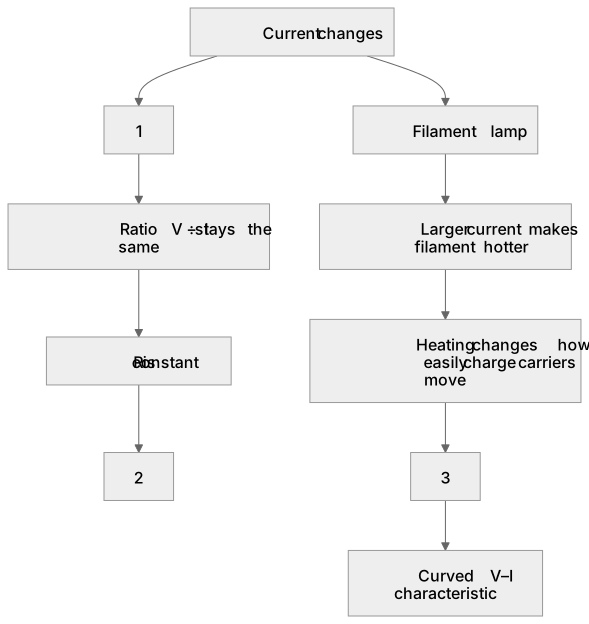
1Box 1
2Box 2
3Box 3
There is more to this lesson
The full lesson goes on to check your understanding and help you earn the marks. Create a free account to carry on, with your progress saved.
A week of Premium from your first lesson · Then the free plan continues · No card, no charge
Test your understanding of Simple circuits: explain that for some resistors the value of R remains constant but that in others it can change as the current changes
Active recall beats re-reading. Take an instant quiz now to test what you’ve learned and lock it into long-term memory.
A week of Premium from your first lesson · Then the free plan continues · No card, no charge