OCR · GCSE · Physics
Course version: J249 · Version from Sept 2018
Describe that charge is a property of all matter and that there are…
Full specification wording
Static and charge: describe that charge is a property of all matter and that there are positive and negative charges (to include: the understanding that in most bodies there are an equal number of positive and negative charges resulting in the body having zero net charge)
Charge is a property that every form of matter possesses, because matter is built from particles that carry charge.
Checked against the OCR J249 specification (opens in a new tab) on .
- Point 2 of 8
- 4 key terms
Study notes
From the checked teaching notes for this specification point.
The idea
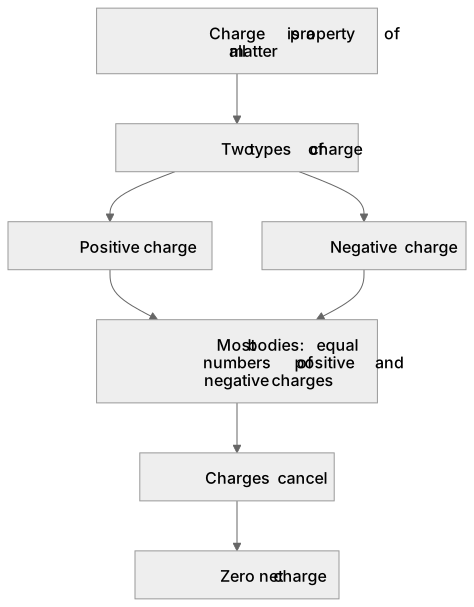
Charge is a property that every form of matter possesses, because matter is built from particles that carry charge. Two kinds of charge exist: positive and negative. In a neutral body the total amount of positive charge equals the total amount of negative charge, so the charges cancel and the net charge is zero. For example, an atom has positively charged protons in its nucleus and negatively charged electrons around it; when the numbers balance, the atom is neutral overall. A body becomes charged only when these quantities become unequal, for instance when electrons are transferred to or from it. When answering a multiple-choice question, decide whether the option correctly states that charge belongs to all matter, that there are two types, and that equal numbers give zero net charge.
What earns the marks
- States that charge is a property of all matter, not only of certain special materials.
- Identifies that charge exists in two types, positive and negative.
- Explains that in most bodies the number of positive charges equals the number of negative charges.
- Concludes that equal numbers of positive and negative charges give a body zero net charge.
Common mistakes and how to put them right
Claims that only some materials contain charge.
Put it right by stating that charge is a property of all matter.
Assumes a neutral body contains no charge at all.
Put it right by explaining that it contains equal positive and negative charge giving zero net charge.
Treats positive and negative charges as adding to a larger total.
Put it right by explaining that they cancel when equal in number.
Exam tips
- Read each option for the two ideas needed: charge belongs to all matter, and equal positive and negative charges cancel.
- Reject any option that says a neutral object has no charged particles inside it.
- Use the word net when describing the overall charge of a balanced body.
Try the lesson
The start of the Static and charge: describe that charge is a property of all matter and that there are positive and negative charges (to include: the understanding that in most bodies there are an equal number of positive and negative charges resulting in the body having zero net charge) lesson, made from checked teaching notes for this specification point.
Have a go first
Which statement about charge in everyday objects is correct?
Listen
Charge is a property that every form of matter possesses, because matter is built from particles that carry charge. Two kinds of charge exist: positive and negative. In a neutral body the total amount of positive charge equals the total amount of negative charge, so the charges cancel and the net charge is zero. For example, an atom has positively charged protons in its nucleus and negatively charged electrons around it; when the numbers balance, the atom is neutral overall. A body becomes charged only when these quantities become unequal, for instance when electrons are transferred to or from it. When answering a multiple-choice question, decide whether the option correctly states that charge belongs to all matter, that there are two types, and that equal numbers give zero net charge. A strong answer earns marks for these points. States that charge is a property of all matter, not only of certain special materials. Identifies that charge exists in two types, positive and negative. Explains that in most bodies the number of positive charges equals the number of negative charges. Concludes that equal numbers of positive and negative charges give a body zero net charge. A common slip: Claims that only some materials contain charge. Instead, stating that charge is a property of all matter. Exam tip: Read each option for the two ideas needed: charge belongs to all matter, and equal positive and negative charges cancel.
See it
Key words
Say what each word means before you turn the card.
Charge as a universal property of matter
Try answering aloud or in your head before turning the card.
Positive and negative charge
Try answering aloud or in your head before turning the card.
Equal numbers giving zero net charge
Try answering aloud or in your head before turning the card.
Neutral bodies and cancellation of charge
Try answering aloud or in your head before turning the card.
See every definition
- Charge as a universal property of matter
- Charge is a property that every form of matter possesses, because matter is built from particles that carry charge.
- Positive and negative charge
- Two kinds of charge exist, and charge exists in two types, positive and negative.
- Equal numbers giving zero net charge
- In a neutral body the total amount of positive charge equals the total amount of negative charge, so the charges cancel and the net charge is zero.
- Neutral bodies and cancellation of charge
- A body with equal numbers of positive and negative charges has zero net charge, because the charges cancel when equal in number.
Label the diagram
Some boxes have lost their names. Pick the right name for each number.
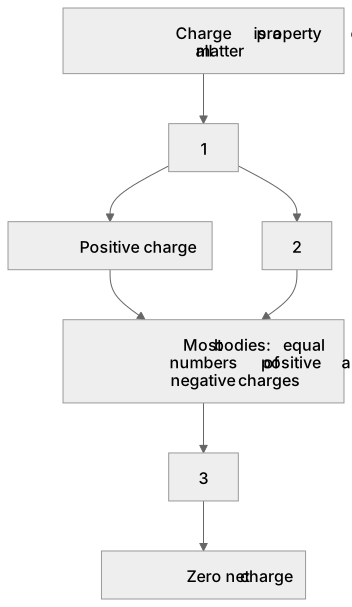
1Box 1
2Box 2
3Box 3
There is more to this lesson
The full lesson goes on to check your understanding and help you earn the marks. Create a free account to carry on, with your progress saved.
A week of Premium from your first lesson · Then the free plan continues · No card, no charge
Test your understanding of Static and charge: describe that charge is a property of all matter and that there are positive and negative charges (to include: the understanding that in most bodies there are an equal number of positive and negative charges resulting in the body having zero net charge)
Active recall beats re-reading. Take an instant quiz now to test what you’ve learned and lock it into long-term memory.
A week of Premium from your first lesson · Then the free plan continues · No card, no charge