OCR · GCSE · Physics
Course version: J249 · Version from Sept 2018
Describe the production of static electricity, and sparking, by rubbing…
Full specification wording
Static and charge: describe the production of static electricity, and sparking, by rubbing surfaces, and evidence that charged objects exert forces of attraction or repulsion on one another when not in contact (to include: the understanding that static charge only builds up on insulators)
Static electricity is produced when two different insulating surfaces are rubbed together.
Checked against the OCR J249 specification (opens in a new tab) on .
- Point 3 of 8
- 4 key terms
Study notes
From the checked teaching notes for this specification point.
The idea
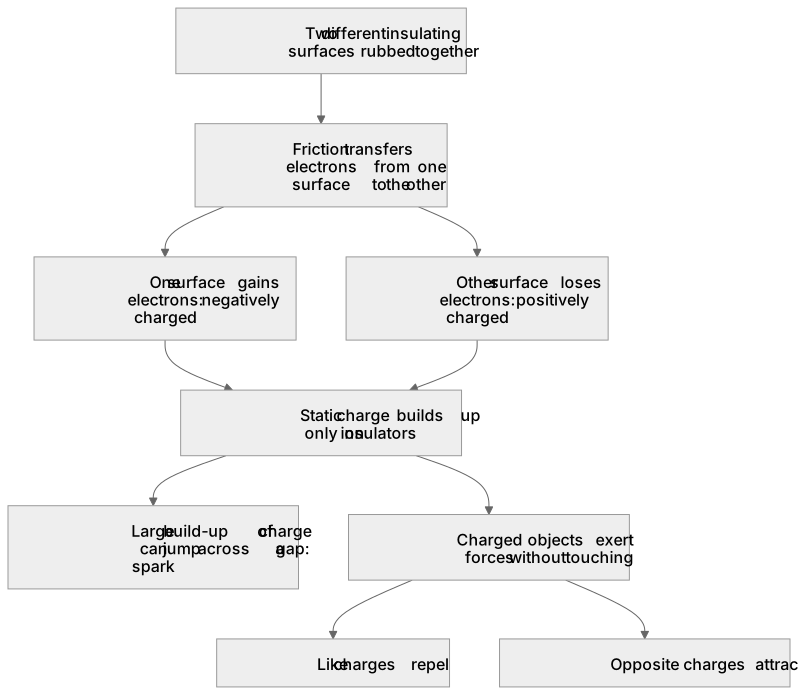
Static electricity is produced when two different insulating surfaces are rubbed together. Friction transfers electrons from one surface to the other, so one surface gains electrons and becomes negatively charged while the other loses electrons and becomes positively charged. Static charge builds up only on insulators, because in a conductor the charge would flow away. A spark can occur when the built-up charge is large enough to jump across a gap, for example from a charged object to a conductor. Charged objects also exert forces on each other without touching: like charges repel and opposite charges attract. Evidence for this is seen when a charged rod attracts small pieces of paper or repels another rod of the same charge at a distance. In a multiple-choice question, check that the option names rubbing, insulator build-up, sparking and non-contact forces correctly.
What earns the marks
- Describes that rubbing two different insulating surfaces together transfers electrons and produces static charge.
- Explains that static charge builds up only on insulators because charge cannot flow away as it would in a conductor.
- States that a spark occurs when built-up static charge jumps across a gap.
- Gives evidence that charged objects exert attraction or repulsion on each other without touching, such as a charged rod attracting small pieces of paper.
Common mistakes and how to put them right
Claims that static charge builds up on metals.
Put it right by stating that static charge builds up only on insulators.
Says charged objects only affect each other on contact.
Put it right by describing attraction or repulsion observed at a distance.
Describes rubbing as creating new charge from nothing.
Put it right by explaining that electrons are transferred between the surfaces.
Exam tips
- Look for the word insulator when an option describes where static charge builds up.
- Check that an option about forces mentions attraction or repulsion without contact.
- Link sparking to a large build-up of charge jumping across a gap.
Try the lesson
The start of the Static and charge: describe the production of static electricity, and sparking, by rubbing surfaces, and evidence that charged objects exert forces of attraction or repulsion on one another when not in contact (to include: the understanding that static charge only builds up on insulators) lesson, made from checked teaching notes for this specification point.
Have a go first
A plastic rod is rubbed with a dry cloth and then held near a thin stream of water from a tap. The stream bends towards the rod. What does this show about the rod?
Listen
Static electricity is produced when two different insulating surfaces are rubbed together. Friction transfers electrons from one surface to the other, so one surface gains electrons and becomes negatively charged while the other loses electrons and becomes positively charged. Static charge builds up only on insulators, because in a conductor the charge would flow away. A spark can occur when the built-up charge is large enough to jump across a gap, for example from a charged object to a conductor. Charged objects also exert forces on each other without touching: like charges repel and opposite charges attract. Evidence for this is seen when a charged rod attracts small pieces of paper or repels another rod of the same charge at a distance. In a multiple-choice question, check that the option names rubbing, insulator build-up, sparking and non-contact forces correctly. A strong answer earns marks for these points. Describes that rubbing two different insulating surfaces together transfers electrons and produces static charge. Explains that static charge builds up only on insulators because charge cannot flow away as it would in a conductor. States that a spark occurs when built-up static charge jumps across a gap. Gives evidence that charged objects exert attraction or repulsion on each other without touching, such as a charged rod attracting small pieces of paper. A common slip: Claims that static charge builds up on metals. Instead, stating that static charge builds up only on insulators. Exam tip: Look for the word insulator when an option describes where static charge builds up.
See it
Key words
Say what each word means before you turn the card.
Production of static electricity by rubbing insulators
Try answering aloud or in your head before turning the card.
Transfer of electrons between surfaces
Try answering aloud or in your head before turning the card.
Sparking from built-up charge
Try answering aloud or in your head before turning the card.
Non-contact forces of attraction and repulsion
Try answering aloud or in your head before turning the card.
See every definition
- Production of static electricity by rubbing insulators
- Two different insulating surfaces are rubbed together, and friction transfers electrons from one surface to the other, producing static charge.
- Transfer of electrons between surfaces
- Friction moves electrons from one surface to the other, so one surface gains electrons and becomes negatively charged while the other loses electrons and becomes positively charged.
- Sparking from built-up charge
- A spark can occur when the built-up charge is large enough to jump across a gap, for example from a charged object to a conductor.
- Non-contact forces of attraction and repulsion
- Charged objects exert forces on each other without touching: like charges repel and opposite charges attract.
Label the diagram
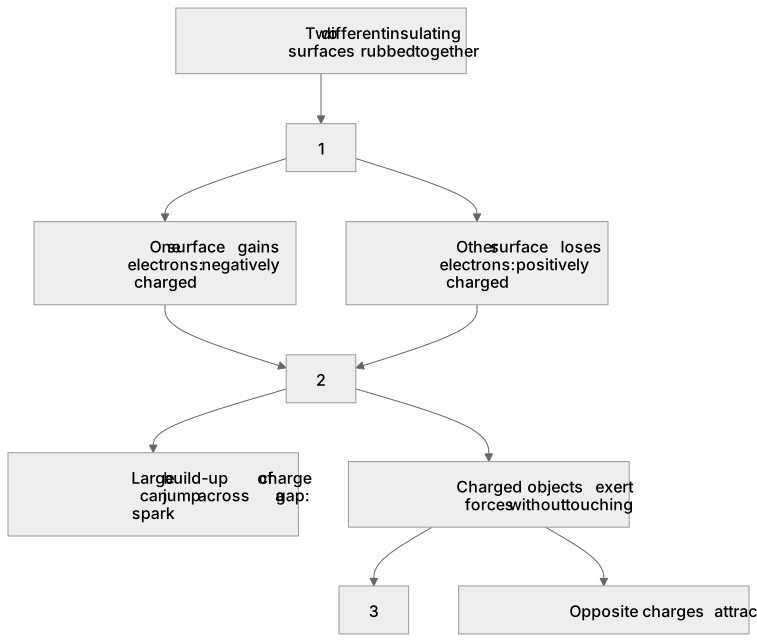
Some boxes have lost their names. Pick the right name for each number.
1Box 1
2Box 2
3Box 3
There is more to this lesson
The full lesson goes on to check your understanding and help you earn the marks. Create a free account to carry on, with your progress saved.
A week of Premium from your first lesson · Then the free plan continues · No card, no charge
Test your understanding of Static and charge: describe the production of static electricity, and sparking, by rubbing surfaces, and evidence that charged objects exert forces of attraction or repulsion on one another when not in contact (to include: the understanding that static charge only builds up on insulators)
Active recall beats re-reading. Take an instant quiz now to test what you’ve learned and lock it into long-term memory.
A week of Premium from your first lesson · Then the free plan continues · No card, no charge