OCR · GCSE · Physics
Course version: J249 · Version from Sept 2018
Recall that current is a rate of flow of charge (electrons) and the…
Full specification wording
Static and charge: recall that current is a rate of flow of charge (electrons) and the conditions needed for charge to flow (to include: conditions for charge to flow: source of potential difference and a closed circuit)
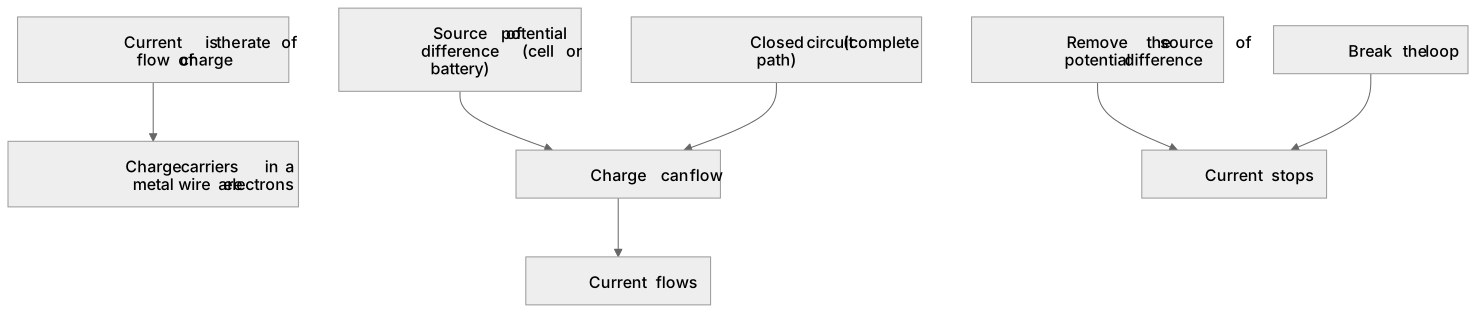
Electric current measures how much charge passes a point each second, so a current of 2 A means 2 coulombs of charge flow past that point every second.
Checked against the OCR J249 specification (opens in a new tab) on .
- Point 6 of 8
- 4 key terms
Study notes
From the checked teaching notes for this specification point.
The idea
Electric current measures how much charge passes a point each second, so a current of 2 A means 2 coulombs of charge flow past that point every second. In a metal wire the moving charges are electrons, which drift through the wire while the current direction is taken as opposite to their motion. Charge flows only when two conditions are met together: there must be a source of potential difference, such as a cell or battery, to push the charge, and there must be a closed circuit so charge can travel all the way round. Break the loop with a switch or remove the cell and the current stops. A complete path with no source of potential difference also gives no current.
What earns the marks
- States that current is the rate of flow of charge, measured as charge passing a point per unit time.
- Identifies electrons as the charge carriers that flow in a metal wire.
- Names a source of potential difference, such as a cell or battery, as one condition for charge to flow.
- States that the circuit must be closed, forming a complete path, as the other condition for charge to flow.
- Recognises that removing the source of potential difference or breaking the loop stops the current.
Common mistakes and how to put them right
Confuses current with voltage.
Put it right: Keep current as the rate of flow of charge and potential difference as what drives it.
Claims charge flows in an open circuit.
Put it right: Require a closed loop for any steady current.
Says a closed circuit alone is enough.
Put it right: Add a source of potential difference as the second condition.
Describes current as the flow of positive charge in a metal wire.
Put it right: Identify electrons as the moving charges.
Exam tips
- Learn the two conditions as a pair and check each option against both before choosing.
- Link the word rate to per second so you can reject answers that describe a total amount of charge rather than a flow.
- When an option mentions only one condition, treat it as incomplete rather than fully correct.
Try the lesson
The start of the Static and charge: recall that current is a rate of flow of charge (electrons) and the conditions needed for charge to flow (to include: conditions for charge to flow: source of potential difference and a closed circuit) lesson, made from checked teaching notes for this specification point.
Have a go first
Which statement best describes electric current in a wire?
Listen
Electric current measures how much charge passes a point each second, so a current of 2 A means 2 coulombs of charge flow past that point every second. In a metal wire the moving charges are electrons, which drift through the wire while the current direction is taken as opposite to their motion. Charge flows only when two conditions are met together: there must be a source of potential difference, such as a cell or battery, to push the charge, and there must be a closed circuit so charge can travel all the way round. Break the loop with a switch or remove the cell and the current stops. A complete path with no source of potential difference also gives no current. A strong answer earns marks for these points. States that current is the rate of flow of charge, measured as charge passing a point per unit time. Identifies electrons as the charge carriers that flow in a metal wire. Names a source of potential difference, such as a cell or battery, as one condition for charge to flow. States that the circuit must be closed, forming a complete path, as the other condition for charge to flow. Exam tip: Learn the two conditions as a pair and check each option against both before choosing.
See it
Key words
Say what each word means before you turn the card.
Current
Try answering aloud or in your head before turning the card.
Electrons
Try answering aloud or in your head before turning the card.
Source of potential difference
Try answering aloud or in your head before turning the card.
Closed circuit
Try answering aloud or in your head before turning the card.
See every definition
- Current
- A rate of flow of charge, carried by electrons.
- Electrons
- The charge carriers that flow in a metal wire.
- Source of potential difference
- One condition for charge to flow, such as a cell or battery, which pushes the charge.
- Closed circuit
- The other condition for charge to flow, forming a complete path so charge can travel all the way round.
Label the diagram
Some boxes have lost their names. Pick the right name for each number.
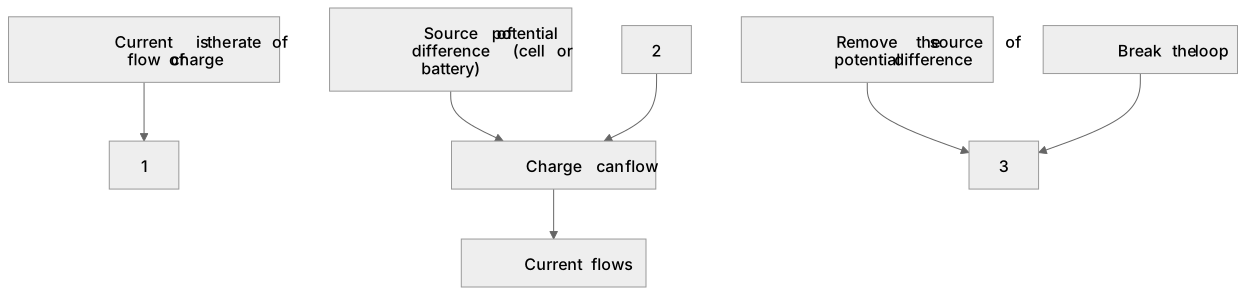
1Box 1
2Box 2
3Box 3
There is more to this lesson
The full lesson goes on to check your understanding and help you earn the marks. Create a free account to carry on, with your progress saved.
A week of Premium from your first lesson · Then the free plan continues · No card, no charge
Test your understanding of Static and charge: recall that current is a rate of flow of charge (electrons) and the conditions needed for charge to flow (to include: conditions for charge to flow: source of potential difference and a closed circuit)
Active recall beats re-reading. Take an instant quiz now to test what you’ve learned and lock it into long-term memory.
A week of Premium from your first lesson · Then the free plan continues · No card, no charge