OCR · GCSE · Physics
Course version: J249 · Version from Sept 2018
Recall that current has the same value at any point in a single closed loop
Full specification wording
Static and charge: recall that current has the same value at any point in a single closed loop
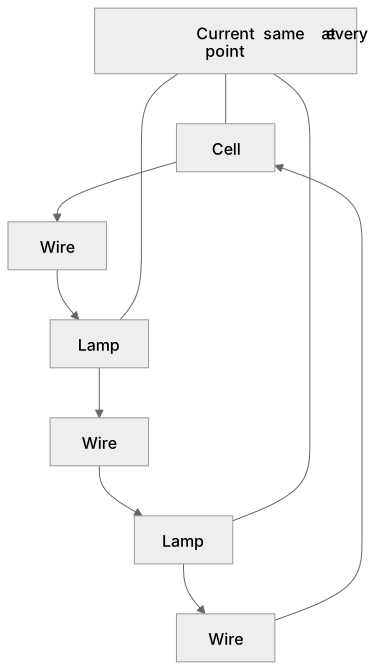
In a single closed loop, charge is not used up as it travels round, so the current is the same at every point.
Checked against the OCR J249 specification (opens in a new tab) on .
- Point 7 of 8
- 4 key terms
Study notes
From the checked teaching notes for this specification point.
The idea
In a single closed loop, charge is not used up as it travels round, so the current is the same at every point. If 0.5 A leaves a cell, then 0.5 A passes through each lamp, each wire and back into the cell. This follows because charge is conserved: the rate at which charge enters any section equals the rate at which it leaves. A common trap is to think current is smaller after a component because energy has been transferred, but it is energy, not charge, that is transferred to the surroundings. The rule applies to one loop only; where a circuit branches, the current splits between the branches.
What earns the marks
- States that the current is the same at every point in a single closed loop.
- Explains that charge is conserved, so the rate of flow entering a section equals the rate leaving it.
- Distinguishes current from energy, noting that components transfer energy without reducing the current.
- Applies the rule to a series loop, giving the same ammeter reading at different positions.
- Recognises that the rule applies to a single loop and that current divides where a circuit branches.
Common mistakes and how to put them right
Assumes current decreases after each component.
Put it right: Keep the current equal all round a single loop.
Confuses current with energy and says a lamp uses up current.
Put it right: State that the lamp transfers energy while the current stays the same.
Applies the single-loop rule to a parallel circuit.
Put it right: Note that current splits between branches there.
Thinks the current is larger near the cell.
Put it right: Give the same value at every point in the loop.
Exam tips
- Picture an ammeter moved to different positions in a series loop and expect identical readings.
- Use the phrase charge is conserved to justify equal current rather than relying on intuition.
- Check whether the circuit is a single loop or has branches before applying the rule.
Try the lesson
The start of the Static and charge: recall that current has the same value at any point in a single closed loop lesson, made from checked teaching notes for this specification point.
Have a go first
A series circuit forms one closed loop with a cell and two bulbs. The current leaving the cell is 1.5 A. What is the current entering the cell on its return path?
Listen
In a single closed loop, charge is not used up as it travels round, so the current is the same at every point. If 0.5 A leaves a cell, then 0.5 A passes through each lamp, each wire and back into the cell. This follows because charge is conserved: the rate at which charge enters any section equals the rate at which it leaves. A common trap is to think current is smaller after a component because energy has been transferred, but it is energy, not charge, that is transferred to the surroundings. The rule applies to one loop only; where a circuit branches, the current splits between the branches. A strong answer earns marks for these points. States that the current is the same at every point in a single closed loop. Explains that charge is conserved, so the rate of flow entering a section equals the rate leaving it. Distinguishes current from energy, noting that components transfer energy without reducing the current. Applies the rule to a series loop, giving the same ammeter reading at different positions. Exam tip: Picture an ammeter moved to different positions in a series loop and expect identical readings.
See it
Key words
Say what each word means before you turn the card.
Current in a series loop
Try answering aloud or in your head before turning the card.
Conservation of charge
Try answering aloud or in your head before turning the card.
Current versus energy transfer
Try answering aloud or in your head before turning the card.
Branching circuits
Try answering aloud or in your head before turning the card.
See every definition
- Current in a series loop
- In a single closed loop, the current is the same at every point, so the same value is found at any point in the loop.
- Conservation of charge
- Charge is not used up as it travels round, so the rate at which charge enters any section equals the rate at which it leaves.
- Current versus energy transfer
- Components transfer energy to the surroundings without reducing the current, so it is energy, not charge, that is transferred.
- Branching circuits
- Where a circuit branches, the current splits between the branches, so the single-loop rule applies to one loop only.
There is more to this lesson
The full lesson goes on to check your understanding and help you earn the marks. Create a free account to carry on, with your progress saved.
A week of Premium from your first lesson · Then the free plan continues · No card, no charge
Test your understanding of Static and charge: recall that current has the same value at any point in a single closed loop
Active recall beats re-reading. Take an instant quiz now to test what you’ve learned and lock it into long-term memory.
A week of Premium from your first lesson · Then the free plan continues · No card, no charge