OCR · GCSE · Physics
Course version: J249 · Version from Sept 2018
The particle model: define density
Density tells you how much mass is packed into a given volume of a material.
Checked against the OCR J249 specification (opens in a new tab) on .
- Point 5 of 7
- 4 key terms
Study notes
From the checked teaching notes for this specification point.
The idea
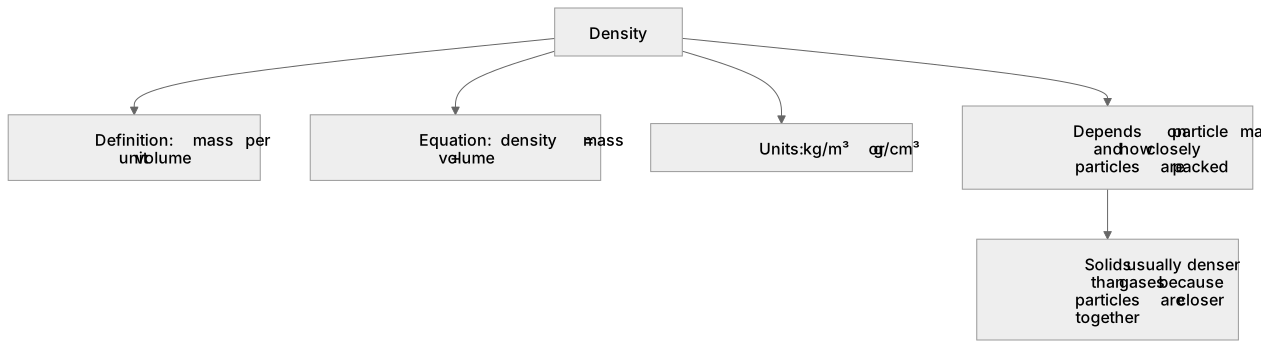
Density tells you how much mass is packed into a given volume of a material. The definition is mass per unit volume, written as density = mass ÷ volume, with units such as kg/m³ or g/cm³. A material with high density, such as iron, has a lot of mass in each cubic metre; a low-density material, such as air, has little. Density depends on both the mass of the particles and how closely they are packed, which links to the particle model: solids are usually denser than gases because their particles are closer together. In a multiple-choice question, pick the option that states mass per unit volume, not mass alone or volume alone.
What earns the marks
- Defines density as mass per unit volume.
- States the relationship density = mass ÷ volume.
- Identifies suitable units such as kg/m³ or g/cm³.
- Links density to how closely particles are packed and the mass of those particles.
Common mistakes and how to put them right
Defines density as volume per unit mass.
Put it right: State it as mass per unit volume.
Gives mass alone as the definition.
Put it right: Include the volume the mass occupies.
Omits units from the definition.
Put it right: Quote kg/m³ or g/cm³ as examples.
Exam tips
- Learn the phrase 'mass per unit volume' word for word as the definition.
- Recall the equation density = mass ÷ volume so you can rearrange it if needed.
- Check units in each option: density must combine a mass unit with a volume unit.
Try the lesson
The start of the The particle model: define density lesson, made from checked teaching notes for this specification point.
Have a go first
Which quantity is found by dividing the mass of a sample by its volume?
Listen
Density tells you how much mass is packed into a given volume of a material. The definition is mass per unit volume, written as density = mass ÷ volume, with units such as kg/m³ or g/cm³. A material with high density, such as iron, has a lot of mass in each cubic metre; a low-density material, such as air, has little. Density depends on both the mass of the particles and how closely they are packed, which links to the particle model: solids are usually denser than gases because their particles are closer together. In a multiple-choice question, pick the option that states mass per unit volume, not mass alone or volume alone. A strong answer earns marks for these points. Defines density as mass per unit volume. States the relationship density = mass ÷ volume. Identifies suitable units such as kg/m³ or g/cm³. Links density to how closely particles are packed and the mass of those particles. Exam tip: Learn the phrase 'mass per unit volume' word for word as the definition.
See it
Key words
Say what each word means before you turn the card.
Density
Try answering aloud or in your head before turning the card.
Density equation
Try answering aloud or in your head before turning the card.
Units of density
Try answering aloud or in your head before turning the card.
Particle packing
Try answering aloud or in your head before turning the card.
See every definition
- Density
- Mass per unit volume, telling you how much mass is packed into a given volume of a material.
- Density equation
- The relationship written as density = mass ÷ volume.
- Units of density
- Units such as kg/m³ or g/cm³, combining a mass unit with a volume unit.
- Particle packing
- How closely particles are packed, which with the mass of the particles density depends on.
Label the diagram
Some boxes have lost their names. Pick the right name for each number.
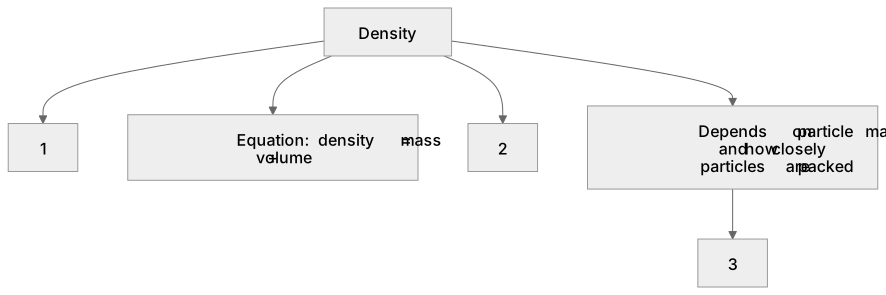
1Box 1
2Box 2
3Box 3
There is more to this lesson
The full lesson goes on to check your understanding and help you earn the marks. Create a free account to carry on, with your progress saved.
A week of Premium from your first lesson · Then the free plan continues · No card, no charge
Test your understanding of The particle model: define density
Active recall beats re-reading. Take an instant quiz now to test what you’ve learned and lock it into long-term memory.
A week of Premium from your first lesson · Then the free plan continues · No card, no charge