OCR · GCSE · Physics
Course version: J249 · Version from Sept 2018
Recall the typical size (order of magnitude) of atoms and small molecules…
Full specification wording
The particle model: recall the typical size (order of magnitude) of atoms and small molecules (to include: knowledge that it is typically 1 × 10⁻¹⁰m)
Atoms and small molecules are extremely small, and physicists describe their typical size as an order of magnitude rather than an exact figure.
Checked against the OCR J249 specification (opens in a new tab) on .
- Point 4 of 7
- 2 key terms
Study notes
From the checked teaching notes for this specification point.
The idea
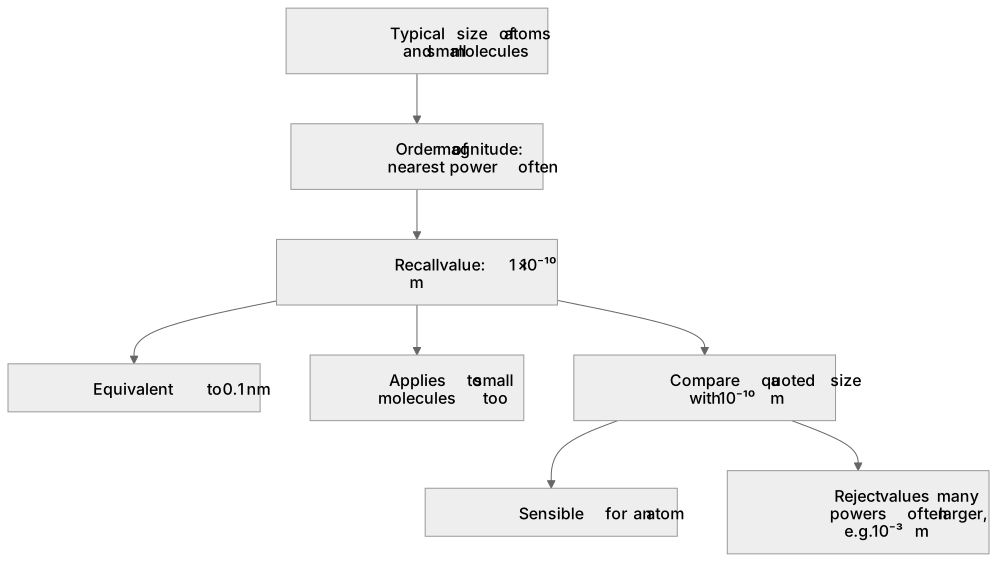
Atoms and small molecules are extremely small, and physicists describe their typical size as an order of magnitude rather than an exact figure. The value to recall is about 1 × 10⁻¹⁰ m, which is 0.1 nm, or one ten-billionth of a metre. An order of magnitude means the nearest power of ten, so a diameter of roughly 10⁻¹⁰ m tells you the scale: about ten million atoms would fit across a one-millimetre gap. Small molecules such as water are of a similar order, typically a few times 10⁻¹⁰ m across. Use this figure to judge whether a quoted size is sensible: a value like 10⁻³ m describes a grain of sand, not an atom.
What earns the marks
- Selects 1 × 10⁻¹⁰ m as the typical order of magnitude of an atom.
- Recognises that an order of magnitude is the nearest power of ten, not an exact measurement.
- Applies the same order of magnitude to small molecules as well as single atoms.
- Rejects values many powers of ten larger, such as 10⁻³ m, as the size of an atom.
Common mistakes and how to put them right
Confuses the order of magnitude with an exact atomic diameter.
Put it right: Treat 1 × 10⁻¹⁰ m as a typical scale.
Writes the size with a positive exponent.
Put it right: Use the negative exponent 10⁻¹⁰ m for a very small length.
Assumes molecules are far larger than atoms.
Put it right: Keep small molecules at a similar order of magnitude.
Exam tips
- Learn 1 × 10⁻¹⁰ m together with its equivalent 0.1 nm so either form is recognised.
- Check the power of ten first: an atom's size must be a very small fraction of a metre.
- Compare any quoted value with 10⁻¹⁰ m and reject answers that are thousands of times too big.
Try the lesson
The start of the The particle model: recall the typical size (order of magnitude) of atoms and small molecules (to include: knowledge that it is typically 1 × 10⁻¹⁰m) lesson, made from checked teaching notes for this specification point.
Have a go first
What is the typical order of magnitude of the diameter of an atom?
Listen
Atoms and small molecules are extremely small, and physicists describe their typical size as an order of magnitude rather than an exact figure. The value to recall is about 1 × 10⁻¹⁰ m, which is 0.1 nm, or one ten-billionth of a metre. An order of magnitude means the nearest power of ten, so a diameter of roughly 10⁻¹⁰ m tells you the scale: about ten million atoms would fit across a one-millimetre gap. Small molecules such as water are of a similar order, typically a few times 10⁻¹⁰ m across. Use this figure to judge whether a quoted size is sensible: a value like 10⁻³ m describes a grain of sand, not an atom. A strong answer earns marks for these points. Selects 1 × 10⁻¹⁰ m as the typical order of magnitude of an atom. Recognises that an order of magnitude is the nearest power of ten, not an exact measurement. Applies the same order of magnitude to small molecules as well as single atoms. Rejects values many powers of ten larger, such as 10⁻³ m, as the size of an atom. Exam tip: Learn 1 × 10⁻¹⁰ m together with its equivalent 0.1 nm so either form is recognised.
See it
Key words
Say what each word means before you turn the card.
Order of magnitude
Try answering aloud or in your head before turning the card.
Scale of atoms and small molecules
Try answering aloud or in your head before turning the card.
See every definition
- Order of magnitude
- The nearest power of ten, used to describe a typical size rather than an exact figure.
- Scale of atoms and small molecules
- Typically 1 × 10⁻¹⁰ m, which is 0.1 nm, or one ten-billionth of a metre.
Label the diagram
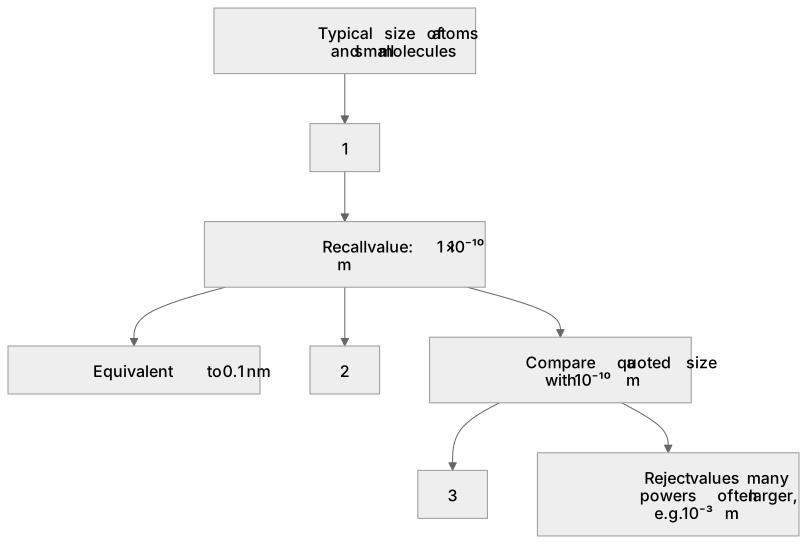
Some boxes have lost their names. Pick the right name for each number.
1Box 1
2Box 2
3Box 3
There is more to this lesson
The full lesson goes on to check your understanding and help you earn the marks. Create a free account to carry on, with your progress saved.
A week of Premium from your first lesson · Then the free plan continues · No card, no charge
Test your understanding of The particle model: recall the typical size (order of magnitude) of atoms and small molecules (to include: knowledge that it is typically 1 × 10⁻¹⁰m)
Active recall beats re-reading. Take an instant quiz now to test what you’ve learned and lock it into long-term memory.
A week of Premium from your first lesson · Then the free plan continues · No card, no charge