OCR · GCSE · Physics
Course version: J249 · Version from Sept 2018
Describe the atom as a positively charged nucleus surrounded by negatively…
Full specification wording
The particle model: describe the atom as a positively charged nucleus surrounded by negatively charged electrons, with the nuclear radius much smaller than that of the atom and with almost all of the mass in the nucleus
Build a mental picture of the atom as mostly empty space.
Checked against the OCR J249 specification (opens in a new tab) on .
- Point 3 of 7
- 4 key terms
Study notes
From the checked teaching notes for this specification point.
The idea
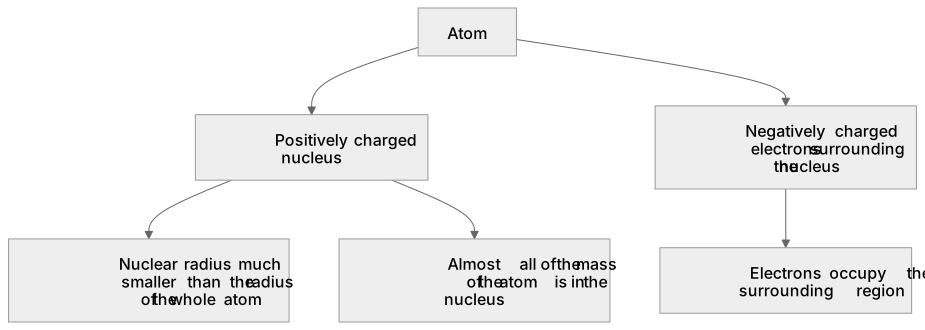
Build a mental picture of the atom as mostly empty space. At the centre sits a tiny nucleus carrying positive charge; around it, negatively charged electrons occupy the surrounding region. The nucleus is far smaller than the whole atom, so the atom's radius is set by where the electrons are, not by the nucleus. Despite its small size, the nucleus holds almost all of the atom's mass, because protons and neutrons are far heavier than electrons. A useful check: if the atom were a sports hall, the nucleus would be a speck near the centre. In a multiple-choice question, test each option against all three ideas — charge arrangement, relative size and mass distribution — and reject any option that puts most mass in the electrons or makes the nucleus comparable in size to the atom.
What earns the marks
- States that the nucleus is positively charged and the electrons are negatively charged.
- Explains that the nuclear radius is much smaller than the radius of the whole atom.
- States that almost all of the mass of the atom is concentrated in the nucleus.
- Rejects an option that places most of the atom's mass in the electrons or makes the nucleus the same size as the atom.
Common mistakes and how to put them right
Places most of the atom's mass in the electron cloud.
Put it right by stating that almost all mass is in the nucleus.
Treats the nucleus as roughly the same size as the atom.
Put it right by stating that the nuclear radius is much smaller.
Reverses the charges by calling the nucleus negative.
Put it right by stating that the nucleus is positive and electrons are negative.
Exam tips
- Read all options before choosing, since several may contain one true idea and one false one.
- Check each option against three separate facts: charge, relative size and where the mass sits.
- Eliminate options that contradict the idea that the atom is mostly empty space.
Try the lesson
The start of the The particle model: describe the atom as a positively charged nucleus surrounded by negatively charged electrons, with the nuclear radius much smaller than that of the atom and with almost all of the mass in the nucleus lesson, made from checked teaching notes for this specification point.
Have a go first
In a simple model of the atom, what is the electric charge of the nucleus?
Listen
Build a mental picture of the atom as mostly empty space. At the centre sits a tiny nucleus carrying positive charge; around it, negatively charged electrons occupy the surrounding region. The nucleus is far smaller than the whole atom, so the atom's radius is set by where the electrons are, not by the nucleus. Despite its small size, the nucleus holds almost all of the atom's mass, because protons and neutrons are far heavier than electrons. A useful check: if the atom were a sports hall, the nucleus would be a speck near the centre. In a multiple-choice question, test each option against all three ideas — charge arrangement, relative size and mass distribution — and reject any option that puts most mass in the electrons or makes the nucleus comparable in size to the atom. A strong answer earns marks for these points. States that the nucleus is positively charged and the electrons are negatively charged. Explains that the nuclear radius is much smaller than the radius of the whole atom. States that almost all of the mass of the atom is concentrated in the nucleus. Rejects an option that places most of the atom's mass in the electrons or makes the nucleus the same size as the atom. A common slip: Places most of the atom's mass in the electron cloud. Instead, stating that almost all mass is in the nucleus. Exam tip: Read all options before choosing, since several may contain one true idea and one false one.
See it
Key words
Say what each word means before you turn the card.
Structure of the atom
Try answering aloud or in your head before turning the card.
Electric charge of nucleus and electrons
Try answering aloud or in your head before turning the card.
Relative size of nucleus and atom
Try answering aloud or in your head before turning the card.
Distribution of mass in the atom
Try answering aloud or in your head before turning the card.
See every definition
- Structure of the atom
- A positively charged nucleus surrounded by negatively charged electrons.
- Electric charge of nucleus and electrons
- The nucleus is positively charged and the electrons are negatively charged.
- Relative size of nucleus and atom
- The nuclear radius is much smaller than the radius of the whole atom.
- Distribution of mass in the atom
- Almost all of the mass of the atom is concentrated in the nucleus.
Label the diagram
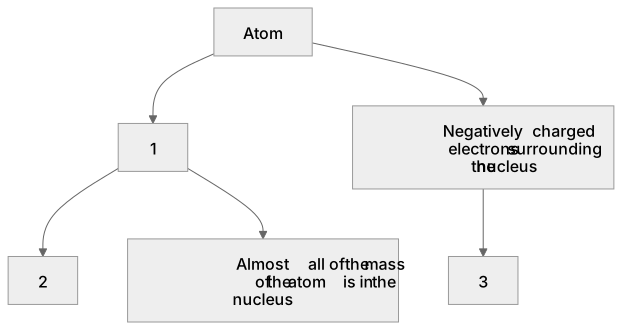
Some boxes have lost their names. Pick the right name for each number.
1Box 1
2Box 2
3Box 3
There is more to this lesson
The full lesson goes on to check your understanding and help you earn the marks. Create a free account to carry on, with your progress saved.
A week of Premium from your first lesson · Then the free plan continues · No card, no charge
Test your understanding of The particle model: describe the atom as a positively charged nucleus surrounded by negatively charged electrons, with the nuclear radius much smaller than that of the atom and with almost all of the mass in the nucleus
Active recall beats re-reading. Take an instant quiz now to test what you’ve learned and lock it into long-term memory.
A week of Premium from your first lesson · Then the free plan continues · No card, no charge