OCR · GCSE · Physics
Course version: J249 · Version from Sept 2018
Describe the different uses of nuclear radiations for exploration of…
Full specification wording
Uses and hazards: describe the different uses of nuclear radiations for exploration of internal organs, and for control or destruction of unwanted tissue (content found only in the physics separate science qualification)
Nuclear radiations are used in medicine in two broad ways.
Checked against the OCR J249 specification (opens in a new tab) on .
- Point 3 of 5
- 4 key terms
Study notes
From the checked teaching notes for this specification point.
The idea
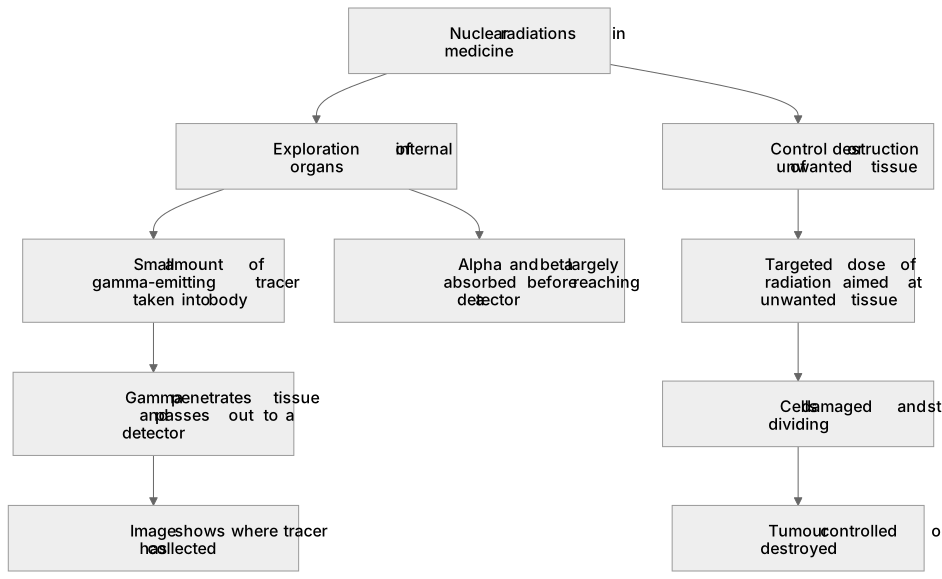
Nuclear radiations are used in medicine in two broad ways. For exploration of internal organs, a small amount of a gamma-emitting tracer is taken into the body and its radiation passes out through tissue to a detector, so an image shows where the tracer has collected; gamma is chosen because it penetrates tissue and leaves the body, while alpha and beta are largely absorbed before reaching a detector. For control or destruction of unwanted tissue, a targeted dose of radiation is aimed at the tissue so that its cells are damaged and stop dividing; this is how radiotherapy treats tumours. The same penetrating property that makes gamma useful for imaging also makes it useful for treatment, but the dose and targeting differ: imaging needs a tiny amount, treatment needs a controlled, larger dose aimed at the unwanted tissue while sparing healthy tissue.
What earns the marks
- Identifies gamma radiation as suitable for imaging internal organs because it penetrates tissue and can be detected outside the body.
- Explains that a tracer emitting radiation is taken into the body and its distribution is detected to build an image of an internal organ.
- States that radiation can be directed at unwanted tissue such as a tumour to damage its cells and control or destroy it.
- Distinguishes the small tracer amount used for exploration from the larger targeted dose used for treatment.
- Recognises that alpha and beta radiation are largely absorbed within the body and so are less useful for imaging from outside.
Common mistakes and how to put them right
Chooses alpha radiation for imaging because it is 'strong'.
Put it right by noting that alpha is absorbed within a few centimetres of tissue and cannot escape to a detector.
Assumes the same dose serves both imaging and treatment.
Put it right by separating a tiny tracer amount for exploration from a controlled larger dose for destroying tissue.
Treats radiation treatment as harmless to all cells.
Put it right by stating that the dose is aimed at unwanted tissue and healthy tissue is shielded as far as possible.
Exam tips
- Link each use to a property of the radiation: penetration for imaging, cell damage for treatment.
- Name the type of radiation you choose and justify it in one clause rather than just naming it.
- Keep the two uses clearly separated in your answer so each clause of the question is addressed.
Try the lesson
The start of the Uses and hazards: describe the different uses of nuclear radiations for exploration of internal organs, and for control or destruction of unwanted tissue (content found only in the physics separate science qualification) lesson, made from checked teaching notes for this specification point.
Have a go first
A patient is given a radioactive tracer that emits gamma rays. A detector outside the body is used to build up an image of an internal organ. Which property of gamma rays makes them suitable for this use?
Listen
Nuclear radiations are used in medicine in two broad ways. For exploration of internal organs, a small amount of a gamma-emitting tracer is taken into the body and its radiation passes out through tissue to a detector, so an image shows where the tracer has collected; gamma is chosen because it penetrates tissue and leaves the body, while alpha and beta are largely absorbed before reaching a detector. For control or destruction of unwanted tissue, a targeted dose of radiation is aimed at the tissue so that its cells are damaged and stop dividing; this is how radiotherapy treats tumours. The same penetrating property that makes gamma useful for imaging also makes it useful for treatment, but the dose and targeting differ: imaging needs a tiny amount, treatment needs a controlled, larger dose aimed at the unwanted tissue while sparing healthy tissue. A strong answer earns marks for these points. Identifies gamma radiation as suitable for imaging internal organs because it penetrates tissue and can be detected outside the body. Explains that a tracer emitting radiation is taken into the body and its distribution is detected to build an image of an internal organ. States that radiation can be directed at unwanted tissue such as a tumour to damage its cells and control or destroy it. Distinguishes the small tracer amount used for exploration from the larger targeted dose used for treatment. A common slip: Chooses alpha radiation for imaging because it is 'strong'. Instead, noting that alpha is absorbed within a few centimetres of tissue and cannot escape to a detector. Exam tip: Link each use to a property of the radiation: penetration for imaging, cell damage for treatment.
See it
Key words
Say what each word means before you turn the card.
Tracers and imaging of internal organs
Try answering aloud or in your head before turning the card.
Penetrating power of alpha, beta and gamma
Try answering aloud or in your head before turning the card.
Radiotherapy and destruction of unwanted tissue
Try answering aloud or in your head before turning the card.
Medical uses of nuclear radiation
Try answering aloud or in your head before turning the card.
See every definition
- Tracers and imaging of internal organs
- A small amount of a gamma-emitting tracer is taken into the body and its radiation passes out through tissue to a detector, so an image shows where the tracer has collected.
- Penetrating power of alpha, beta and gamma
- Gamma penetrates tissue and leaves the body, while alpha and beta are largely absorbed before reaching a detector.
- Radiotherapy and destruction of unwanted tissue
- A targeted dose of radiation is aimed at the tissue so that its cells are damaged and stop dividing, which is how tumours are treated.
- Medical uses of nuclear radiation
- Nuclear radiations are used in medicine for exploration of internal organs and for control or destruction of unwanted tissue.
Label the diagram
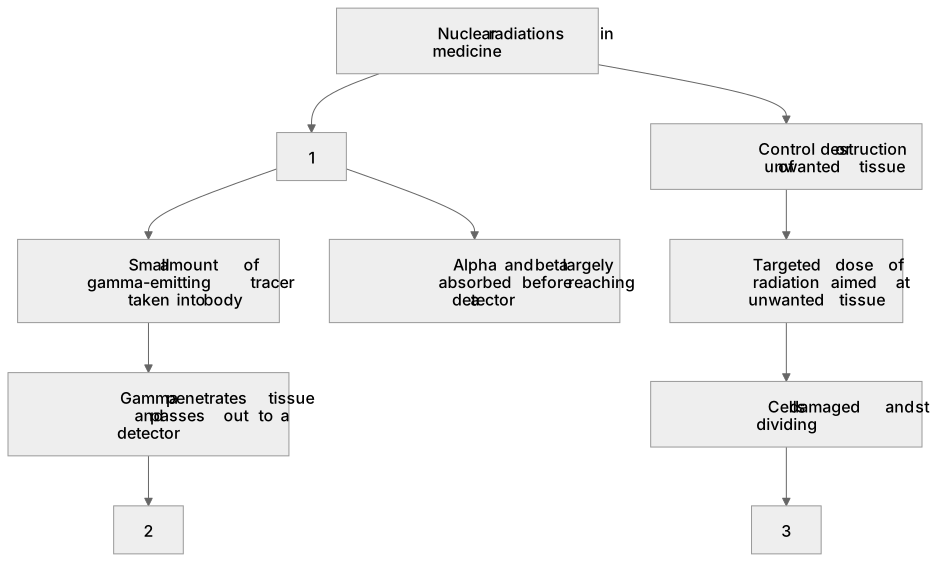
Some boxes have lost their names. Pick the right name for each number.
1Box 1
2Box 2
3Box 3
There is more to this lesson
The full lesson goes on to check your understanding and help you earn the marks. Create a free account to carry on, with your progress saved.
A week of Premium from your first lesson · Then the free plan continues · No card, no charge
Test your understanding of Uses and hazards: describe the different uses of nuclear radiations for exploration of internal organs, and for control or destruction of unwanted tissue (content found only in the physics separate science qualification)
Active recall beats re-reading. Take an instant quiz now to test what you’ve learned and lock it into long-term memory.
A week of Premium from your first lesson · Then the free plan continues · No card, no charge