OCR · GCSE · Physics
Course version: J249 · Version from Sept 2018
Explain why the hazards associated with radioactive material differ…
Full specification wording
Uses and hazards: explain why the hazards associated with radioactive material differ according to the half-life involved (content found only in the physics separate science qualification)
This content is assessed only in the physics separate science qualification, so treat it as separate-science scope even though the row is listed for both tiers.
Checked against the OCR J249 specification (opens in a new tab) on .
- Point 2 of 5
- 4 key terms
Study notes
From the checked teaching notes for this specification point.
The idea
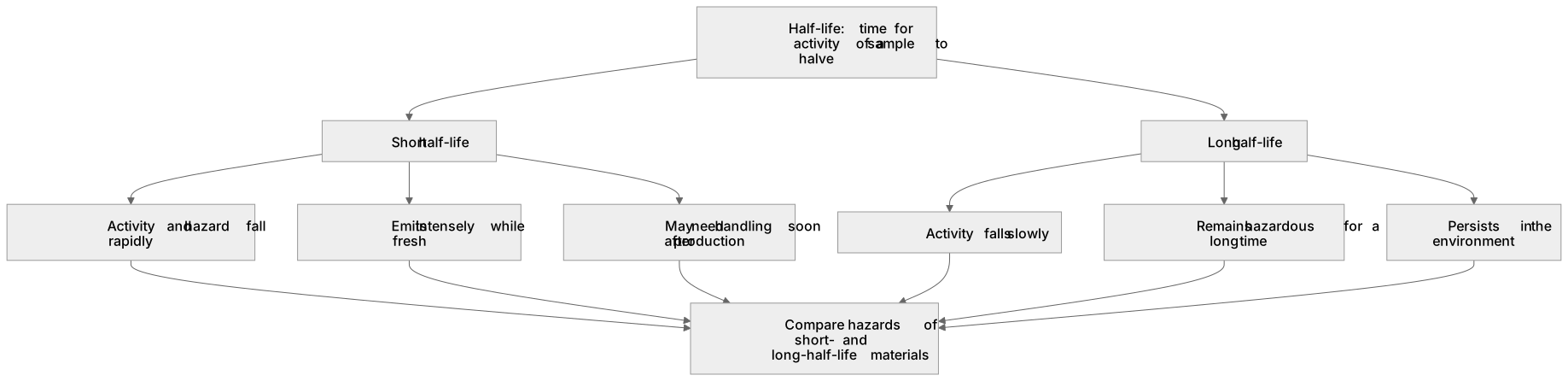
This content is assessed only in the physics separate science qualification, so treat it as separate-science scope even though the row is listed for both tiers. Half-life is the time for the activity of a sample to halve. A short half-life means the material decays quickly, so its activity and hazard fall rapidly, but it emits intensely while fresh and may need handling soon after production. A long half-life means activity falls slowly, so the material remains hazardous for a long time and persists in the environment. Explain the hazard by linking half-life to how long the material stays active and how intense the emission is at a given moment, using a comparison such as a short-half-life tracer versus a long-lived waste source.
What earns the marks
- Defines half-life as the time taken for the activity of a sample to halve.
- Explains that a short half-life gives a rapid fall in activity, so the hazard decreases quickly.
- Explains that a long half-life gives a slow fall in activity, so the material stays hazardous for a long period.
- Links half-life to persistence in the environment or the length of time precautions are needed.
- Compares two materials with different half-lives to show how the hazard differs.
Common mistakes and how to put them right
States that a short half-life always means a lower hazard.
Put it right: Explain that it emits intensely while fresh even though it decays quickly.
Confuses half-life with the time for all activity to stop.
Put it right: State that activity halves in each half-life and never reaches zero in this model.
Ignores the separate-science scope and treats the point as core content.
Put it right: Keep the explanation within the physics separate science qualification.
Exam tips
- Define half-life precisely before applying it to hazard.
- Use a paired example, one short and one long half-life, to make the comparison explicit.
- Separate the two ideas: intensity of emission now versus how long the hazard lasts.
Try the lesson
The start of the Uses and hazards: explain why the hazards associated with radioactive material differ according to the half-life involved (content found only in the physics separate science qualification) lesson, made from checked teaching notes for this specification point.
Have a go first
A spill of a radioisotope with a very long half-life is cleared up badly, leaving a trace on a floor. Why does this residue remain a hazard for a long time?
Listen
This content is assessed only in the physics separate science qualification, so treat it as separate-science scope even though the row is listed for both tiers. Half-life is the time for the activity of a sample to halve. A short half-life means the material decays quickly, so its activity and hazard fall rapidly, but it emits intensely while fresh and may need handling soon after production. A long half-life means activity falls slowly, so the material remains hazardous for a long time and persists in the environment. Explain the hazard by linking half-life to how long the material stays active and how intense the emission is at a given moment, using a comparison such as a short-half-life tracer versus a long-lived waste source. A strong answer earns marks for these points. Defines half-life as the time taken for the activity of a sample to halve. Explains that a short half-life gives a rapid fall in activity, so the hazard decreases quickly. Explains that a long half-life gives a slow fall in activity, so the material stays hazardous for a long period. Links half-life to persistence in the environment or the length of time precautions are needed. Exam tip: Define half-life precisely before applying it to hazard.
See it
Key words
Say what each word means before you turn the card.
Half-life
Try answering aloud or in your head before turning the card.
Short half-life
Try answering aloud or in your head before turning the card.
Long half-life
Try answering aloud or in your head before turning the card.
Separate-science scope
Try answering aloud or in your head before turning the card.
See every definition
- Half-life
- The time for the activity of a sample to halve.
- Short half-life
- The material decays quickly, so its activity and hazard fall rapidly, but it emits intensely while fresh.
- Long half-life
- Activity falls slowly, so the material remains hazardous for a long time and persists in the environment.
- Separate-science scope
- Content assessed only in the physics separate science qualification, treated as separate-science scope even though the row is listed for both tiers.
Label the diagram
Some boxes have lost their names. Pick the right name for each number.
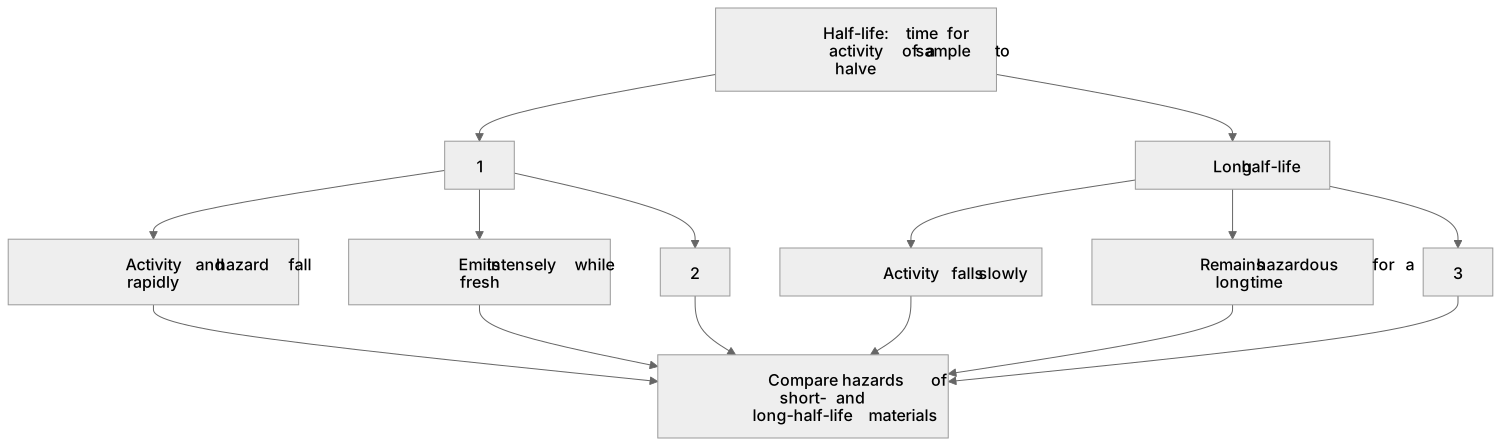
1Box 1
2Box 2
3Box 3
There is more to this lesson
The full lesson goes on to check your understanding and help you earn the marks. Create a free account to carry on, with your progress saved.
A week of Premium from your first lesson · Then the free plan continues · No card, no charge
Test your understanding of Uses and hazards: explain why the hazards associated with radioactive material differ according to the half-life involved (content found only in the physics separate science qualification)
Active recall beats re-reading. Take an instant quiz now to test what you’ve learned and lock it into long-term memory.
A week of Premium from your first lesson · Then the free plan continues · No card, no charge