AQA · A-Level · Psychology
Course version: 7182-2025 · Exams from 2027
Biological explanations for anorexia nervosa: genetic and neural.
Full specification wording
Eating behaviour: Biological explanations for anorexia nervosa: genetic and neural.
Biological explanations for anorexia nervosa (AN) focus on genetic vulnerability and neural mechanisms.
Checked against the AQA 7182-2025 specification (opens in a new tab) on .
- Point 3 of 6
- 3 key terms
Study notes
From the checked teaching notes for this specification point.
The idea
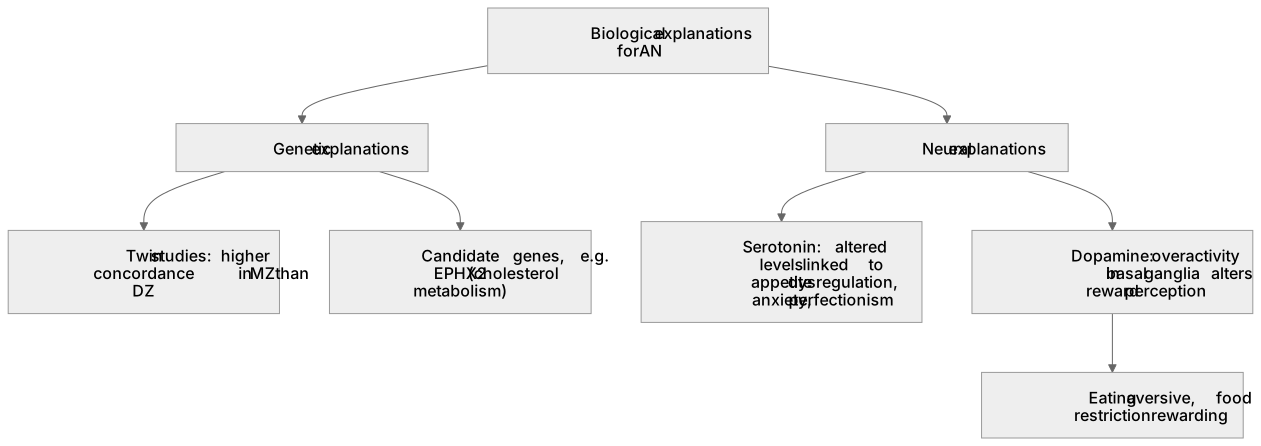
Biological explanations for anorexia nervosa (AN) focus on genetic vulnerability and neural mechanisms. Genetic explanations suggest AN is heritable, supported by twin studies showing higher concordance rates for monozygotic twins compared to dizygotic twins. Candidate gene studies investigate specific genes, such as the EPHX2 gene, which is involved in cholesterol metabolism, as altered cholesterol processing is often seen in AN. Neural explanations highlight neurotransmitter imbalances, particularly serotonin and dopamine. Overactivity in dopamine receptors in the basal ganglia may alter reward perception, making eating anxiety-inducing rather than pleasurable. Additionally, altered serotonin pathways can explain comorbid symptoms like perfectionism and obsessive traits often seen in AN.
What earns the marks
- Genetic explanations rely on twin and family studies demonstrating higher concordance rates for AN in monozygotic twins than dizygotic twins.
- Candidate genes, such as EPHX2 (involved in cholesterol metabolism) and those linked to serotonin receptors, are implicated in genetic vulnerability to AN.
- Neural explanations focus on the role of serotonin, where altered levels are linked to appetite dysregulation, anxiety, and perfectionism.
- Dopamine imbalances, particularly overactivity in the basal ganglia, are proposed to disrupt the brain's reward system, making food restriction rewarding and eating aversive.
- Evaluation can include the diathesis-stress model, arguing that biological vulnerabilities require environmental triggers to manifest as AN.
Common mistakes and how to put them right
Stating that a single gene causes anorexia nervosa.
Put it right: Explain that AN is polygenic, meaning multiple genes contribute to a vulnerability rather than a single gene determining the disorder.
Error: Confusing the roles of dopamine and serotonin in AN. Correction: Clearly distinguish that serotonin is typically linked to mood, anxiety, and perfectionism, while dopamine is linked to the reward system and altered responses to food.
Ignoring the issue of cause and effect in neural explanations.
Put it right: Point out that neurotransmitter imbalances might be a consequence of starvation rather than the root cause of the disorder.
Exam tips
- Always use the terms monozygotic (MZ) and dizygotic (DZ) instead of identical and non-identical when discussing twin studies.
- Highlight the difficulty in separating genetic and environmental factors, as families share both DNA and living environments.
- Use the diathesis-stress model as a sophisticated evaluation point to show how biological and psychological explanations can be integrated.
Try the lesson
The start of the Eating behaviour: Biological explanations for anorexia nervosa: genetic and neural. lesson, made from checked teaching notes for this specification point.
Have a go first
Which of the following findings from twin studies provides the strongest evidence for a genetic explanation of anorexia nervosa?
Listen
Biological explanations for anorexia nervosa (AN) focus on genetic vulnerability and neural mechanisms. Genetic explanations suggest AN is heritable, supported by twin studies showing higher concordance rates for monozygotic twins compared to dizygotic twins. Candidate gene studies investigate specific genes, such as the EPHX2 gene, which is involved in cholesterol metabolism, as altered cholesterol processing is often seen in AN. Neural explanations highlight neurotransmitter imbalances, particularly serotonin and dopamine. Overactivity in dopamine receptors in the basal ganglia may alter reward perception, making eating anxiety-inducing rather than pleasurable. Additionally, altered serotonin pathways can explain comorbid symptoms like perfectionism and obsessive traits often seen in AN. A strong answer earns marks for these points. Genetic explanations rely on twin and family studies demonstrating higher concordance rates for AN in monozygotic twins than dizygotic twins. Candidate genes, such as EPHX2 (involved in cholesterol metabolism) and those linked to serotonin receptors, are implicated in genetic vulnerability to AN. Neural explanations focus on the role of serotonin, where altered levels are linked to appetite dysregulation, anxiety, and perfectionism. Dopamine imbalances, particularly overactivity in the basal ganglia, are proposed to disrupt the brain's reward system, making food restriction rewarding and eating aversive. A common slip: Stating that a single gene causes anorexia nervosa. Instead, Explain that AN is polygenic, meaning multiple genes contribute to a vulnerability rather than a single gene determining the disorder. Exam tip: Always use the terms monozygotic (MZ) and dizygotic (DZ) instead of identical and non-identical when discussing twin studies.
See it
Key words
Say what each word means before you turn the card.
Genetic inheritance
Try answering aloud or in your head before turning the card.
Neurochemistry
Try answering aloud or in your head before turning the card.
Biological reductionism
Try answering aloud or in your head before turning the card.
See every definition
- Genetic inheritance
- Suggests anorexia nervosa is heritable, supported by twin studies showing higher concordance rates for monozygotic twins compared to dizygotic twins.
- Neurochemistry
- Highlights neurotransmitter imbalances, particularly serotonin and dopamine, where altered serotonin pathways can explain comorbid symptoms like perfectionism and obsessive traits.
- Biological reductionism
- An issue used to evaluate biological explanations of anorexia nervosa, alongside cause-and-effect.
Label the diagram
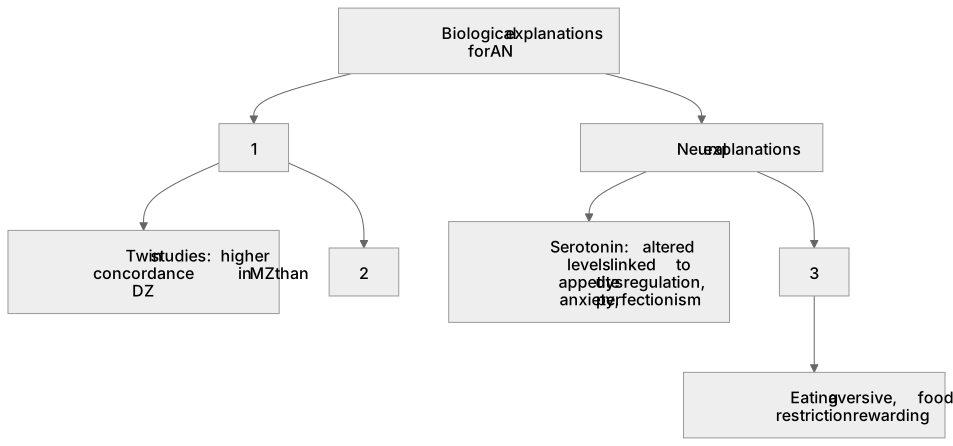
Some boxes have lost their names. Pick the right name for each number.
1Box 1
2Box 2
3Box 3
There is more to this lesson
The full lesson goes on to check your understanding and help you earn the marks. Create a free account to carry on, with your progress saved.
A week of Premium from your first lesson · Then the free plan continues · No card, no charge
Test your understanding of Eating behaviour: Biological explanations for anorexia nervosa: genetic and neural.
Active recall beats re-reading. Take an instant quiz now to test what you’ve learned and lock it into long-term memory.
A week of Premium from your first lesson · Then the free plan continues · No card, no charge