AQA · A-Level · Psychology
Course version: 7182-2025 · Exams from 2027
Psychological explanations for anorexia nervosa: family systems theory,…
Full specification wording
Eating behaviour: Psychological explanations for anorexia nervosa: family systems theory, including enmeshment, autonomy and control; social learning theory, including modelling, reinforcement and media; cognitive theory, including distortions and irrational beliefs.
Three psychological explanations for anorexia nervosa exist.
Checked against the AQA 7182-2025 specification (opens in a new tab) on .
- Point 4 of 6
- 4 key terms
Study notes
From the checked teaching notes for this specification point.
The idea
Three psychological explanations for anorexia nervosa exist. Minuchin's family systems theory locates the illness in family dynamics: boundaries blur into enmeshment (e.g. a parent answering for a child), and refusing food becomes a bid for autonomy and control by someone feeling ineffective. Social learning theory focuses on the media, modelling of thin ideals, and direct or vicarious reinforcement (e.g. praise for weight loss). Becker's Fiji study provides evidence, showing disordered eating increased after television was introduced. Cognitive theory looks inward, distinguishing between perceptual distortions (overestimating body size) and irrational beliefs (e.g. 'one biscuit means I have failed completely').
What earns the marks
- Explain family systems theory by detailing enmeshment (blurred boundaries) and how food refusal is an attempt to gain autonomy and control.
- Apply social learning theory by explaining the modelling of thin ideals from the media, and reinforcement (e.g. vicarious reinforcement from seeing models praised).
- Outline cognitive theory by distinguishing perceptual distortions (misperceiving body size) from irrational beliefs (e.g. dichotomous thinking about food).
- Evaluate family systems theory by discussing its socially sensitive nature, as it potentially blames parents and relies on retrospective clinical observations.
- Evaluate social learning theory by noting it struggles to explain why most media-exposed individuals do not develop anorexia, suggesting a biological vulnerability is also required.
- Evaluate cognitive theory by questioning whether cognitive distortions and irrational beliefs are symptoms rather than underlying causes, though CBT's success supports their role in maintenance.
Common mistakes and how to put them right
Defining enmeshment loosely as 'a close family' rather than as blurred boundaries where members speak and feel for one another.
Assuming that describing media effects without a named study earns no credit.
Put it right: Explaining the mechanism of media influence (modelling and reinforcement) is valid knowledge even without citing Becker.
Blurring the three explanations into one undifferentiated psychological account instead of separating family, learning and cognitive claims.
Confusing perceptual distortion of body size with irrational beliefs about eating.
Put it right: The specification names both and they are distinct concepts.
Exam tips
- The specification names eight specific terms across the three theories (enmeshment, autonomy, control, modelling, reinforcement, media, distortions, irrational beliefs), so be prepared to define and apply each one.
- When evaluating psychological explanations, use the biological account as a counterweight and argue for an interactionist position rather than declaring a single winner.
- In scenario questions, quote the stem: if a mother answers questions put to her daughter, explicitly name that as enmeshment before explaining it.
Try the lesson
The start of the Eating behaviour: Psychological explanations for anorexia nervosa: family systems theory, including enmeshment, autonomy and control; social learning theory, including modelling, reinforcement and media; cognitive theory, including distortions and irrational beliefs. lesson, made from checked teaching notes for this specification point.
Have a go first
According to Minuchin's family systems theory, which of the following best describes an 'enmeshed' family environment that could contribute to anorexia nervosa?
Listen
Three psychological explanations for anorexia nervosa exist. Minuchin's family systems theory locates the illness in family dynamics: boundaries blur into enmeshment (e.g. a parent answering for a child), and refusing food becomes a bid for autonomy and control by someone feeling ineffective. Social learning theory focuses on the media, modelling of thin ideals, and direct or vicarious reinforcement (e.g. praise for weight loss). Becker's Fiji study provides evidence, showing disordered eating increased after television was introduced. Cognitive theory looks inward, distinguishing between perceptual distortions (overestimating body size) and irrational beliefs (e.g. 'one biscuit means I have failed completely'). A strong answer earns marks for these points. Explain family systems theory by detailing enmeshment (blurred boundaries) and how food refusal is an attempt to gain autonomy and control. Apply social learning theory by explaining the modelling of thin ideals from the media, and reinforcement (e.g. vicarious reinforcement from seeing models praised). Outline cognitive theory by distinguishing perceptual distortions (misperceiving body size) from irrational beliefs (e.g. dichotomous thinking about food). Evaluate family systems theory by discussing its socially sensitive nature, as it potentially blames parents and relies on retrospective clinical observations. Exam tip: The specification names eight specific terms across the three theories (enmeshment, autonomy, control, modelling, reinforcement, media, distortions, irrational beliefs), so be prepared to define and apply each one.
See it

Key words
Say what each word means before you turn the card.
Enmeshment and family boundaries
Try answering aloud or in your head before turning the card.
Autonomy, control and effectiveness
Try answering aloud or in your head before turning the card.
Modelling, reinforcement and media influence
Try answering aloud or in your head before turning the card.
Cognitive distortions and irrational beliefs
Try answering aloud or in your head before turning the card.
See every definition
- Enmeshment and family boundaries
- A family systems idea in which boundaries blur into enmeshment, so that members speak and feel for one another, for example a parent answering for a child.
- Autonomy, control and effectiveness
- Refusing food becomes a bid for autonomy and control by someone feeling ineffective within the family.
- Modelling, reinforcement and media influence
- Social learning theory focuses on the media, modelling of thin ideals, and direct or vicarious reinforcement, such as praise for weight loss.
- Cognitive distortions and irrational beliefs
- Cognitive theory distinguishes perceptual distortions, such as overestimating body size, from irrational beliefs, such as one biscuit meaning complete failure.
Label the diagram
Some boxes have lost their names. Pick the right name for each number.
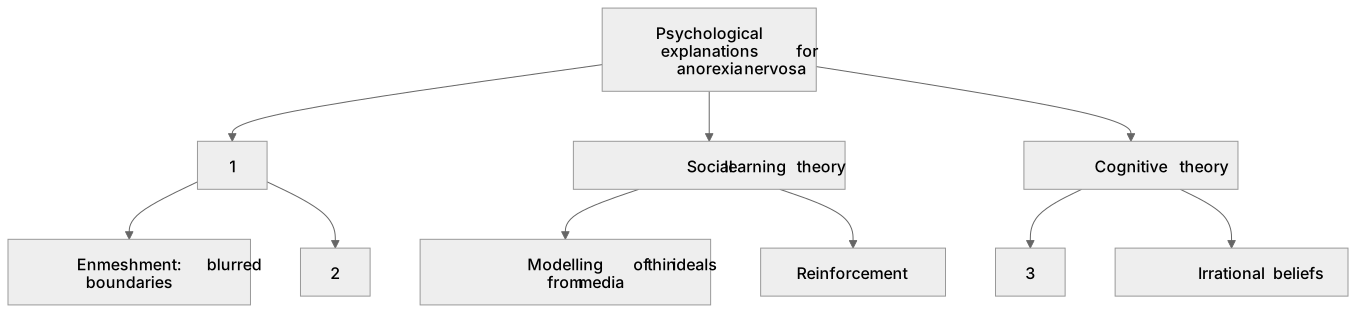
1Box 1
2Box 2
3Box 3
There is more to this lesson
The full lesson goes on to check your understanding and help you earn the marks. Create a free account to carry on, with your progress saved.
A week of Premium from your first lesson · Then the free plan continues · No card, no charge
Test your understanding of Eating behaviour: Psychological explanations for anorexia nervosa: family systems theory, including enmeshment, autonomy and control; social learning theory, including modelling, reinforcement and media; cognitive theory, including distortions and irrational beliefs.
Active recall beats re-reading. Take an instant quiz now to test what you’ve learned and lock it into long-term memory.
A week of Premium from your first lesson · Then the free plan continues · No card, no charge