AQA · A-Level · Psychology
Explanations for Forgetting
Forgetting is not simply a failure of memory — it is a window into how memory systems are organised, accessed, and disrupted. This topic requires candidates to master two distinct theoretical frameworks — Interference Theory and Retrieval Failure Theory — and to deploy precise knowledge of landmark studies to earn AO1, AO2, and AO3 marks. With AO3 weighted at 40%, the ability to evaluate research methodology critically and apply theory to novel scenarios is what separates the top-band candidates from the rest.
- 10 min read
- 5 worked examples
- 5 practice questions
- 8 key terms
Study Notes
Overview
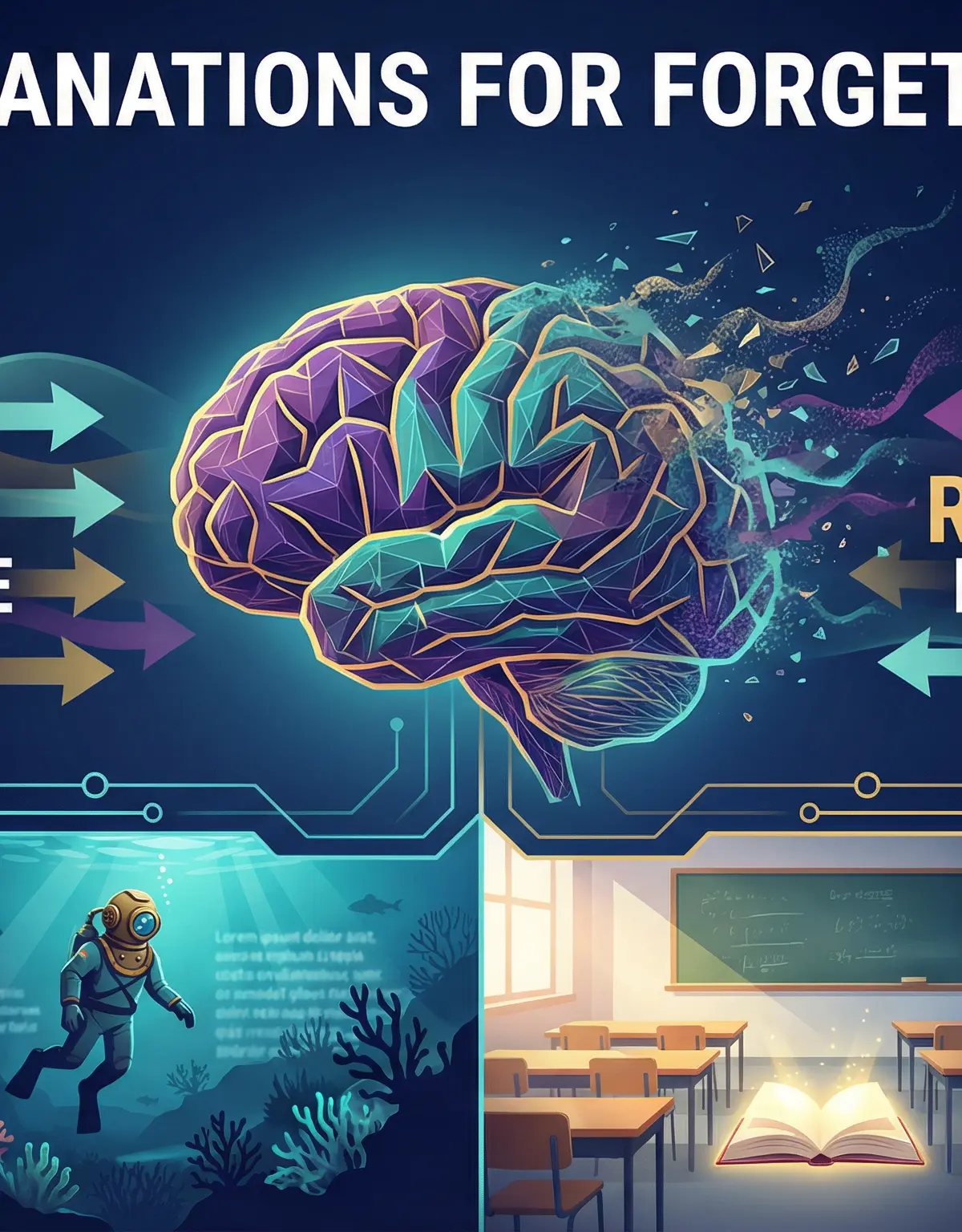
Explanations for Forgetting is a core topic within the AQA A-Level Psychology Memory unit, requiring candidates to demonstrate precise theoretical knowledge, critical evaluation of research evidence, and the ability to apply psychological concepts to novel scenarios. The topic centres on two competing theoretical frameworks: Interference Theory, which proposes that forgetting results from competing memories disrupting one another, and Retrieval Failure Theory, which argues that memories are inaccessible — not lost — due to the absence of appropriate retrieval cues. AQA examiners consistently reward candidates who can distinguish clearly between these theories, name and apply specific research studies with their findings, and produce evaluations that go beyond generic commentary to engage with the specific methodological and theoretical implications of the evidence. With AO3 weighted at 40% of total marks, analytical depth is the primary differentiator between grade bands.

Theory 1: Interference Theory
What Is Interference Theory?
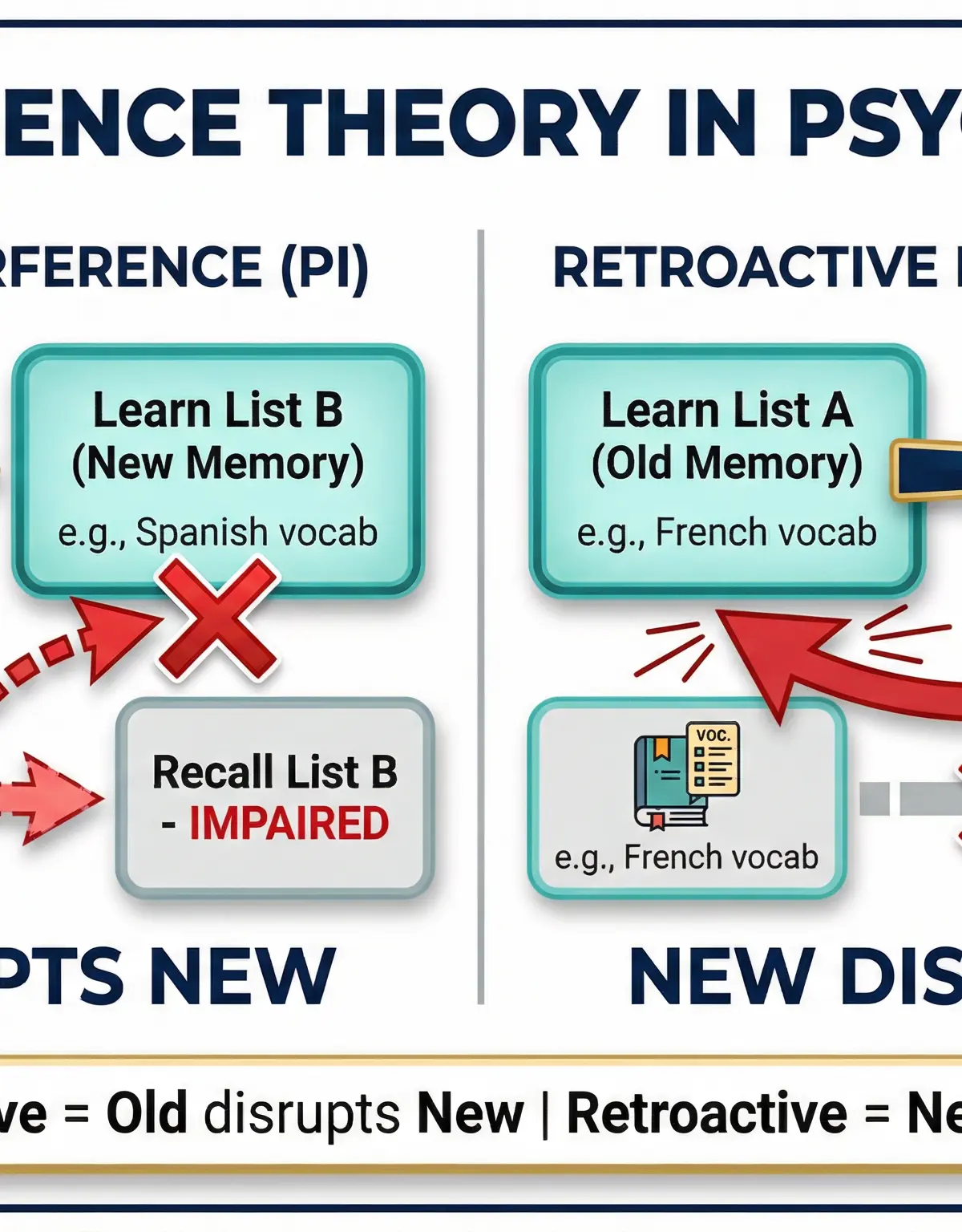
Interference Theory proposes that forgetting occurs because memories compete with one another, and that this competition is most severe when memories are similar in content. Critically, the memory trace itself is not destroyed — it is disrupted or obscured by competing information. There are two distinct types of interference, and candidates must define and apply each with precision.
Proactive Interference (PI)
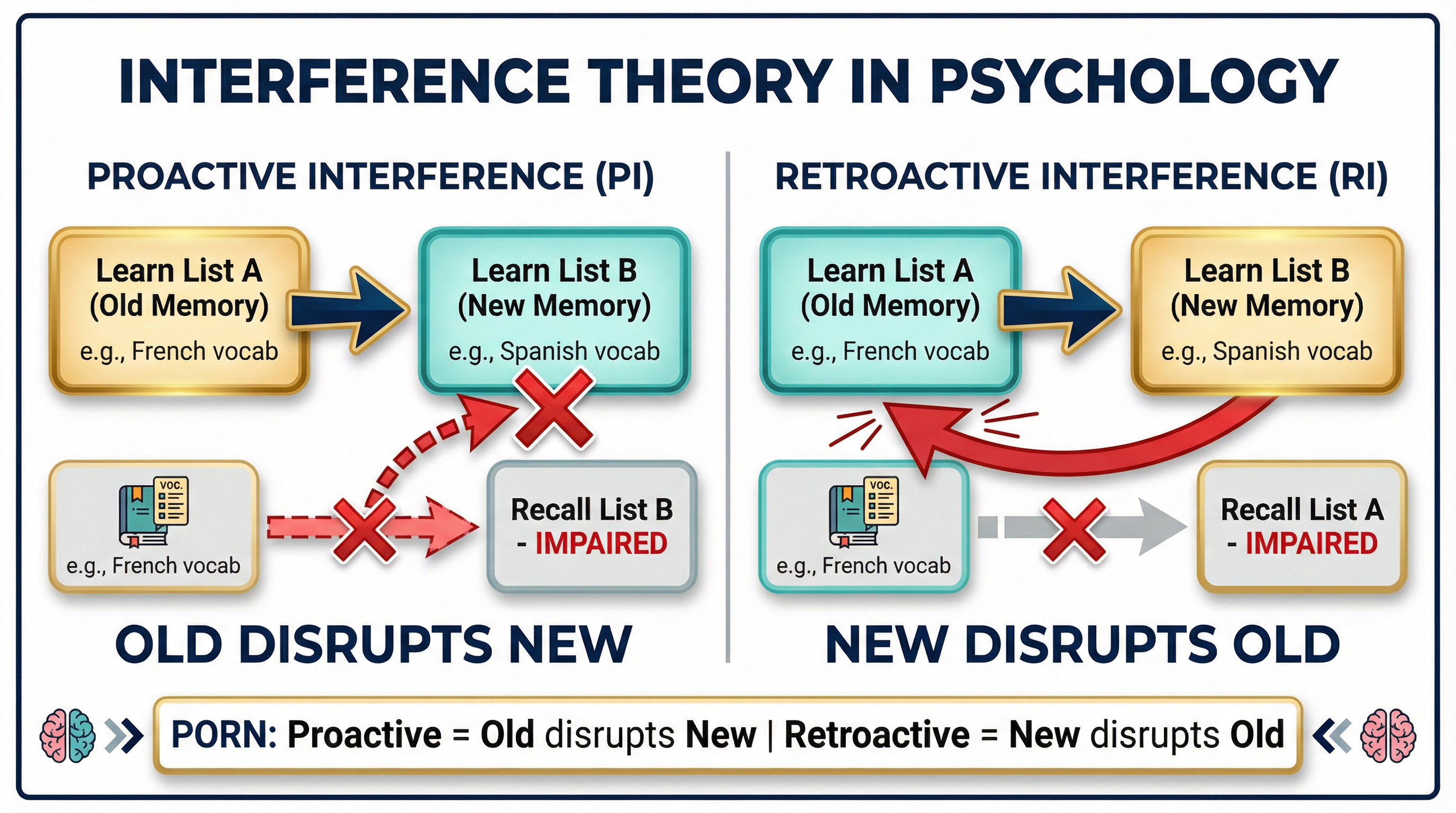
Definition: Proactive Interference occurs when an older memory disrupts the recall of a newer memory. The term 'proactive' refers to the direction of disruption — the old memory acts forward in time to impair the new one.
Example: A student who has studied French for two years begins learning Spanish. When attempting to recall Spanish vocabulary, the previously learned French words intrude and cause errors. The old French memories are acting proactively — forward — to disrupt the new Spanish learning.
Exam Application: If a question stem describes someone struggling to recall recently learned information after having extensive prior knowledge in a similar domain, this is Proactive Interference. Quote the stem explicitly: 'As stated in the stem, [person]'s older [subject] knowledge is disrupting recall of the newer [subject], which is consistent with Proactive Interference.'
Retroactive Interference (RI)
Definition: Retroactive Interference occurs when a newer memory disrupts the recall of an older memory. The term 'retroactive' refers to the direction of disruption — the new memory acts backward in time to impair the old one.
Example: After learning Spanish, the same student attempts to recall their French vocabulary. The newly acquired Spanish now interferes, acting retroactively to disrupt the older French memories.
Memory Hook — PORN: Proactive = Old disrupts New; Retroactive = New disrupts Old. This mnemonic is the single most effective tool for ensuring accurate definitions under exam conditions.
Key Research: McGeoch and McDonald (1931)
Procedure: Participants learned a list of adjectives to a criterion of perfect recall. They then learned an interpolated (second) list, which varied across conditions in its similarity to the first list. Conditions included: synonyms, antonyms, unrelated adjectives, nonsense syllables, three-digit numbers, and a rest condition (no interpolated learning).
Findings: Recall of the original list was worst in the synonyms condition and best in the rest condition. The greater the similarity between the two lists, the greater the retroactive interference and the poorer the recall. Synonyms produced the most interference; nonsense syllables and numbers produced far less.
Theoretical Link: This directly supports Interference Theory — specifically, that similarity is the critical variable driving memory competition. The finding that synonyms caused the most disruption demonstrates that semantic similarity increases interference.
Theory 2: Retrieval Failure Theory
The Encoding Specificity Principle (Tulving, 1983)
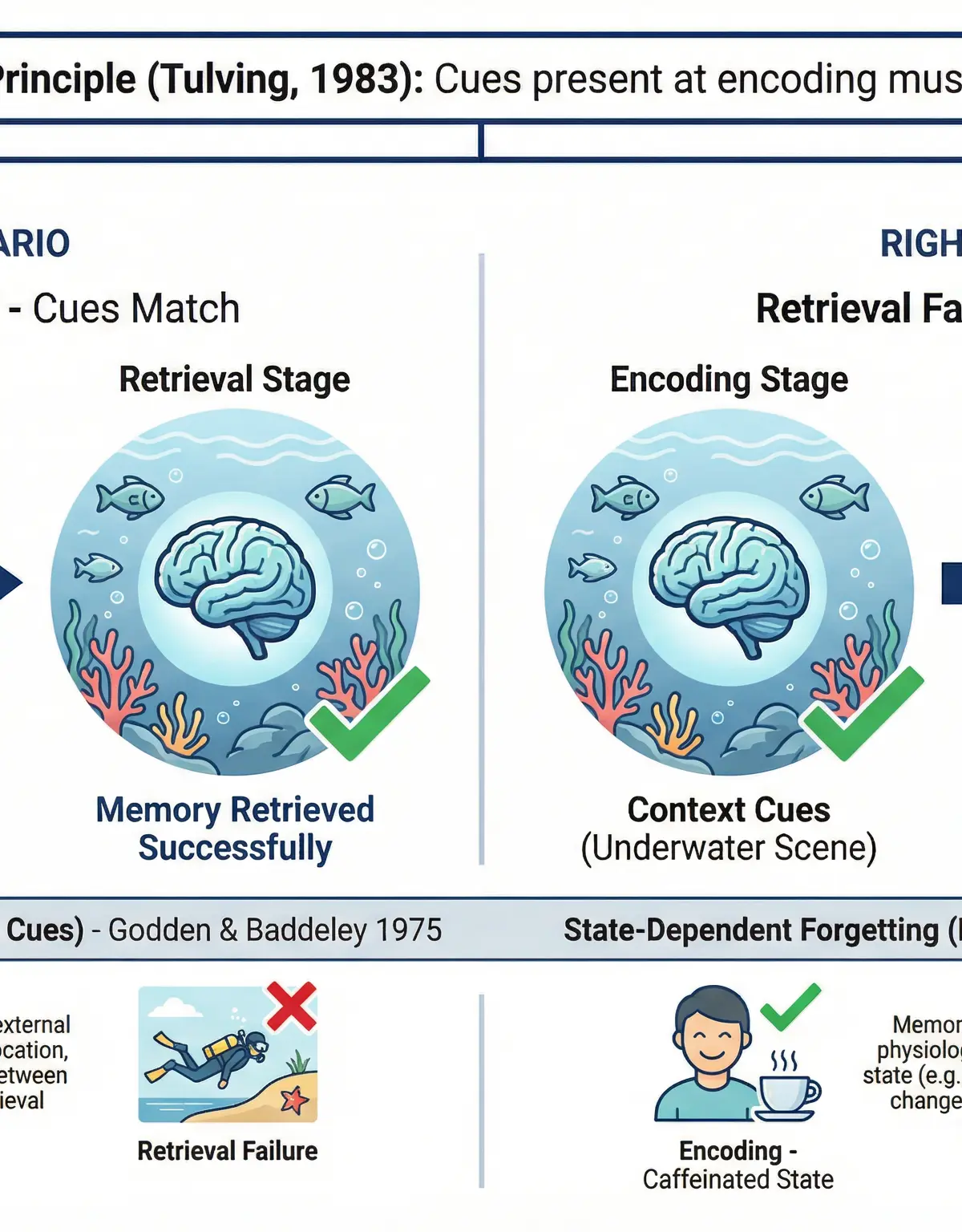
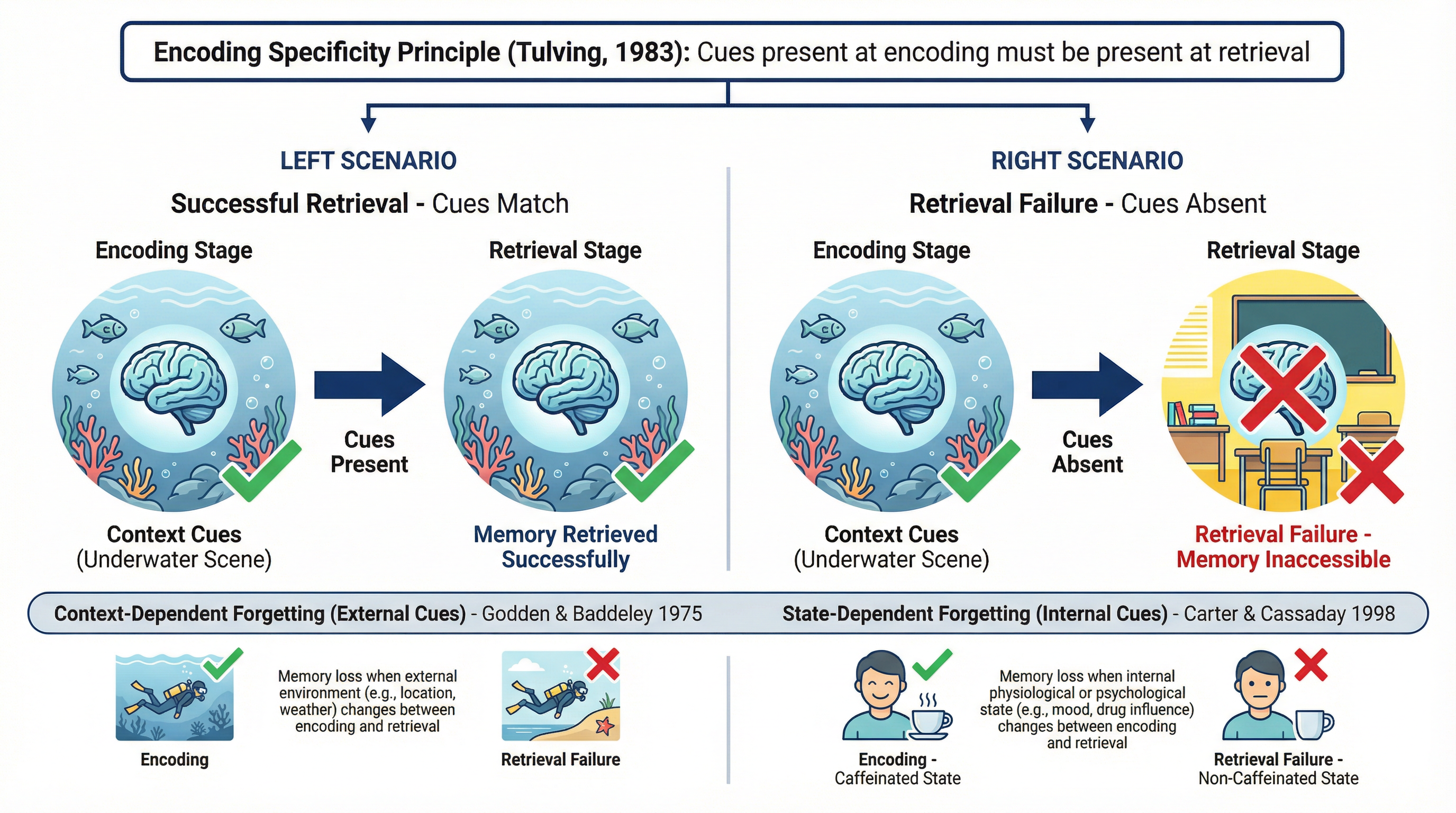
Retrieval Failure Theory is founded on Endel Tulving's Encoding Specificity Principle (ESP), proposed in 1983. Tulving argued that at the moment of encoding, contextual information — both external (environmental) and internal (physiological/psychological) — is encoded alongside the target memory as part of an integrated memory trace. The principle states:
'A retrieval cue can only aid retrieval if the information in the cue was encoded at the same time as the to-be-remembered information.' — Tulving (1983)
When retrieval cues present at encoding are absent at the time of recall, the memory becomes inaccessible — not erased. This is the critical distinction from Interference Theory: Retrieval Failure is about missing keys, not competing information.
Context-Dependent Forgetting (External Cues)
Definition: Forgetting that occurs because the external environmental context at retrieval differs from the context present at encoding.
Key Study — Godden and Baddeley (1975):
- Participants: 18 members of a university diving club.
- Procedure: Participants learned lists of 36 unrelated words in one of two environments — on land or underwater (approximately 20 feet deep). They were then tested for recall in either the same environment or the other environment, creating four conditions: Learn Land/Recall Land; Learn Land/Recall Underwater; Learn Underwater/Recall Underwater; Learn Underwater/Recall Land.
- Findings: Recall was approximately 40% better in the matching condition (same environment at learning and recall) compared to the mismatching condition. Words learned underwater were recalled better underwater; words learned on land were recalled better on land.
- Theoretical Link: The environmental context (underwater sounds, visual cues, physical sensations) was encoded alongside the word lists. When the context at retrieval matched the context at encoding, these cues facilitated recall. When contexts mismatched, retrieval failure occurred — directly supporting the Encoding Specificity Principle.
Important Limitation: A follow-up study found that the context effect disappeared when a recognition test was used instead of free recall. This suggests that context-dependent forgetting may be specific to recall tasks and does not generalise to all forms of memory retrieval, limiting the theory's scope.
State-Dependent Forgetting (Internal Cues)
Definition: Forgetting that occurs because the internal physiological or psychological state at retrieval differs from the state present at encoding.
Key Study — Carter and Cassaday (1998):
- Procedure: Participants learned prose passages and word lists either under the influence of antihistamine drugs (which cause mild sedation/drowsiness) or in a normal, non-drugged state. Recall was tested either in the same state or a different state.
- Findings: Recall was significantly better when the internal state at recall matched the internal state at encoding. Participants who learned material while drowsy recalled it better when drowsy; those who learned in a normal state recalled better in a normal state. Mismatching states produced retrieval failure.
- Theoretical Link: The internal physiological state (level of alertness/sedation) functioned as an internal retrieval cue, encoded alongside the target information. Absence of this cue at retrieval impaired access to the memory.
Real-World Application: State-dependent forgetting has implications for eyewitness testimony. Research suggests that individuals who experience events in an emotionally aroused state may recall those events more accurately when returned to a similar emotional state — a phenomenon relevant to police interview techniques and the cognitive interview.
Comparing the Two Theories
| Feature | Interference Theory | Retrieval Failure Theory |
|---|---|---|
| Core Mechanism | Competing memories disrupt recall | Absence of encoding cues prevents access |
| Memory Status | Memory may be overwritten or confused | Memory is intact but inaccessible |
| Key Variable | Similarity between memories | Match between encoding and retrieval cues |
| Key Study | McGeoch & McDonald (1931) | Godden & Baddeley (1975); Carter & Cassaday (1998) |
| Cue Type | N/A — about competition | External (context) or Internal (state) |
| Practical Implication | Avoid studying similar subjects back-to-back | Revise in exam-like conditions |
Evaluation: Strengths and Limitations
Interference Theory — Strengths
McGeoch and McDonald's (1931) study provides strong laboratory-based evidence with high internal validity. The controlled manipulation of list similarity allows confident causal conclusions about the role of similarity in interference. Furthermore, Interference Theory has real-world support: studies of everyday forgetting (e.g., Baddeley & Hitch, 1977, on rugby players forgetting match results) demonstrate that interference effects occur outside the laboratory, strengthening ecological validity.
Interference Theory — Limitations
The primary limitation is the lack of mundane realism in the supporting research. Learning lists of word pairs in a laboratory bears little resemblance to the complex, meaningful learning that characterises everyday memory. Candidates must explain why this matters: because real-world memories are embedded in rich contextual networks, the interference effects observed with decontextualised word lists may be exaggerated relative to everyday forgetting. This is a specific, developed evaluation — not a generic 'ecological validity' claim.
Retrieval Failure Theory — Strengths
Godden and Baddeley's (1975) study has higher ecological validity than typical laboratory word-list studies, as it used real divers in genuine underwater environments rather than artificial lab settings. The theory also has strong practical applications: it suggests that students should revise in conditions similar to exam conditions (quiet, timed, no music) to maximise cue-matching at retrieval — advice that is directly actionable.
Retrieval Failure Theory — Limitations
As noted, the context effect disappears with recognition tests (Godden & Baddeley, 1980), suggesting the theory may only apply to free recall. Additionally, the Encoding Specificity Principle is difficult to falsify: because any cue could theoretically have been encoded alongside a memory, it is hard to test the theory in a way that could definitively disprove it, which is a scientific weakness.
Visual Resources
2 diagrams and illustrations
Interactive Diagrams
3 interactive diagrams to visualise key concepts
Conceptual Flow Outline
Decision flowchart: Which explanation for forgetting applies? Follow the path from retrieval attempt to identify whether Retrieval Failure or Interference is the operative mechanism.
Conceptual Flow Outline
Direction of interference: Proactive acts forward (old disrupts new); Retroactive acts backward (new disrupts old). Use PORN mnemonic to recall.
Conceptual Flow Outline
Retrieval Failure Theory: The Encoding Specificity Principle branches into context-dependent and state-dependent forgetting, each supported by a key study.
Worked Examples
5 worked examples — open one to explore the question and available guidance.
Practice Questions
Test your understanding — click to reveal model answers
Outline what is meant by 'proactive interference'. (2 marks)
Hint: Focus on the direction of disruption — which memory (old or new) is doing the disrupting, and which is being disrupted?
Explain what is meant by the Encoding Specificity Principle. (3 marks)
Hint: Name the theorist, state the principle, and explain what happens when cues are absent.
Describe and evaluate the study by Godden and Baddeley (1975). (6 marks)
Hint: AO1: procedure and findings. AO3: at least two evaluation points — one strength, one limitation. Be specific about the finding (the 40% figure).
Priya studied for her Biology exam in her bedroom with music playing. On the day of the exam, she sat in a silent exam hall and found she could not recall much of what she had revised. Using your knowledge of psychology, explain Priya's forgetting. (4 marks)
Hint: Identify the specific type of forgetting, define it, quote the stem, and explain the mechanism.
Discuss explanations for forgetting. Refer to evidence in your answer. (16 marks)
Hint: Cover both Interference Theory (PI and RI) and Retrieval Failure Theory (context-dependent and state-dependent). Keep AO1 concise (approx. 6 marks) and develop 3–4 AO3 evaluation points. Conclude with a reasoned judgement.