AQA · A-Level · Psychology
Course version: 7182-2025 · Exams from 2027
Gender identities, including binary, non-binary and gender fluid. How…
Full specification wording
Gender: Gender identities, including binary, non-binary and gender fluid. How gender has been measured using the Bem Sex Role Inventory.
Gender identity is a person's internal sense of their gender.
Checked against the AQA 7182-2025 specification (opens in a new tab) on .
- Point 2 of 6
- 4 key terms
Study notes
From the checked teaching notes for this specification point.
The idea
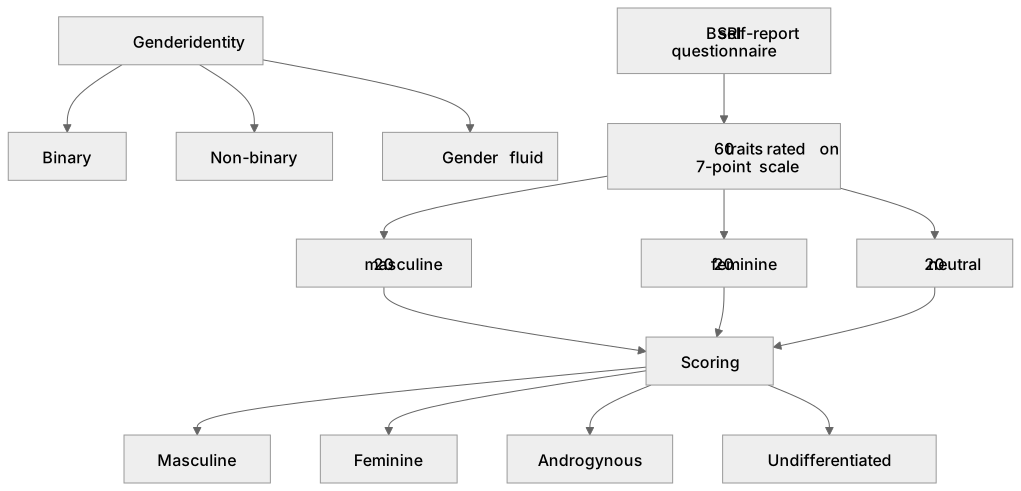
Gender identity is a person's internal sense of their gender. Binary identities align strictly with traditional male or female categories. Non-binary identities exist outside this dichotomy, while gender fluid individuals experience shifts in their gender identity over time. To measure gender, the Bem Sex Role Inventory (BSRI) uses a self-report questionnaire. Respondents rate themselves on a 7-point scale across 60 traits: 20 masculine, 20 feminine, and 20 neutral. Scores classify individuals as masculine, feminine, androgynous (high in both), or undifferentiated (low in both). Bem argued that androgyny is psychologically healthy, as it allows for greater behavioural flexibility.
What earns the marks
- Define binary, non-binary, and gender fluid identities accurately.
- Describe the structure of the BSRI, noting it consists of 60 items divided equally into masculine, feminine, and neutral traits.
- Explain the scoring system of the BSRI, which uses a 7-point rating scale to classify individuals into four distinct categories: masculine, feminine, androgynous, or undifferentiated.
- Evaluate the BSRI by discussing its reliance on self-report measures, which may be subject to social desirability bias, or its temporal validity given its development in the 1970s.
Common mistakes and how to put them right
Confusing sex and gender identity.
Put it right: Clearly distinguish sex as a biological classification and gender identity as a psychological and social construct.
Stating the BSRI only measures masculinity and femininity.
Put it right: Note that the BSRI yields four categories, explicitly including androgynous and undifferentiated classifications.
Using 'non-binary' and 'gender fluid' interchangeably.
Put it right: Define non-binary as an identity outside the male/female dichotomy, and gender fluid as an identity that changes over time or context.
Exam tips
- When evaluating the BSRI, use the concept of temporal validity to discuss whether 1970s stereotypes of masculinity and femininity still apply today.
- Be prepared to explain exactly how the BSRI is administered, specifically mentioning the 7-point rating scale and the 60 traits.
- Link the concept of androgyny in the BSRI to psychological well-being, as Bem proposed that adaptability is a sign of mental health.
Try the lesson
The start of the Gender: Gender identities, including binary, non-binary and gender fluid. How gender has been measured using the Bem Sex Role Inventory. lesson, made from checked teaching notes for this specification point.
Have a go first
How does the Bem Sex Role Inventory (BSRI) measure an individual's psychological androgyny?
Listen
Gender identity is a person's internal sense of their gender. Binary identities align strictly with traditional male or female categories. Non-binary identities exist outside this dichotomy, while gender fluid individuals experience shifts in their gender identity over time. To measure gender, the Bem Sex Role Inventory (BSRI) uses a self-report questionnaire. Respondents rate themselves on a 7-point scale across 60 traits: 20 masculine, 20 feminine, and 20 neutral. Scores classify individuals as masculine, feminine, androgynous (high in both), or undifferentiated (low in both). Bem argued that androgyny is psychologically healthy, as it allows for greater behavioural flexibility. A strong answer earns marks for these points. Define binary, non-binary, and gender fluid identities accurately. Describe the structure of the BSRI, noting it consists of 60 items divided equally into masculine, feminine, and neutral traits. Explain the scoring system of the BSRI, which uses a 7-point rating scale to classify individuals into four distinct categories: masculine, feminine, androgynous, or undifferentiated. Evaluate the BSRI by discussing its reliance on self-report measures, which may be subject to social desirability bias, or its temporal validity given its development in the 1970s. A common slip: Confusing sex and gender identity. Instead, Clearly distinguish sex as a biological classification and gender identity as a psychological and social construct. Exam tip: When evaluating the BSRI, use the concept of temporal validity to discuss whether 1970s stereotypes of masculinity and femininity still apply today.
See it
Key words
Say what each word means before you turn the card.
Binary identities
Try answering aloud or in your head before turning the card.
Non-binary identities
Try answering aloud or in your head before turning the card.
Gender fluid
Try answering aloud or in your head before turning the card.
Bem Sex Role Inventory (BSRI)
Try answering aloud or in your head before turning the card.
See every definition
- Binary identities
- Identities that align strictly with traditional male or female categories.
- Non-binary identities
- Identities that exist outside the male/female dichotomy.
- Gender fluid
- An identity where individuals experience shifts in their gender identity over time.
- Bem Sex Role Inventory (BSRI)
- A self-report questionnaire that uses a 7-point scale across 60 traits to measure gender.
Label the diagram
Some boxes have lost their names. Pick the right name for each number.
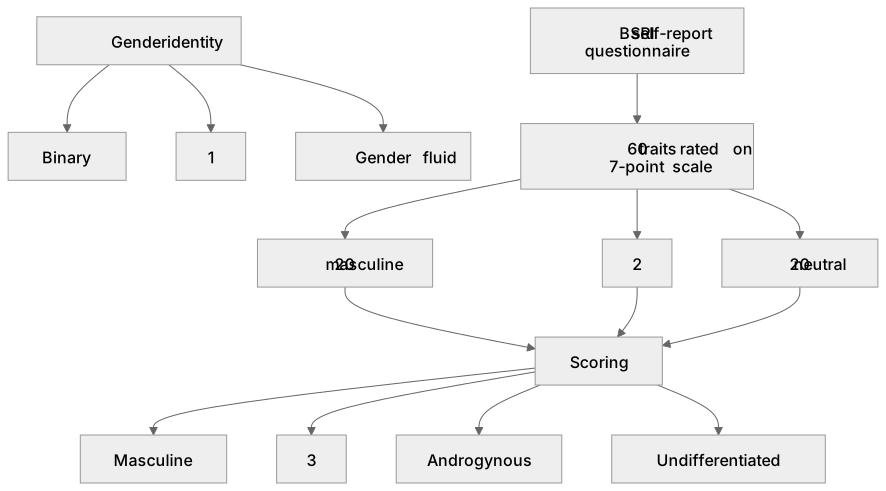
1Box 1
2Box 2
3Box 3
There is more to this lesson
The full lesson goes on to check your understanding and help you earn the marks. Create a free account to carry on, with your progress saved.
A week of Premium from your first lesson · Then the free plan continues · No card, no charge
Test your understanding of Gender: Gender identities, including binary, non-binary and gender fluid. How gender has been measured using the Bem Sex Role Inventory.
Active recall beats re-reading. Take an instant quiz now to test what you’ve learned and lock it into long-term memory.
A week of Premium from your first lesson · Then the free plan continues · No card, no charge