AQA · A-Level · Psychology
Course version: 7182-2025 · Exams from 2027
Understand simple probability (to include: explaining the difference…
Full specification wording
Handling data: Understand simple probability (to include: explaining the difference between the 0.05 and 0.01 levels of significance)
Simple probability is the likelihood of an event occurring, expressed as a number between 0 and 1, a fraction, or a percentage.
Checked against the AQA 7182-2025 specification (opens in a new tab) on .
- Point 4 of 17
- 4 key terms
Study notes
From the checked teaching notes for this specification point.
The idea
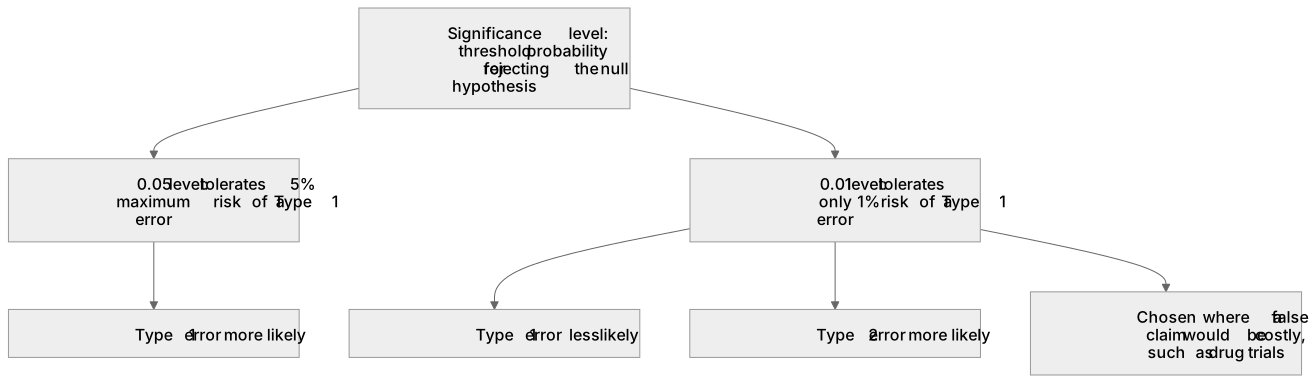
Simple probability is the likelihood of an event occurring, expressed as a number between 0 and 1, a fraction, or a percentage. In psychology, probability (p) determines if results are statistically significant. A significance level is the threshold probability set to decide whether to reject the null hypothesis, representing the maximum acceptable risk of a Type 1 error (rejecting a true null). Psychology normally works at p = 0.05, tolerating a 5% maximum risk of a Type 1 error. The stricter 0.01 level tolerates only a 1% risk and is chosen where a false claim would be costly, such as in drug trials. Tightening the criterion to 0.01 cuts the risk of a Type 1 error but raises the risk of a Type 2 error (retaining a false null).
What earns the marks
- Defining simple probability: expressing the likelihood of an event as a numerical value between 0 and 1, a fraction, or a percentage.
- Defining significance level: the threshold probability set by the researcher for rejecting the null hypothesis, representing the maximum acceptable risk of a Type 1 error.
- Distinguishing the two figures: 0.05 permits a 5% risk of a Type 1 error and 0.01 permits only a 1% risk, making 0.01 more stringent and demanding a more extreme calculated value.
- Linking the criterion to error: working at 0.05 rather than 0.01 makes a Type 1 error more likely; working at 0.01 makes a Type 2 error (missing a real effect) more likely.
- Justifying a stricter criterion by naming the consequence in that study, such as a new drug being licensed on a false positive.
Common mistakes and how to put them right
Defining the significance level as the probability that the results arose by chance, which conflates the alpha threshold with the p-value.
Claiming that a significant result proves the hypothesis, or that there is a 95% chance the hypothesis is true, when the figure describes the threshold for rejecting the null hypothesis.
Swapping the two errors, so that rejecting a true null hypothesis is called a Type 2 error instead of a Type 1 error.
Expressing simple probability incorrectly, such as giving a probability value greater than 1 or a negative number.
Exam tips
- A typical question prints a calculated value with an extract from a table and the phrase 'at the 0.05 level', so read the number of participants off the stem before choosing the row and column.
- Where asked why a researcher used the stricter criterion, the answer needs the consequence of a wrong decision in that particular investigation, not a general remark about accuracy.
- Explaining the difference between the two criteria requires both figures to appear together with what each one means as a percentage or proportion.
Try the lesson
The start of the Handling data: Understand simple probability (to include: explaining the difference between the 0.05 and 0.01 levels of significance) lesson, made from checked teaching notes for this specification point.
Have a go first
A psychologist conducts two experiments. Experiment A is significant at the p = 0.05 level, and Experiment B is significant at the p = 0.01 level. Which statement correctly explains the difference between these two levels of significance?
Listen
Simple probability is the likelihood of an event occurring, expressed as a number between 0 and 1, a fraction, or a percentage. In psychology, probability (p) determines if results are statistically significant. A significance level is the threshold probability set to decide whether to reject the null hypothesis, representing the maximum acceptable risk of a Type 1 error (rejecting a true null). Psychology normally works at p = 0.05, tolerating a 5% maximum risk of a Type 1 error. The stricter 0.01 level tolerates only a 1% risk and is chosen where a false claim would be costly, such as in drug trials. Tightening the criterion to 0.01 cuts the risk of a Type 1 error but raises the risk of a Type 2 error (retaining a false null). A strong answer earns marks for these points. Defining simple probability: expressing the likelihood of an event as a numerical value between 0 and 1, a fraction, or a percentage. Defining significance level: the threshold probability set by the researcher for rejecting the null hypothesis, representing the maximum acceptable risk of a Type 1 error. Distinguishing the two figures: 0.05 permits a 5% risk of a Type 1 error and 0.01 permits only a 1% risk, making 0.01 more stringent and demanding a more extreme calculated value. Linking the criterion to error: working at 0.05 rather than 0.01 makes a Type 1 error more likely; working at 0.01 makes a Type 2 error (missing a real effect) more likely. Exam tip: A typical question prints a calculated value with an extract from a table and the phrase 'at the 0.05 level', so read the number of participants off the stem before choosing the row and column.
See it
Key words
Say what each word means before you turn the card.
simple probability
Try answering aloud or in your head before turning the card.
levels of significance
Try answering aloud or in your head before turning the card.
Type 1 and Type 2 errors
Try answering aloud or in your head before turning the card.
null hypothesis testing
Try answering aloud or in your head before turning the card.
See every definition
- simple probability
- The likelihood of an event occurring, expressed as a number between 0 and 1, a fraction, or a percentage.
- levels of significance
- A threshold probability set to decide whether to reject the null hypothesis, representing the maximum acceptable risk of a Type 1 error.
- Type 1 and Type 2 errors
- A Type 1 error is rejecting a true null; a Type 2 error is retaining a false null.
- null hypothesis testing
- Deciding whether to reject the null hypothesis by comparing probability against a significance level.
Label the diagram
Some boxes have lost their names. Pick the right name for each number.
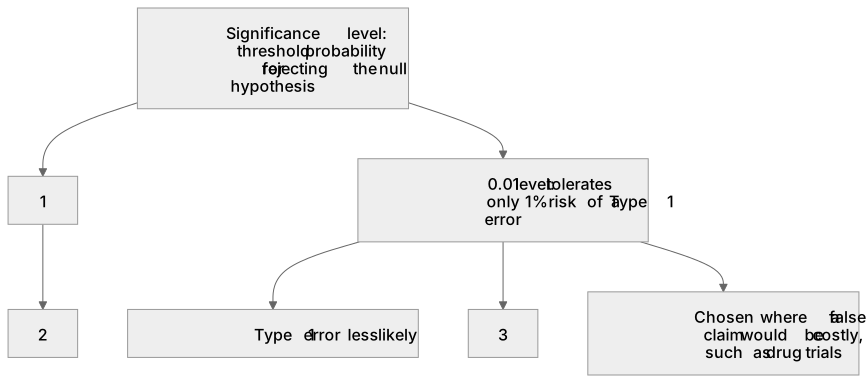
1Box 1
2Box 2
3Box 3
There is more to this lesson
The full lesson goes on to check your understanding and help you earn the marks. Create a free account to carry on, with your progress saved.
A week of Premium from your first lesson · Then the free plan continues · No card, no charge
Test your understanding of Handling data: Understand simple probability (to include: explaining the difference between the 0.05 and 0.01 levels of significance)
Active recall beats re-reading. Take an instant quiz now to test what you’ve learned and lock it into long-term memory.
A week of Premium from your first lesson · Then the free plan continues · No card, no charge