AQA · A-Level · Psychology
Course version: 7182-2025 · Exams from 2027
Understand the principles of sampling as applied to scientific data (to…
Full specification wording
Handling data: Understand the principles of sampling as applied to scientific data (to include: explaining how a random or stratified sample could be obtained from a target population)
Sampling determines how well participants represent the target population, dictating the generalisability of scientific data.
Checked against the AQA 7182-2025 specification (opens in a new tab) on .
- Point 5 of 17
- 4 key terms
Study notes
From the checked teaching notes for this specification point.
The idea
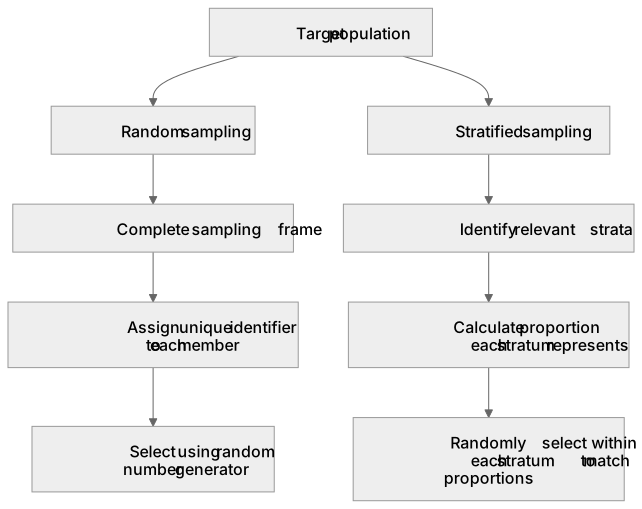
Sampling determines how well participants represent the target population, dictating the generalisability of scientific data. A random sample gives every member of the target population an equal chance of selection. This requires a complete sampling frame, assigning each a number, and using a random number generator. A stratified sample reflects the exact proportions of relevant subgroups (strata) within the population. Researchers identify these strata, calculate their relative frequencies, and perform random sampling within each stratum. For example, if a population of 1,000 includes 600 females, a sample of 50 must contain 30 randomly selected females. Both methods aim to minimise selection bias and improve representativeness.
What earns the marks
- Stratified sampling procedure: identify relevant strata within the target population, calculate the proportion each stratum represents, and randomly select participants within each stratum to match these proportions.
- Evaluating random sampling: eliminates researcher bias but requires a complete list of the population, which is rarely available, and can still theoretically produce an unrepresentative sample by chance.
- Evaluating stratified sampling: highly representative as it guarantees proportional representation of key variables, but identifying all relevant strata is difficult and time-consuming.
Common mistakes and how to put them right
Confusing random sampling with opportunity sampling.
Put it right: Random sampling is a systematic process giving every population member an equal chance of selection, not just approaching available people.
Omitting the final random selection step in stratified sampling. Students often calculate the proportions but fail to state that participants within each stratum must be selected randomly.
Failing to contextualise the sampling method.
Put it right: When asked how a sample could be obtained, answers must apply the steps to the specific target population and numbers provided in the scenario.
Exam tips
- When explaining how to obtain a stratified sample, always show your mathematical working for the proportions if population figures are provided in the stem.
- Use the term 'sampling frame' when describing random sampling to demonstrate A-level appropriate terminology for the list of the target population.
Try the lesson
The start of the Handling data: Understand the principles of sampling as applied to scientific data (to include: explaining how a random or stratified sample could be obtained from a target population) lesson, made from checked teaching notes for this specification point.
Have a go first
A researcher wants to select a random sample of 50 students from a college of 1000 students. Which procedure describes a true random sampling method?
Listen
Sampling determines how well participants represent the target population, dictating the generalisability of scientific data. A random sample gives every member of the target population an equal chance of selection. This requires a complete sampling frame, assigning each a number, and using a random number generator. A stratified sample reflects the exact proportions of relevant subgroups (strata) within the population. Researchers identify these strata, calculate their relative frequencies, and perform random sampling within each stratum. For example, if a population of 1,000 includes 600 females, a sample of 50 must contain 30 randomly selected females. Both methods aim to minimise selection bias and improve representativeness. A strong answer earns marks for these points. Random sampling procedure: requires a comprehensive sampling frame of the target population, assigning a unique identifier to each member, and using a genuinely random method (e.g., a computer generator) to select the sample. Stratified sampling procedure: identify relevant strata within the target population, calculate the proportion each stratum represents, and randomly select participants within each stratum to match these proportions. Evaluating random sampling: eliminates researcher bias but requires a complete list of the population, which is rarely available, and can still theoretically produce an unrepresentative sample by chance. Evaluating stratified sampling: highly representative as it guarantees proportional representation of key variables, but identifying all relevant strata is difficult and time-consuming. Exam tip: When explaining how to obtain a stratified sample, always show your mathematical working for the proportions if population figures are provided in the stem.
See it
Key words
Say what each word means before you turn the card.
random sample
Try answering aloud or in your head before turning the card.
stratified sample
Try answering aloud or in your head before turning the card.
sampling frame
Try answering aloud or in your head before turning the card.
representativeness
Try answering aloud or in your head before turning the card.
See every definition
- random sample
- A sample in which every member of the target population has an equal chance of selection, requiring a complete sampling frame, a unique identifier for each member and a genuinely random method.
- stratified sample
- A sample that reflects the exact proportions of relevant subgroups (strata) within the population, obtained by identifying the strata, calculating their relative frequencies and randomly sampling within each stratum.
- sampling frame
- A comprehensive list of the target population, needed for random sampling, with a unique identifier assigned to each member.
- representativeness
- The extent to which a sample reflects the target population, which both random and stratified sampling aim to improve by minimising selection bias.
Label the diagram
Some boxes have lost their names. Pick the right name for each number.
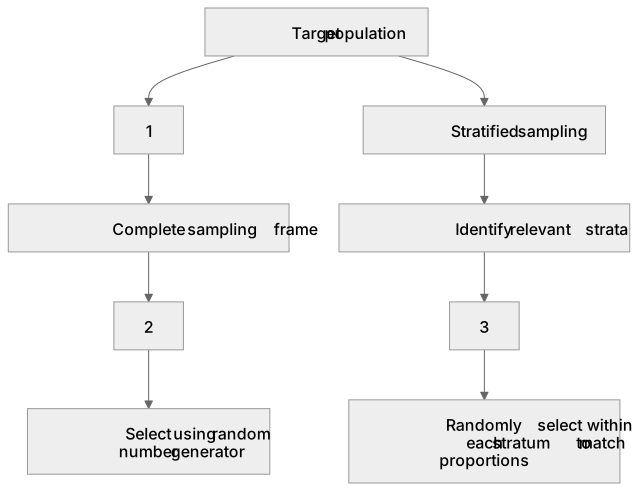
1Box 1
2Box 2
3Box 3
There is more to this lesson
The full lesson goes on to check your understanding and help you earn the marks. Create a free account to carry on, with your progress saved.
A week of Premium from your first lesson · Then the free plan continues · No card, no charge
Test your understanding of Handling data: Understand the principles of sampling as applied to scientific data (to include: explaining how a random or stratified sample could be obtained from a target population)
Active recall beats re-reading. Take an instant quiz now to test what you’ve learned and lock it into long-term memory.
A week of Premium from your first lesson · Then the free plan continues · No card, no charge