AQA · A-Level · Psychology
Lateralisation and Split-Brain Research
Sperry's 1968 split-brain research offered a groundbreaking glimpse into the independent functions of the brain's two hemispheres. By studying patients who had their corpus callosum severed, he revealed how language is lateralised to the left hemisphere and visuo-spatial skills to the right, a foundational concept for understanding brain organisation and earning marks in the AQA exam.
- 6 min read
- 3 worked examples
- 5 practice questions
- 6 key terms
Study Notes
Overview
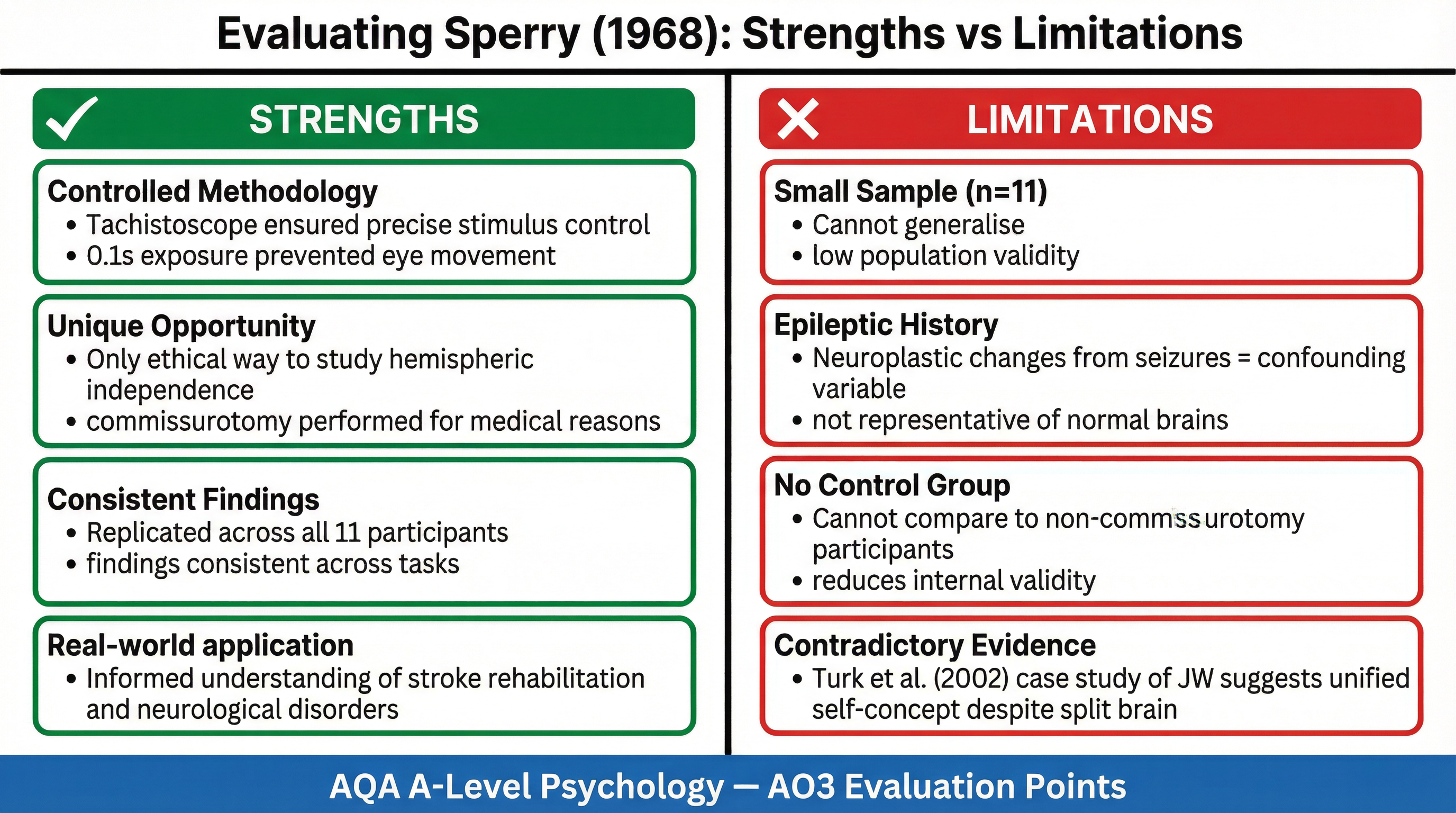
This guide focuses on hemispheric lateralisation and the pivotal split-brain research conducted by Roger Sperry (1968). This topic is a cornerstone of the Biopsychology section of the AQA A-Level specification. Examiners expect candidates to demonstrate a precise understanding of Sperry's methodology, including the use of a tachistoscope, and to articulate the distinct functions of the left and right hemispheres as revealed by his findings. A significant portion of marks, particularly in higher-tariff questions, are awarded for AO3 evaluation. This involves critically assessing the research's strengths, such as its controlled nature, and its limitations, including the small, unique sample of epileptic patients. Mastery of this study is not just about memorising facts; it's about understanding the logic of the experimental design and the profound implications of its conclusions for our understanding of consciousness and brain function.

Key Individuals
Roger Sperry
Role: Neuropsychologist and Nobel Prize laureate.
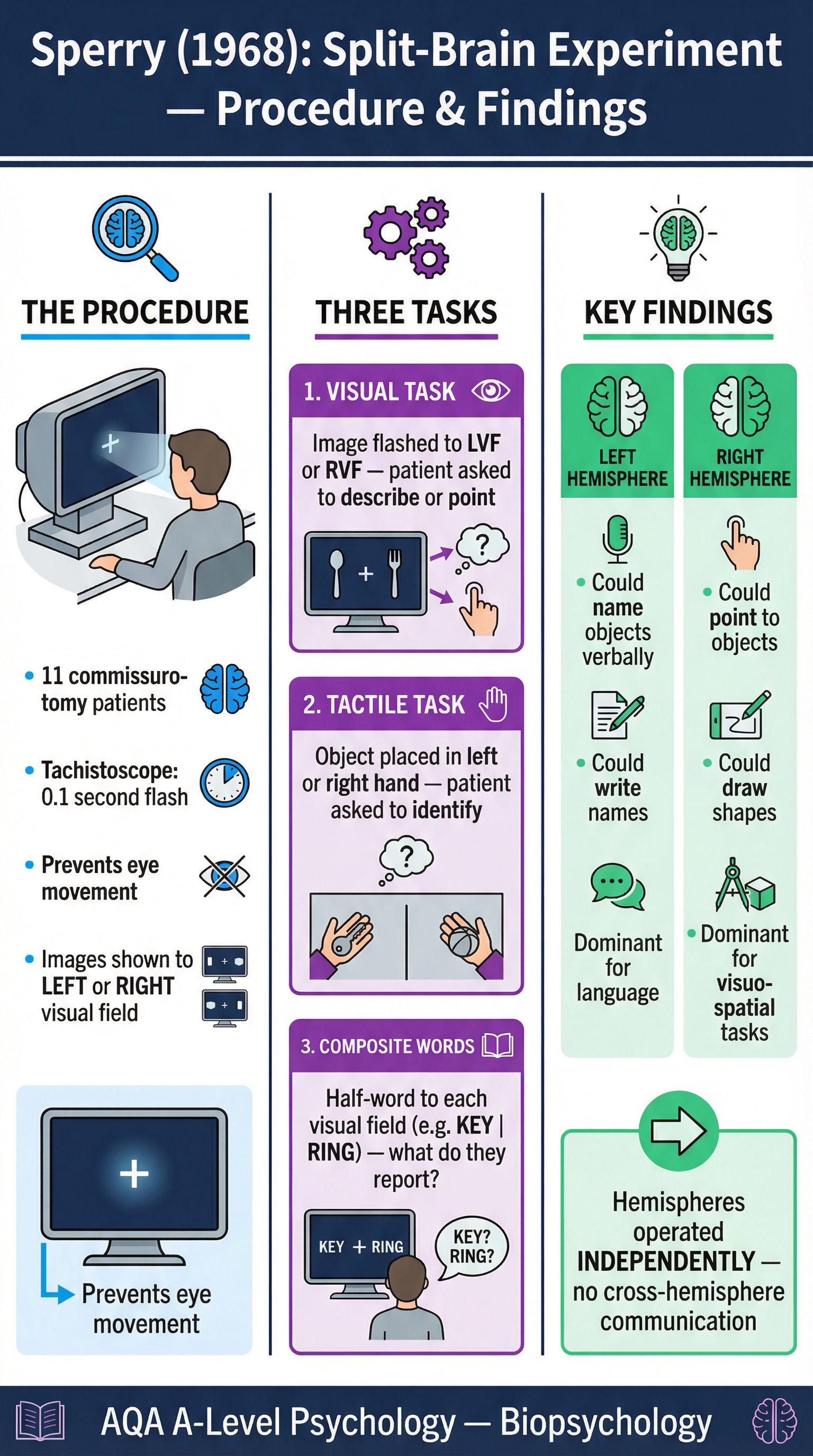
Key Actions: Devised and conducted the 1968 study on 11 commissurotomy (split-brain) patients to investigate hemispheric lateralisation.
Impact: Sperry's work provided the first direct experimental evidence of the specialised functions of the left and right hemispheres, fundamentally shaping modern neuroscience. His findings are a core component of the AQA Psychology specification.
Michael Gazzaniga
Role: Psychologist, a student of Sperry's who worked closely with him on the split-brain research.
Key Actions: Continued and expanded upon Sperry's work, conducting further experiments and developing theories about consciousness and the 'left-brain interpreter'.
Impact: Gazzaniga's subsequent research has refined our understanding of how the two hemispheres interact and how the left hemisphere, in particular, creates a coherent narrative of our experiences.
Key Concepts & Procedure
Hemispheric Lateralisation
What it is: The theory that different mental functions and behaviours are predominantly controlled by either the left or the right hemisphere. For the exam, you must know that for most right-handed people, the left hemisphere is dominant for language and analytical thought, while the right hemisphere is dominant for visuo-spatial tasks, facial recognition, and emotion.
Why it matters: This principle underpins the entire study. Sperry's research was designed specifically to test the theory of lateralisation by studying hemispheres that could no longer communicate.
The Split-Brain Procedure (Commissurotomy)
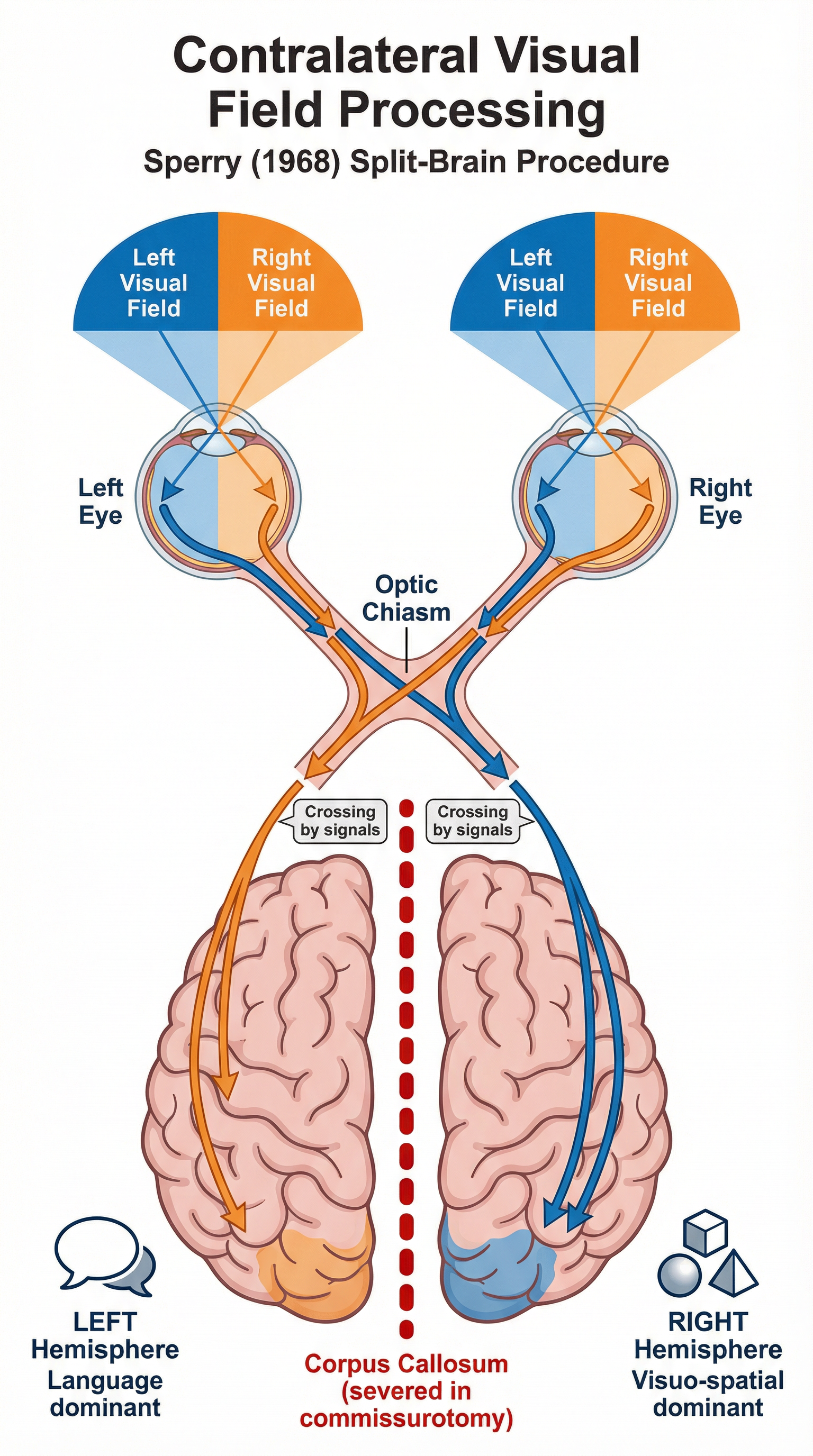
What happened: The corpus callosum, a large bundle of nerve fibres connecting the two hemispheres, was surgically severed. This was a treatment for patients with severe, drug-resistant epilepsy, as it prevents a seizure from spreading across the entire brain.
Why it matters: This created a unique 'natural experiment'. For the first time, researchers could present a stimulus to a single hemisphere and observe its function in isolation, as information could no longer cross over to the other side.
The Tachistoscope Procedure
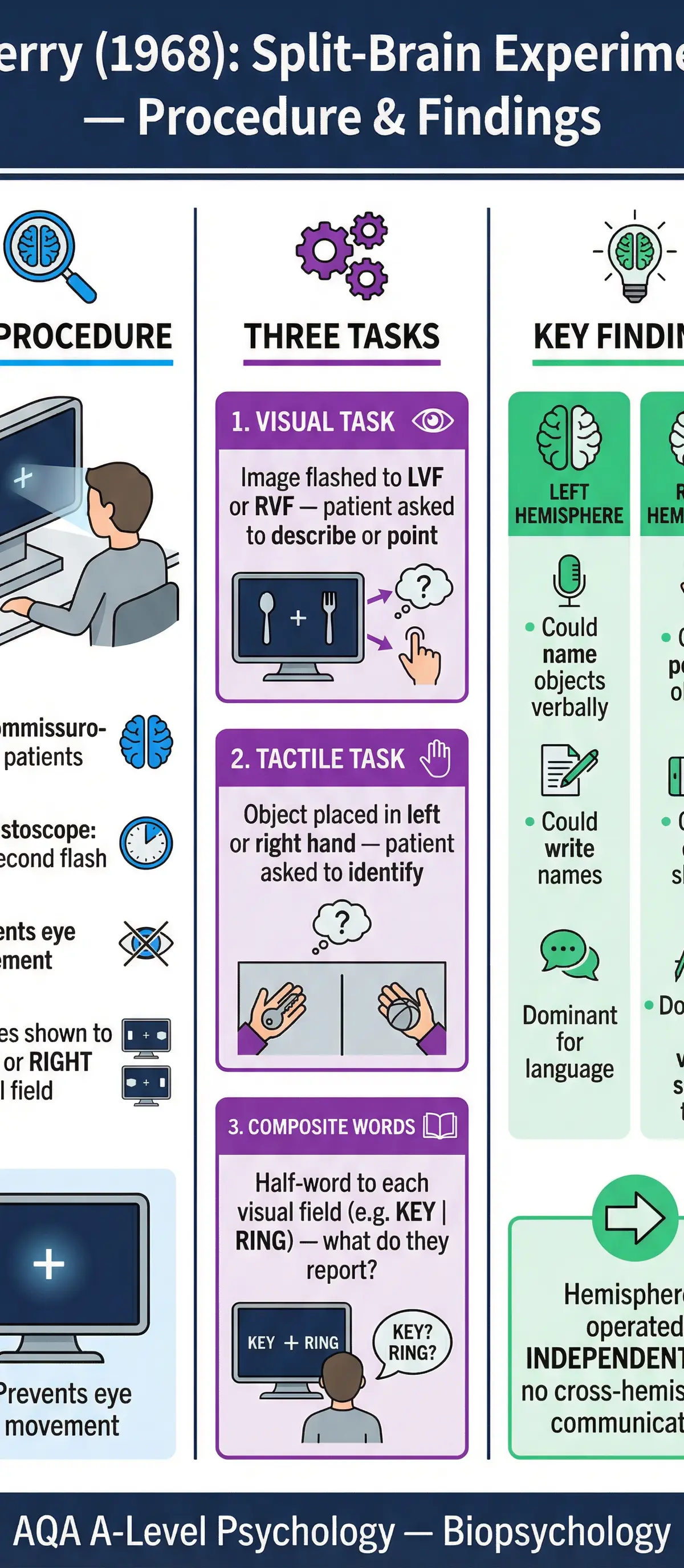
What happened: Sperry used a device called a tachistoscope to present visual information to one visual field at a time. An image or word was flashed for just 0.1 seconds. This is crucial because it is too fast for the participant to move their eyes, ensuring the information only entered the intended visual field.
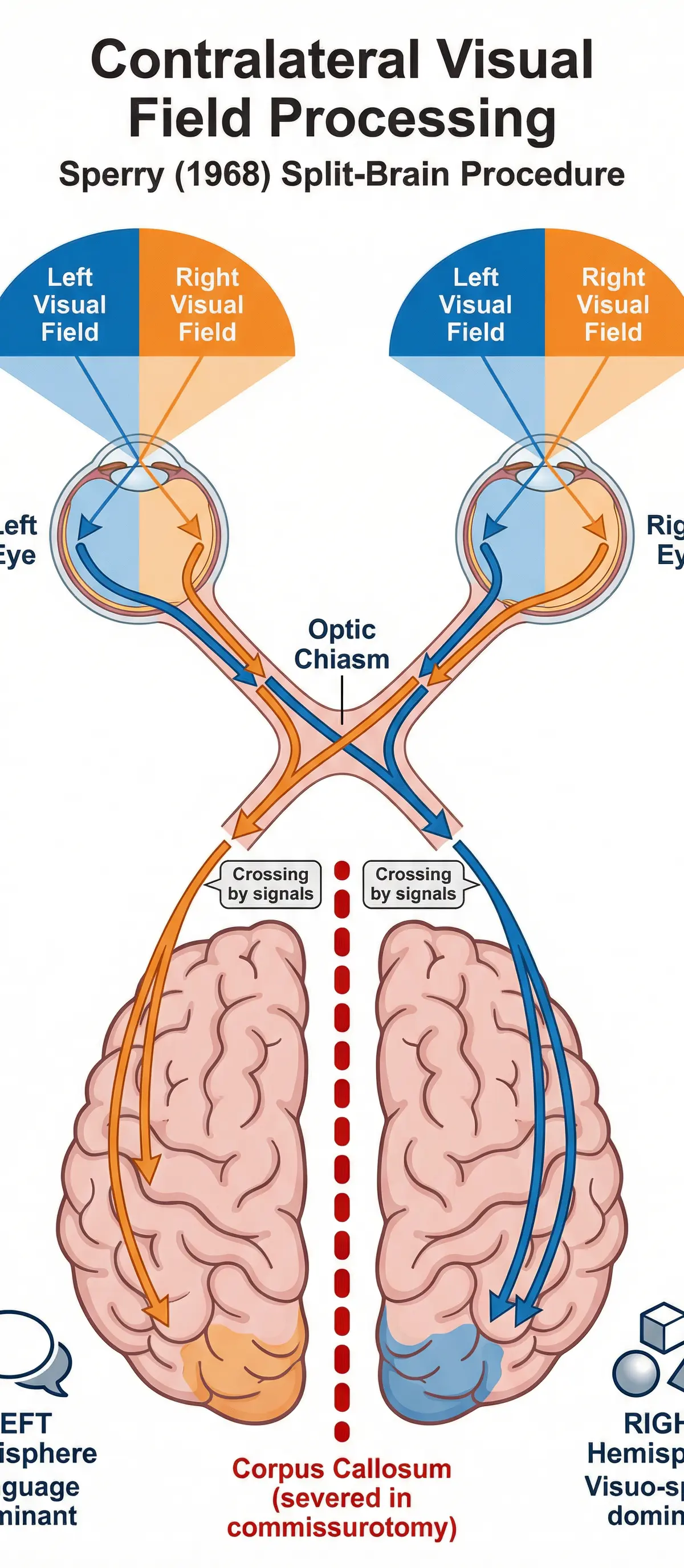
Specific Knowledge: Remember the principle of contralateral control: information from the Left Visual Field (LVF) is processed by the Right Hemisphere, and information from the Right Visual Field (RVF) is processed by the Left Hemisphere. Candidates often confuse visual field with the left or right eye, which is a critical error.
Second-Order Concepts
Causation
Sperry's research was caused by a confluence of factors: the availability of a unique patient group (commissurotomy patients), the development of technology (the tachistoscope) that allowed for precise experimental control, and a driving theoretical question about the extent of hemispheric lateralisation.
Consequence
The immediate consequence was a clear demonstration of hemispheric specialisation. The long-term consequences have been vast, influencing theories of consciousness, our understanding of neurological disorders, and approaches to rehabilitation after brain injury (e.g., stroke). It cemented the idea that the brain is not a single, homogenous organ but a complex system of specialised modules.
Change & Continuity
Sperry's work marked a significant change from previous holistic views of the brain. However, more recent research into neuroplasticity has introduced continuity, showing that while hemispheres are specialised, the brain is not static. Functions can reorganise and lateralisation can change with age or after injury, challenging the idea that these functions are rigidly fixed.
Significance
The significance of Sperry's research is immense. It provided the first compelling experimental evidence for theories of lateralisation and opened up a new field of cognitive neuroscience. For the AQA exam, its significance lies in its status as a classic study that candidates must know in detail, particularly regarding its methodology and evaluation.
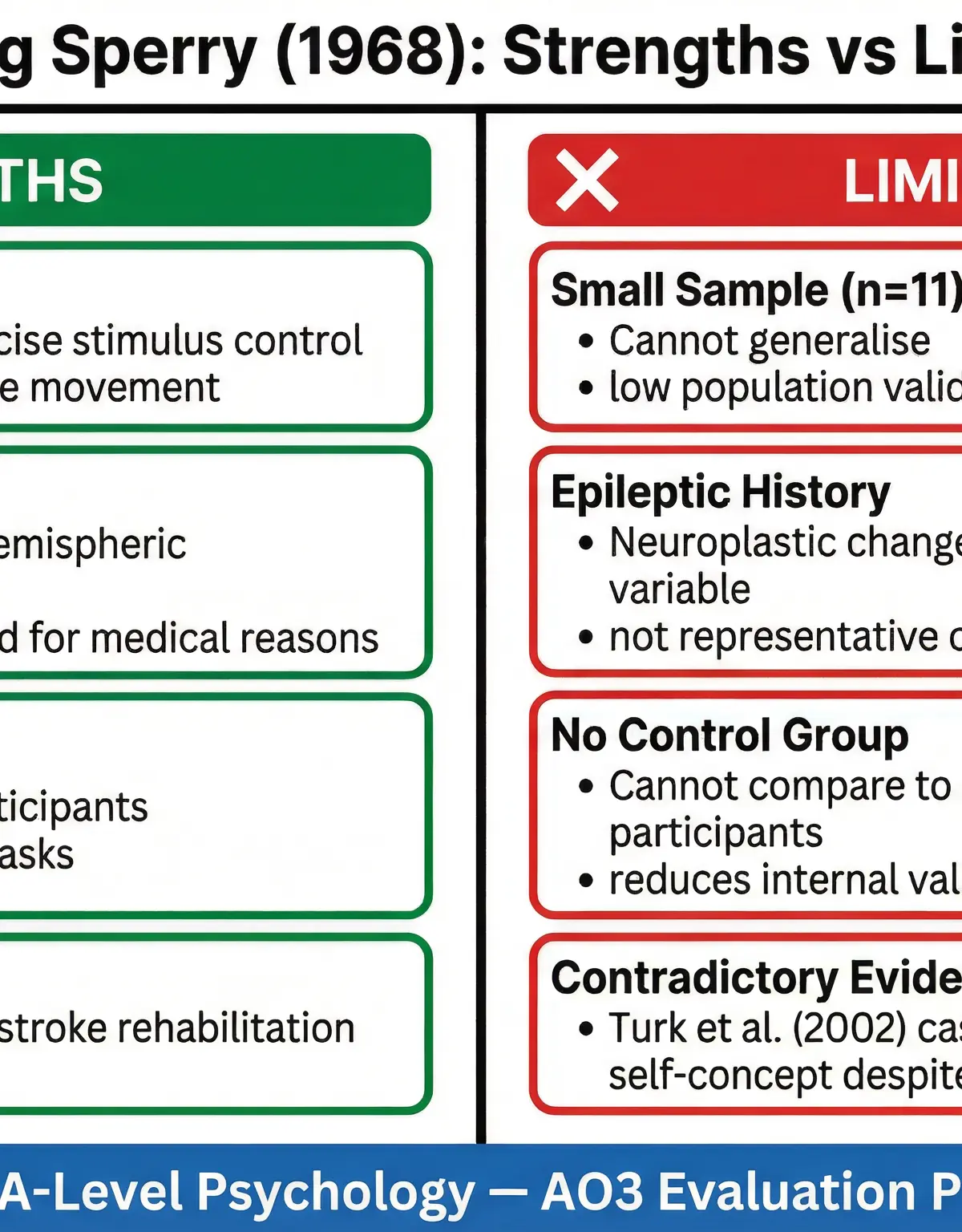
Evaluation of Sperry's Research
Visual Resources
3 diagrams and illustrations
Interactive Diagrams
1 interactive diagram to visualise key concepts
Conceptual Flow Outline
Flowchart of information processing in a split-brain patient during a visual task.
Worked Examples
3 worked examples — open one to explore the question and available guidance.
Practice Questions
Test your understanding — click to reveal model answers
Discuss what split-brain research has shown about hemispheric lateralisation. (16 marks)
Hint: Focus on a balance of AO1 (what the research showed) and AO3 (evaluating how well it showed it). Aim for 6 marks of description and 10 marks of evaluation.
Outline the procedure of Sperry's (1968) split-brain research. (6 marks)
Hint: Be precise. Mention the sample, the equipment, and the key features of the task.
Explain one limitation of using split-brain patients to study hemispheric lateralisation. (3 marks)
Hint: Don't just state the limitation, explain the implication for the research findings.
Using your knowledge of split-brain research, explain what a patient would report if the word 'FACE' was flashed to their left visual field. (3 marks)
Hint: Trace the information from the visual field to the hemisphere to the response.
Explain why research into brain plasticity might challenge the findings of split-brain research. (4 marks)
Hint: Think about how plasticity suggests the brain is 'flexible' whereas Sperry's findings suggest it is 'fixed'.