AQA · A-Level · Psychology
Course version: 7182-2025 · Exams from 2027
Variables: manipulation and control of variables, including independent,…
Full specification wording
Scientific processes: Variables: manipulation and control of variables, including independent, dependent, extraneous; operationalisation of variables.
In psychological research, the independent variable (IV) is deliberately manipulated by the researcher to observe its effect, while the dependent variable (DV) is the outcome that is measured.
Checked against the AQA 7182-2025 specification (opens in a new tab) on .
- Point 8 of 17
- 4 key terms
Study notes
From the checked teaching notes for this specification point.
The idea
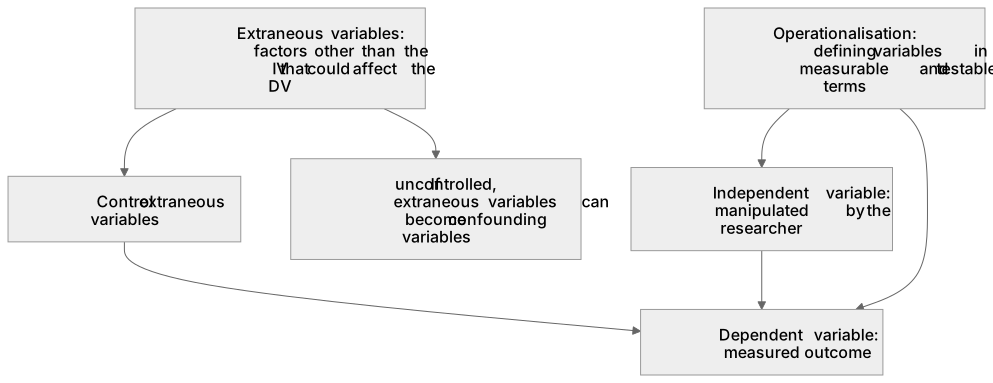
In psychological research, the independent variable (IV) is deliberately manipulated by the researcher to observe its effect, while the dependent variable (DV) is the outcome that is measured. To ensure valid results, researchers must control extraneous variables (EVs)—any factors other than the IV that could affect the DV, such as noise levels or participant age. If left uncontrolled, EVs can become confounding variables. Operationalisation is the crucial process of defining these variables in strictly measurable and testable terms.
For example: Instead of a vague IV like 'caffeine' and DV like 'memory', a researcher operationalises them as 'drinking 200 milligrams of caffeine' and 'the number of words correctly recalled from a list of twenty'.
What earns the marks
- Identify the independent variable as the factor manipulated by the researcher and the dependent variable as the factor measured.
- Explain that extraneous variables are nuisance factors that must be controlled to prevent them from affecting the dependent variable.
- Define operationalisation as the process of making variables physically measurable or testable.
- Apply operationalisation to a novel scenario by providing specific, quantifiable measures for both the independent and dependent variables.
Common mistakes and how to put them right
Confusing the independent and dependent variables.
Put it right: The independent variable is manipulated (the cause) and the dependent variable is measured (the effect).
Failing to fully operationalise variables in exam answers; stating 'memory' is incorrect, whereas 'number of words recalled' is the correct operationalised form.
Using the terms extraneous and confounding variables interchangeably.
Put it right: An extraneous variable is a potential nuisance, whereas a confounding variable has actually varied systematically with the independent variable.
Exam tips
- When asked to write a hypothesis, always ensure both the independent and dependent variables are fully operationalised.
- Use the scenario provided in the stem to identify specific extraneous variables rather than giving generic examples like 'temperature'.
- Clearly state how the independent variable is manipulated by describing the different conditions the participants will experience.
Try the lesson
The start of the Scientific processes: Variables: manipulation and control of variables, including independent, dependent, extraneous; operationalisation of variables. lesson, made from checked teaching notes for this specification point.
Have a go first
In an experiment investigating the effect of caffeine on memory recall, participants are given either a caffeinated drink or a decaffeinated drink before completing a memory test. What is the independent variable in this study?
Listen
In psychological research, the independent variable (IV) is deliberately manipulated by the researcher to observe its effect, while the dependent variable (DV) is the outcome that is measured. To ensure valid results, researchers must control extraneous variables (EVs)—any factors other than the IV that could affect the DV, such as noise levels or participant age. If left uncontrolled, EVs can become confounding variables. Operationalisation is the crucial process of defining these variables in strictly measurable and testable terms. For example, instead of a vague IV like 'caffeine' and DV like 'memory', a researcher operationalises them as 'drinking 200 milligrams of caffeine' and 'the number of words correctly recalled from a list of twenty'. A strong answer earns marks for these points. Identify the independent variable as the factor manipulated by the researcher and the dependent variable as the factor measured. Explain that extraneous variables are nuisance factors that must be controlled to prevent them from affecting the dependent variable. Define operationalisation as the process of making variables physically measurable or testable. Apply operationalisation to a novel scenario by providing specific, quantifiable measures for both the independent and dependent variables. Exam tip: When asked to write a hypothesis, always ensure both the independent and dependent variables are fully operationalised.
See it
Key words
Say what each word means before you turn the card.
Independent variable
Try answering aloud or in your head before turning the card.
Dependent variable
Try answering aloud or in your head before turning the card.
Extraneous variables
Try answering aloud or in your head before turning the card.
Operationalisation
Try answering aloud or in your head before turning the card.
See every definition
- Independent variable
- The factor that is deliberately manipulated by the researcher to observe its effect.
- Dependent variable
- The outcome that is measured by the researcher.
- Extraneous variables
- Any factors other than the independent variable that could affect the dependent variable, such as noise levels or participant age.
- Operationalisation
- The process of defining variables in strictly measurable and testable terms.
Label the diagram
Some boxes have lost their names. Pick the right name for each number.
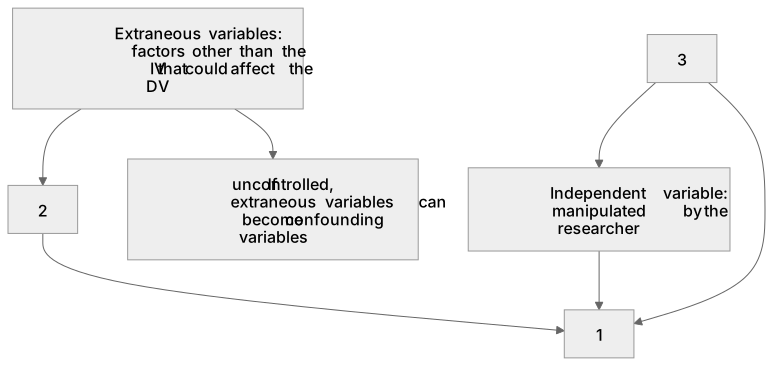
1Box 1
2Box 2
3Box 3
There is more to this lesson
The full lesson goes on to check your understanding and help you earn the marks. Create a free account to carry on, with your progress saved.
A week of Premium from your first lesson · Then the free plan continues · No card, no charge
Test your understanding of Scientific processes: Variables: manipulation and control of variables, including independent, dependent, extraneous; operationalisation of variables.
Active recall beats re-reading. Take an instant quiz now to test what you’ve learned and lock it into long-term memory.
A week of Premium from your first lesson · Then the free plan continues · No card, no charge