AQA · A-Level · Psychology
Course version: 7182-2025 · Exams from 2027
Reliability across all methods of investigation. Ways of measuring…
Full specification wording
Scientific processes: Reliability across all methods of investigation. Ways of measuring reliability: test-retest and inter-observer; improving reliability.
Reliability refers to the consistency of a measure across all methods of investigation, including experiments, observations, and questionnaires.
Checked against the AQA 7182-2025 specification (opens in a new tab) on .
- Point 14 of 17
Study notes
From the checked teaching notes for this specification point.
The idea
Reliability refers to the consistency of a measure across all methods of investigation, including experiments, observations, and questionnaires. If a tool is reliable, it produces the same results when repeated under identical conditions. Test-retest reliability measures external consistency by administering the same test to the same participants on two separate occasions and correlating the scores (a correlation coefficient of +0.80 or higher indicates good reliability). Inter-observer reliability assesses consistency between two or more independent observers coding the same behaviour; their records are correlated to ensure objectivity. Reliability can be improved by standardising procedures, operationalising variables clearly, training observers, or replacing ambiguous questionnaire items with closed questions.
What earns the marks
- Define reliability as the consistency of findings or measuring instruments across different research methods.
- Explain test-retest reliability as administering the same test to the same people twice, with an appropriate time gap to prevent recall but avoid genuine change.
- Describe inter-observer reliability as multiple researchers independently recording behaviour using the same behavioural categories, then correlating their data.
- Identify that a Spearman's rho or Pearson's r correlation coefficient of +0.80 or greater demonstrates strong reliability.
- Explain methods to improve reliability, such as standardising instructions, operationalising behavioural categories, or rewriting ambiguous questions.
Common mistakes and how to put them right
Confusing reliability with validity.
Put it right: Reliability is about consistency (getting the same result), whereas validity is about accuracy (measuring what is intended).
Stating that inter-observer reliability involves observers discussing their findings to reach an agreement.
Put it right: Observers must record data independently before comparing and correlating their results.
Suggesting a short time gap for test-retest reliability.
Put it right: The gap must be long enough so participants forget their original answers, but short enough that their actual traits have not changed.
Exam tips
- When asked how to assess reliability in a scenario, explicitly state whether test-retest or inter-observer is most appropriate for the method used.
- Always mention the statistical threshold (+0.80 correlation coefficient) when explaining how to establish reliability.
- If asked to improve reliability in an observation, specifically mention operationalising behavioural categories so they are mutually exclusive and observable.
Try the lesson
The start of the Scientific processes: Reliability across all methods of investigation. Ways of measuring reliability: test-retest and inter-observer; improving reliability. lesson, made from checked teaching notes for this specification point.
Have a go first
A researcher wants to assess the reliability of a new questionnaire measuring stress levels. They administer the questionnaire to the same group of participants on two separate occasions, one month apart. Which method of assessing reliability is being used?
Listen
Reliability refers to the consistency of a measure across all methods of investigation, including experiments, observations, and questionnaires. If a tool is reliable, it produces the same results when repeated under identical conditions. Test-retest reliability measures external consistency by administering the same test to the same participants on two separate occasions and correlating the scores (a correlation coefficient of +0.80 or higher indicates good reliability). Inter-observer reliability assesses consistency between two or more independent observers coding the same behaviour; their records are correlated to ensure objectivity. Reliability can be improved by standardising procedures, operationalising variables clearly, training observers, or replacing ambiguous questionnaire items with closed questions. A strong answer earns marks for these points. Define reliability as the consistency of findings or measuring instruments across different research methods. Explain test-retest reliability as administering the same test to the same people twice, with an appropriate time gap to prevent recall but avoid genuine change. Describe inter-observer reliability as multiple researchers independently recording behaviour using the same behavioural categories, then correlating their data. Identify that a Spearman's rho or Pearson's r correlation coefficient of +0.80 or greater demonstrates strong reliability. A common slip: Confusing reliability with validity. Instead, reliability is about consistency (getting the same result), whereas validity is about accuracy (measuring what is intended). Exam tip: When asked how to assess reliability in a scenario, explicitly state whether test-retest or inter-observer is most appropriate for the method used.
See it
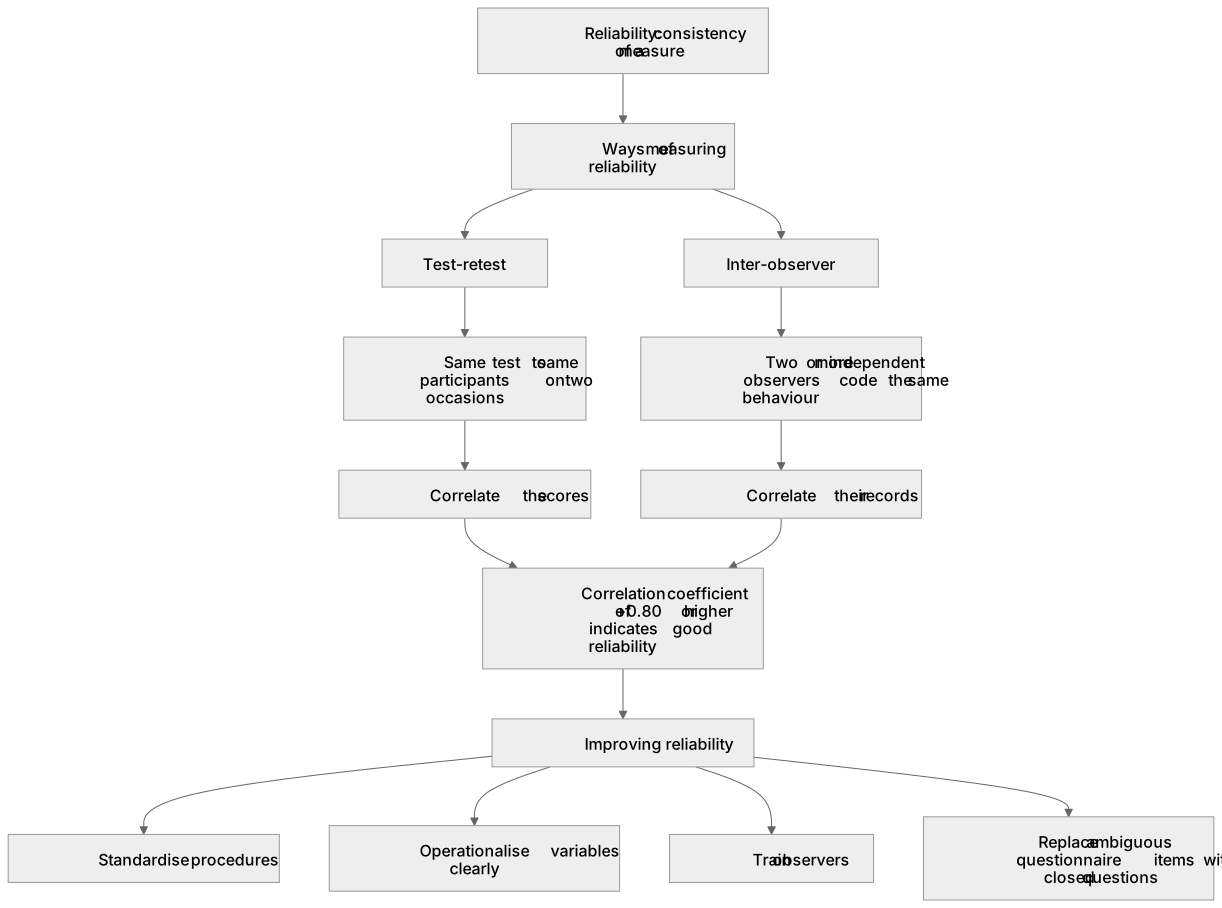
Label the diagram
Some boxes have lost their names. Pick the right name for each number.
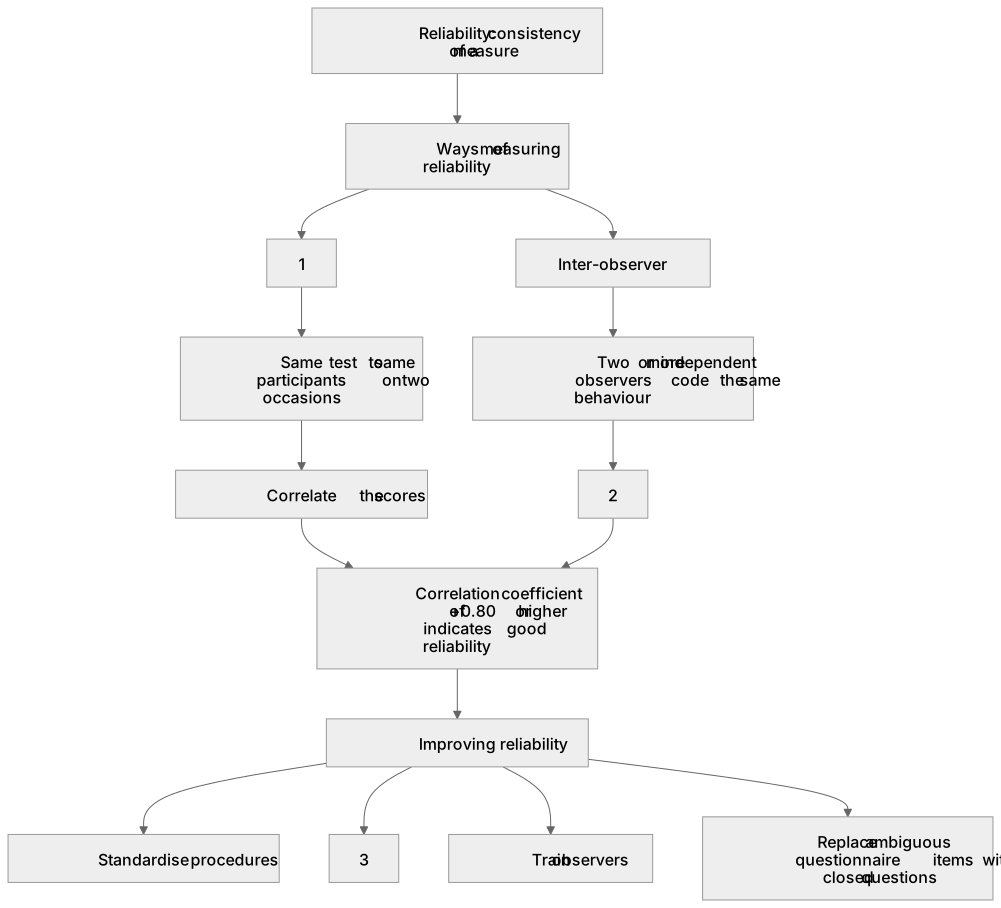
1Box 1
2Box 2
3Box 3
There is more to this lesson
The full lesson goes on to check your understanding and help you earn the marks. Create a free account to carry on, with your progress saved.
A week of Premium from your first lesson · Then the free plan continues · No card, no charge
Test your understanding of Scientific processes: Reliability across all methods of investigation. Ways of measuring reliability: test-retest and inter-observer; improving reliability.
Active recall beats re-reading. Take an instant quiz now to test what you’ve learned and lock it into long-term memory.
A week of Premium from your first lesson · Then the free plan continues · No card, no charge