AQA · A-Level · Psychology
Course version: 7182-2025 · Exams from 2027
The implications of psychological research for the economy.
Full specification wording
Scientific processes: The implications of psychological research for the economy.
The economy here means the money and working time a country gains or loses, so a creditworthy answer runs from a finding, through a change in behaviour or policy, to a cost.
Checked against the AQA 7182-2025 specification (opens in a new tab) on .
- Point 13 of 17
- 4 key terms
Study notes
From the checked teaching notes for this specification point.
The idea
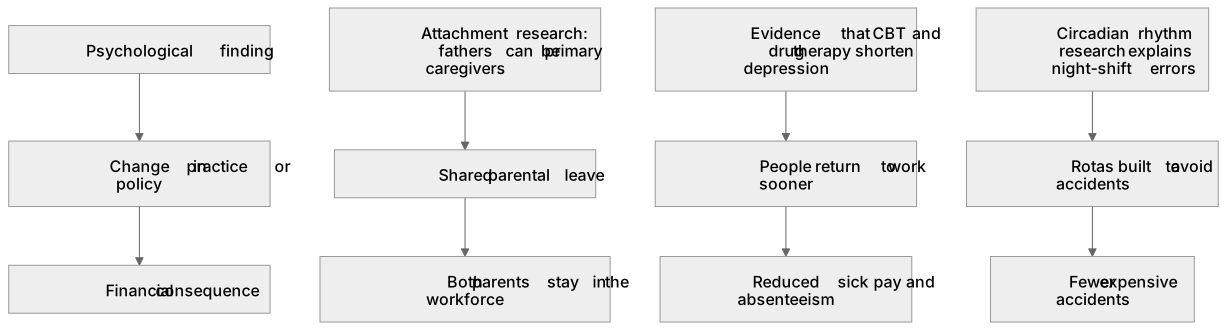
The economy here means the money and working time a country gains or loses, so a creditworthy answer runs from a finding, through a change in behaviour or policy, to a cost. Attachment research showing that fathers can be primary caregivers underpins shared parental leave, which keeps both parents in the workforce rather than one leaving it. Absence caused by mental illness costs employers billions a year, so evidence that CBT and drug therapy shorten episodes of depression returns people to work sooner and reduces sick pay. Work on circadian rhythms explains why errors cluster on night shifts, as at Chernobyl, and lets employers build rotas that avoid expensive accidents. Weak answers describe the psychology in detail and never arrive at the money, which is where the marks are.
What earns the marks
- States that economic implications concern the money and productivity gained or lost by employers and the state.
- Identifies a relevant area of research, such as attachment, treatments for mental illness or biological rhythms.
- Explains the change in practice or policy that the research supports.
- Makes the financial consequence explicit, for example reduced absenteeism, lower treatment costs or fewer accidents.
- Evaluates the link, noting that the chain from finding to saving is often indirect or hard to quantify.
Common mistakes and how to put them right
Describing the study at length and never mentioning cost, productivity or employment.
Talking about the cost of doing the research rather than the economic effect of its findings.
Asserting a saving with no mechanism, for example 'therapy helps the economy'.
Using an unrelated topic because it is well known, when the question directs you to the material in the stem.
Exam tips
- Write the chain in three steps, finding, change in practice, financial consequence, and make each visible in its own clause.
- One developed example outscores three undeveloped ones in these questions.
- Have an evaluative sentence ready about how hard it is to isolate the economic impact of a single study.
Try the lesson
The start of the Scientific processes: The implications of psychological research for the economy. lesson, made from checked teaching notes for this specification point.
Have a go first
Which of the following best describes a direct implication of psychological research into effective treatments for depression on the economy?
Listen
The economy here means the money and working time a country gains or loses, so a creditworthy answer runs from a finding, through a change in behaviour or policy, to a cost. Attachment research showing that fathers can be primary caregivers underpins shared parental leave, which keeps both parents in the workforce rather than one leaving it. Absence caused by mental illness costs employers billions a year, so evidence that CBT and drug therapy shorten episodes of depression returns people to work sooner and reduces sick pay. Work on circadian rhythms explains why errors cluster on night shifts, as at Chernobyl, and lets employers build rotas that avoid expensive accidents. Weak answers describe the psychology in detail and never arrive at the money, which is where the marks are. A strong answer earns marks for these points. States that economic implications concern the money and productivity gained or lost by employers and the state. Identifies a relevant area of research, such as attachment, treatments for mental illness or biological rhythms. Explains the change in practice or policy that the research supports. Makes the financial consequence explicit, for example reduced absenteeism, lower treatment costs or fewer accidents. Exam tip: Write the chain in three steps, finding, change in practice, financial consequence, and make each visible in its own clause.
See it
Key words
Say what each word means before you turn the card.
Application of research to policy
Try answering aloud or in your head before turning the card.
Absenteeism and productivity
Try answering aloud or in your head before turning the card.
Cost of treatment and healthcare
Try answering aloud or in your head before turning the card.
Real-world impact of psychology
Try answering aloud or in your head before turning the card.
See every definition
- Application of research to policy
- Using a finding to support a change in practice or policy, such as shared parental leave or rotas that avoid expensive accidents.
- Absenteeism and productivity
- Absence caused by mental illness costs employers billions a year, and therapy that shortens episodes of depression returns people to work sooner and reduces sick pay.
- Cost of treatment and healthcare
- Evidence that CBT and drug therapy shorten episodes of depression is linked to the money and working time a country gains or loses.
- Real-world impact of psychology
- The chain from a finding, through a change in behaviour or policy, to a cost, which is where the marks are.
Label the diagram
Some boxes have lost their names. Pick the right name for each number.
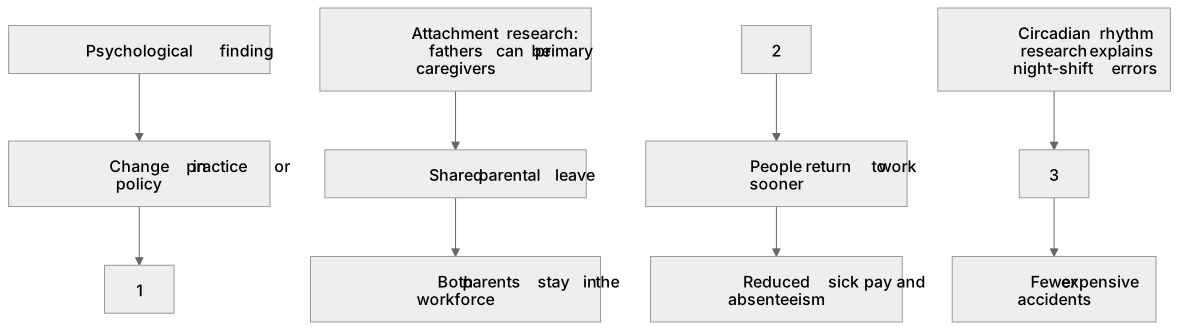
1Box 1
2Box 2
3Box 3
There is more to this lesson
The full lesson goes on to check your understanding and help you earn the marks. Create a free account to carry on, with your progress saved.
A week of Premium from your first lesson · Then the free plan continues · No card, no charge
Test your understanding of Scientific processes: The implications of psychological research for the economy.
Active recall beats re-reading. Take an instant quiz now to test what you’ve learned and lock it into long-term memory.
A week of Premium from your first lesson · Then the free plan continues · No card, no charge