AQA · A-Level · Psychology
Social Influence and Social Change
This study guide explores the psychological mechanisms behind social change, focusing on how minorities can influence majorities. It is a crucial topic for AQA A-Level Psychology, as it explains how societal shifts, from the suffragettes to modern environmentalism, actually happen, providing you with the key theories and research to excel in your exam.
- 6 min read
- 3 worked examples
- 4 practice questions
- 7 key terms
Study Notes

Overview
This topic examines the intricate processes by which a society's attitudes, beliefs, and behaviours are transformed over time. Social change, in the context of the AQA specification, is largely driven by minority influence, a process where a small group or even a single individual persuades the majority to adopt their viewpoint. Examiners expect candidates to demonstrate a clear understanding of the step-by-step process, from the initial efforts of a minority to the eventual widespread acceptance of a new norm. This involves detailing the key characteristics of a successful minority—Consistency, Commitment, and Flexibility—and explaining how these lead to deeper cognitive processing and internalisation of the new attitude in the majority. Furthermore, you must be able to describe the subsequent stages, including the 'snowball effect' and 'social cryptoamnesia', and evaluate the theories using relevant research evidence. Marks are awarded for a precise application of these concepts to novel scenarios and for a critical assessment of their real-world validity.
The Process of Social Change
1. Minority Influence: The Engine of Change
What is it: Social change is initiated when a minority group challenges the established norms and values of the majority.
Why it matters: For any change to begin, there must be a catalyst. The minority provides this by presenting an alternative viewpoint that disrupts the status quo and forces the majority to re-evaluate their own beliefs. This is not about simple compliance; it is about starting a process of genuine conversion.
Key Characteristics for Success:
- Consistency: The minority must present a consistent and unwavering message over time. This can be synchronic (all members saying the same thing) or diachronic (saying the same thing for a long period). Consistency creates cognitive conflict in the majority, making them question their own views. Moscovici's study is the key evidence here.
- Commitment: Minorities often engage in extreme activities to draw attention to their cause. This commitment, sometimes involving risk or sacrifice, demonstrates certainty and courage. This is known as the augmentation principle. It suggests to the majority that the cause must be valid.
- Flexibility: While consistency is important, minorities must not appear rigid or dogmatic. Nemeth (1986) argued that being able to adapt and accept valid counter-arguments makes the minority appear more reasonable and less extreme, increasing their chances of persuasion.
2. The Snowball Effect
What happened: Once the minority has gained some traction through their consistent and committed approach, a process of conversion begins. More and more people from the majority start to switch to the minority viewpoint.
Why it matters: This is the critical tipping point. As the minority grows in size, its influence accelerates rapidly, much like a snowball gathering mass as it rolls downhill. The rate of conversion increases until the minority view becomes the new majority norm.

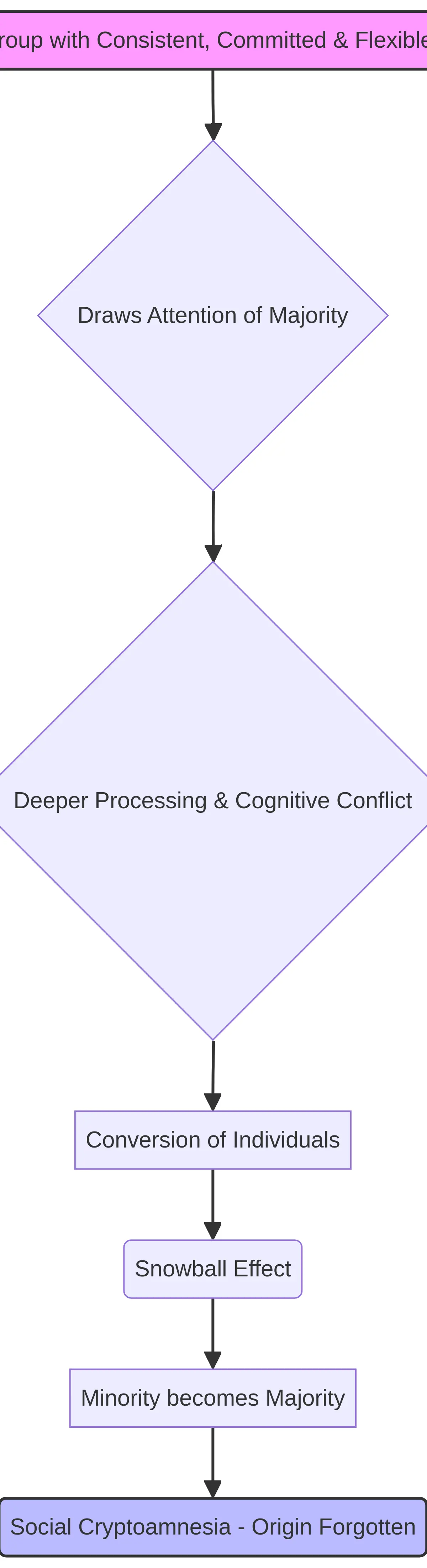
3. Social Cryptoamnesia
What happened: After a period of time, the new majority attitude becomes an integral part of the social culture. However, the population often has no memory that this new attitude was once a minority view.
Why it matters: This final stage signifies that the social change is complete and has been fully internalised. The origin of the change is forgotten, and the new belief is taken for granted as the norm. For example, many people today support recycling and environmentalism without knowing the specific activists who pioneered the movement.
Key Individuals & Research
Serge Moscovici
Role: Pioneering researcher into minority influence.
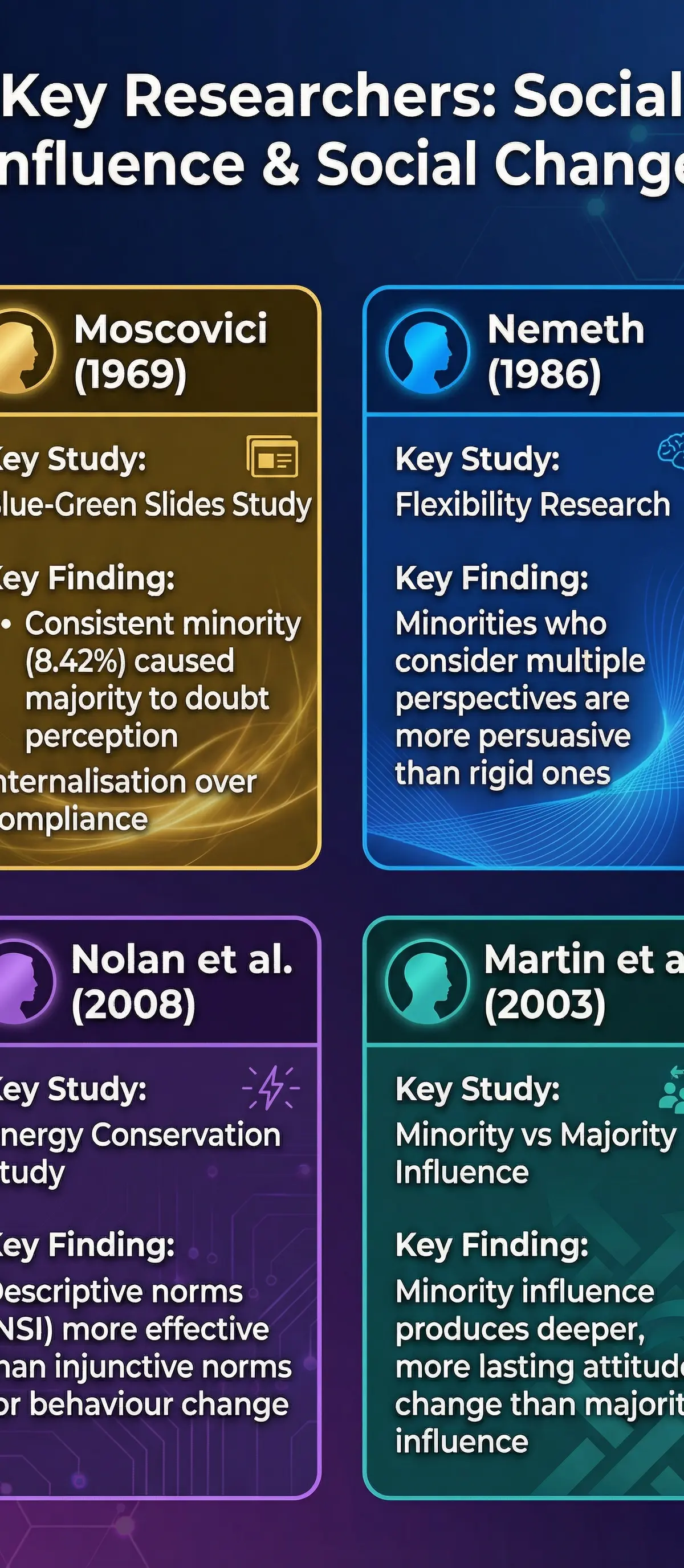
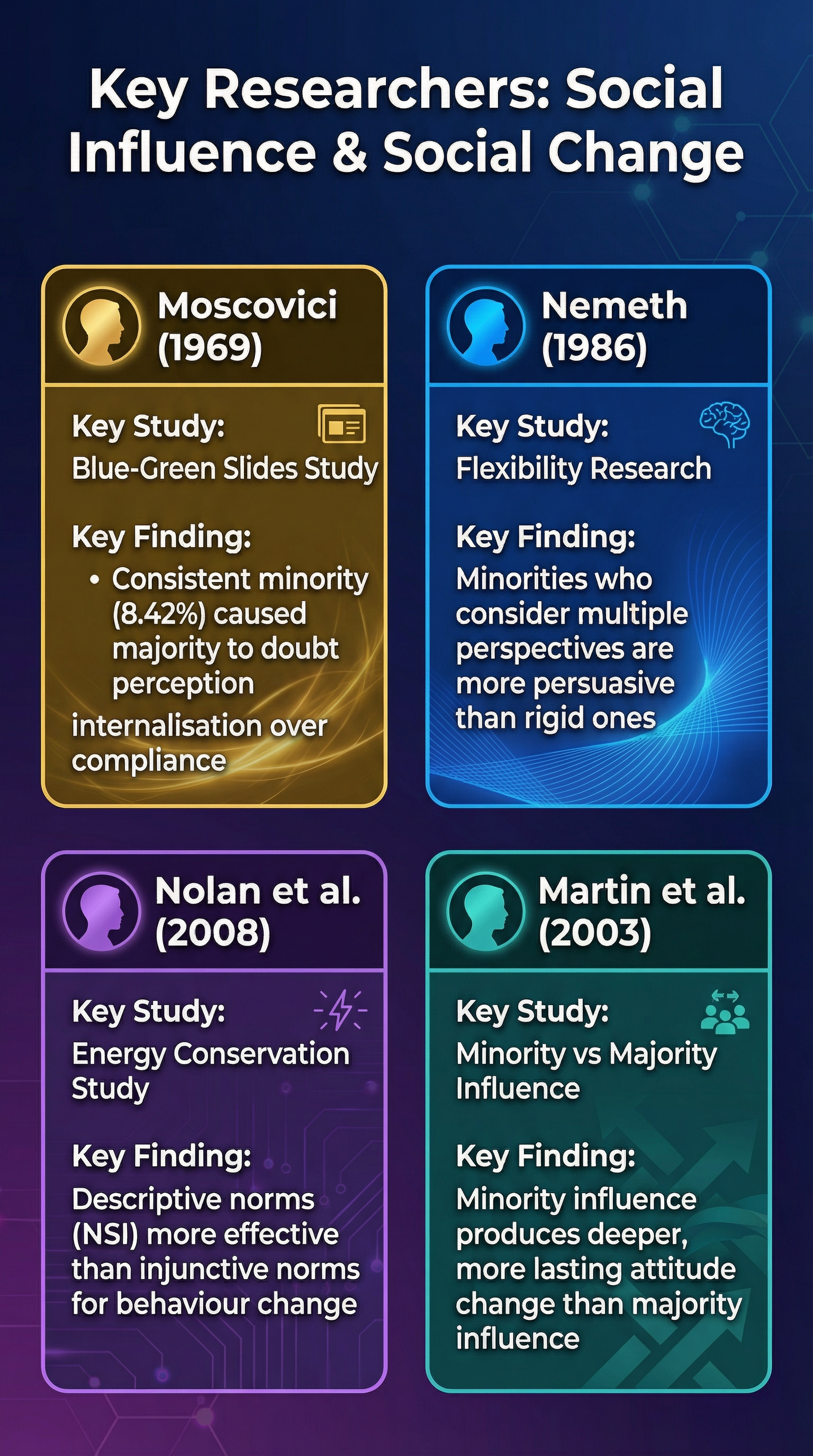
Key Actions: Conducted the famous 'blue-green slide' experiment in 1969. Groups of six participants (four real, two confederates) were asked to name the colour of 36 slides, which were all varying shades of blue. In the consistent condition, the two confederates called the slides 'green' every time, influencing around 8.42% of the majority to agree. In the inconsistent condition, their influence was negligible.
Impact: Moscovici demonstrated that a consistent minority could indeed influence the majority, challenging the traditional view that influence only flows from the majority to the minority. He showed that this influence leads to internalisation (private as well as public change).
Charlan Nemeth
Role: Researcher who highlighted the importance of flexibility.
Key Actions: Argued that consistency without flexibility can be perceived as dogmatic and off-putting. In her research, she found that a minority who was prepared to compromise on a key point was more effective at influencing the majority than one that was completely rigid.
Impact: Nemeth refined the understanding of minority influence, showing that there needs to be a balance between being consistent in your core message and being flexible in your delivery.
Nolan et al. (2008)
Role: Researcher who investigated the role of Normative Social Influence (NSI) in social change.
Key Actions: Conducted a field experiment on energy conservation. They hung messages on the front doors of houses in San Diego, California, every week for a month. The key message was that most other residents were trying to reduce their energy consumption. A control group had a message just asking them to save energy, but with no reference to others' behaviour.
Impact: They found that the descriptive norm message (referencing others' behaviour) produced a significant decrease in energy usage compared to the control. This suggests that NSI can be a powerful tool for social change, as people are motivated to fit in with their social group.
Visual Resources
3 diagrams and illustrations

Interactive Diagrams
1 interactive diagram to visualise key concepts
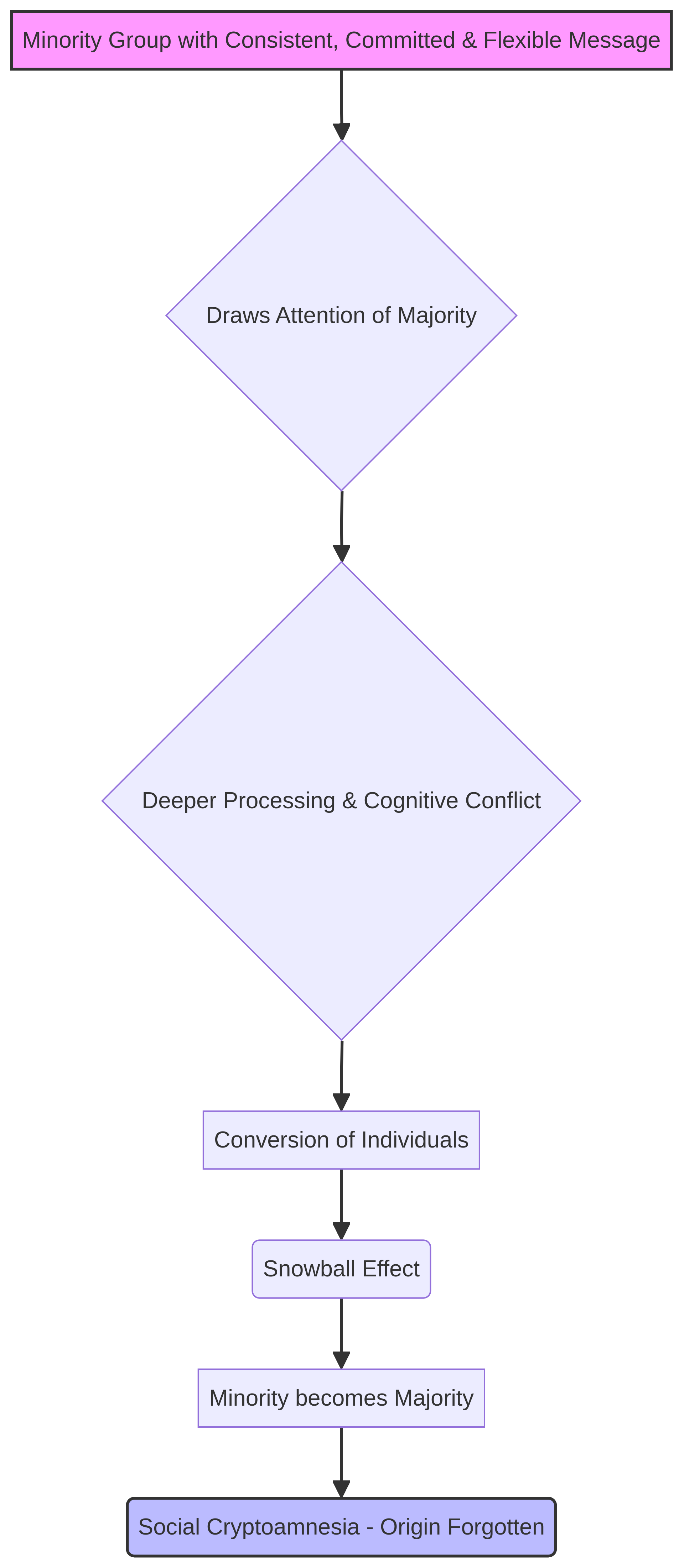
Conceptual Flow Outline
Flowchart showing the stages of social change through minority influence.
Worked Examples
3 worked examples — open one to explore the question and available guidance.
Practice Questions
Test your understanding — click to reveal model answers
Describe and evaluate the role of normative social influence in bringing about social change. (10 marks)
Hint: Think about how the desire to fit in can be harnessed by campaigns. Use Nolan et al. (2008) as your key study and consider the limitations of this approach.
Explain the role of consistency in minority influence. (4 marks)
Hint: Define the two types of consistency and explain what effect it has on the majority. Use Moscovici.
What is meant by the augmentation principle? (2 marks)
Hint: Think about how risk and sacrifice 'augment' or strengthen the message.
Discuss what psychological research has told us about social change. (16 marks)
Hint: This is a broad question. You should cover both minority influence processes (Moscovici, Nemeth) and the role of conformity/obedience (Asch, Milgram, Zimbardo) in maintaining or changing social norms. Your evaluation should compare the different explanations.