Pearson Edexcel · A-Level · Psychology
Social Impact Theory
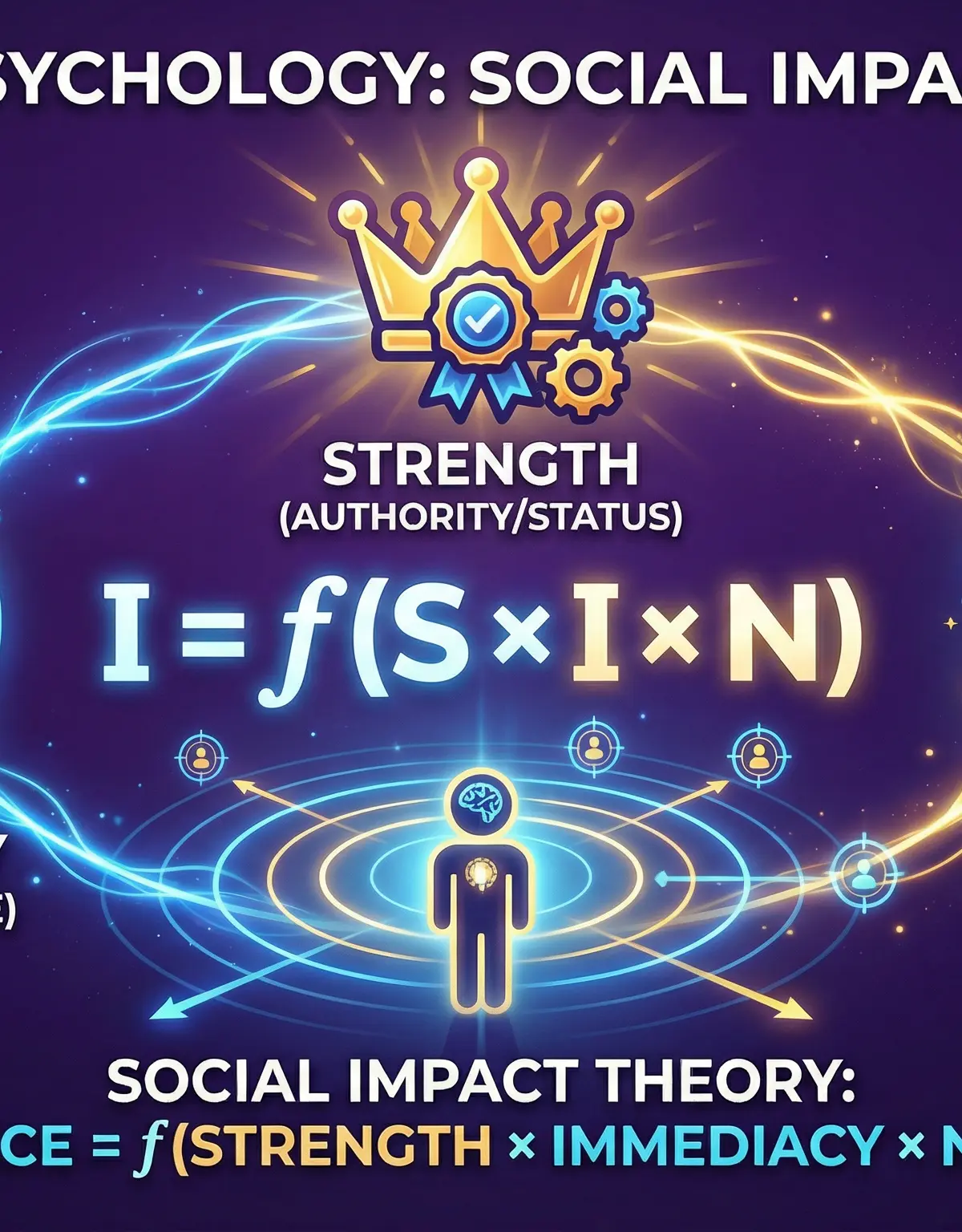
Latané's (1981) Social Impact Theory offers a mathematical formula, I = f(SIN), to predict the level of social influence based on the Strength, Immediacy, and Number of sources. This guide breaks down the core principles, key studies, and evaluation points candidates need to secure top marks in the Edexcel A-Level exam.
- 8 min read
- 3 worked examples
- 5 practice questions
- 6 key terms
Study Notes
Overview
Social Impact Theory, developed by Bibb Latané in 1981, is a model that seeks to explain and predict the extent to which individuals are affected by the real, implied, or imagined presence of other people. It moves beyond purely descriptive accounts of social influence by proposing a mathematical formula: I = f(S x I x N). For candidates, this theory is a gift; it provides a clear, structured way to describe social influence (AO1), apply it to novel scenarios (AO2), and evaluate its strengths and weaknesses (AO3). Examiners expect candidates to not only define the three core factors but also to explain the crucial distinction between the multiplication and division of impact, particularly in the context of bystander behaviour. Mastery of this topic is demonstrated by a candidate's ability to use the formula as a framework, cite key evidence like Sedikides & Jackson (1990), and contrast the theory's predictive power with the explanatory power of other theories like Agency Theory.

The Core Formula: I = f(SIN)
The central proposition of the theory is that the impact (I) of any social force is a function (f) of the combination of three factors: Strength (S), Immediacy (I), and Number (N). Credit is awarded for stating this formula clearly. It acts as a predictive tool, suggesting that as the combined value of S, I, and N increases, so does the social impact.
The Three Key Factors (SIN)
Examiners will award marks for a clear and accurate definition of each of the three factors. It is crucial to use psychological terminology and avoid simplistic, everyday language.
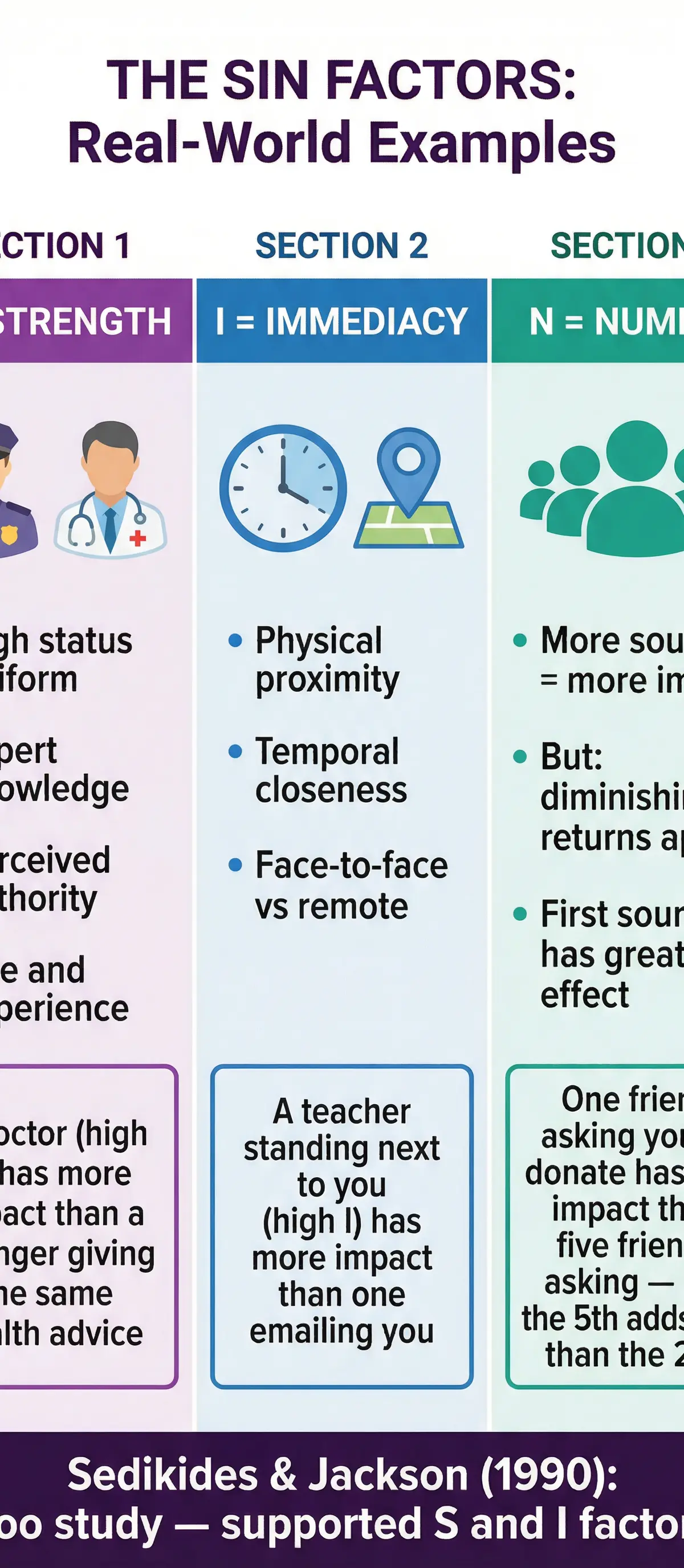
Strength (S)
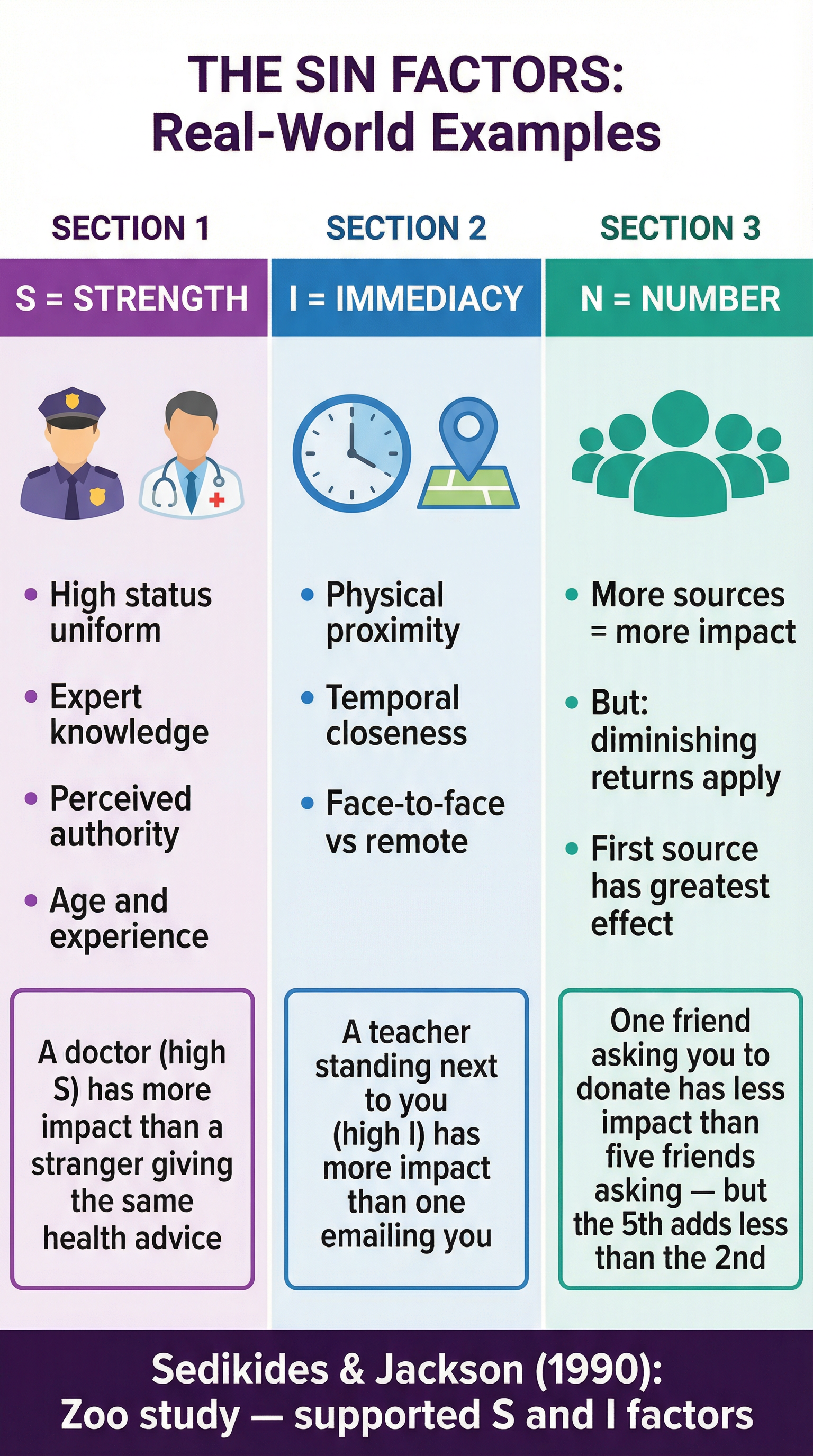
What it is: Strength refers to the perceived power, authority, status, or expertise of the source of influence. It is crucial that candidates understand this is about social power, not physical strength. A common error is to define this in terms of physical size or force, which will not receive credit.
Why it matters: The higher the perceived status of the source, the more impact they will have. For example, a request from a uniformed police officer (high Strength) is more likely to be obeyed than the same request from someone in casual clothes (low Strength).
Specific Knowledge: Credit is given for examples such as a doctor's advice (expertise), a parent's instruction (authority), or an older person's opinion (age/experience).
Immediacy (I)
What it is: Immediacy relates to the proximity of the source to the target in terms of time and space. Higher impact occurs when the source is physically closer and the influence attempt is happening in the present moment.
Why it matters: Influence is stronger when it is direct and present. A teacher standing over a student's desk (high Immediacy) has more impact than a note sent from the staffroom (low Immediacy). This also includes temporal distance; events in the distant past have less immediacy.
Specific Knowledge: Candidates can gain marks by contrasting face-to-face interaction with remote communication like email or text messages.
Number (N)
What it is: Number refers to how many sources of influence are present. Generally, the more sources there are, the greater the impact.
Why it matters: This explains why conformity rates increase as the size of the majority grows. However, candidates must demonstrate a nuanced understanding of this factor by referencing the Psychosocial Law.
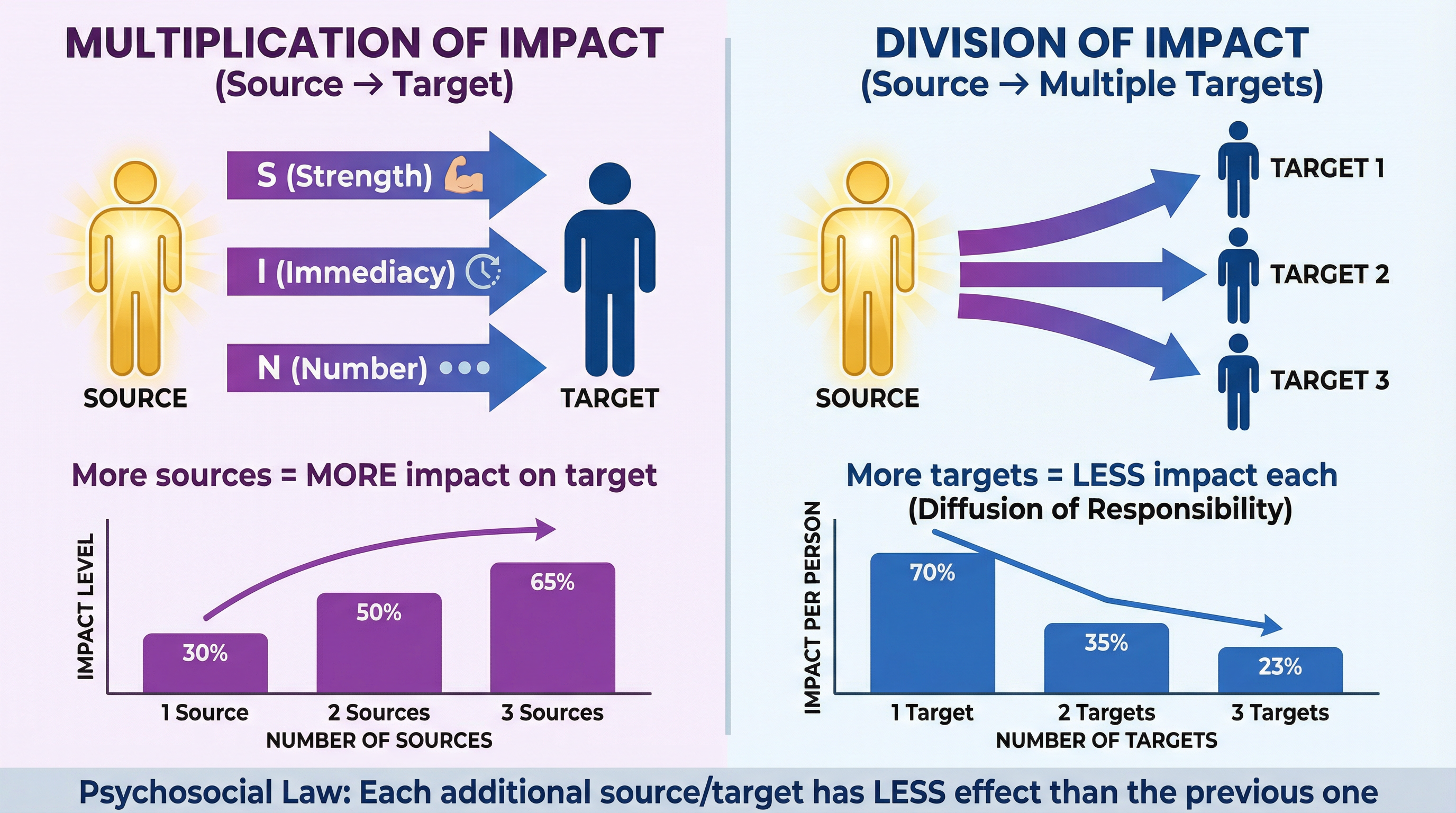
The Psychosocial Law: Latané argued that the effect of the Number factor is not linear. The first source of influence has the most dramatic impact, and each subsequent source adds progressively less impact. This is a principle of diminishing returns. For example, the difference in impact between 1 and 2 sources is far greater than the difference between 9 and 10 sources. Marks are specifically awarded for explaining this concept.
Multiplication vs. Division of Impact
A key distinction that separates high-achieving candidates is the ability to explain the two ways social force operates.
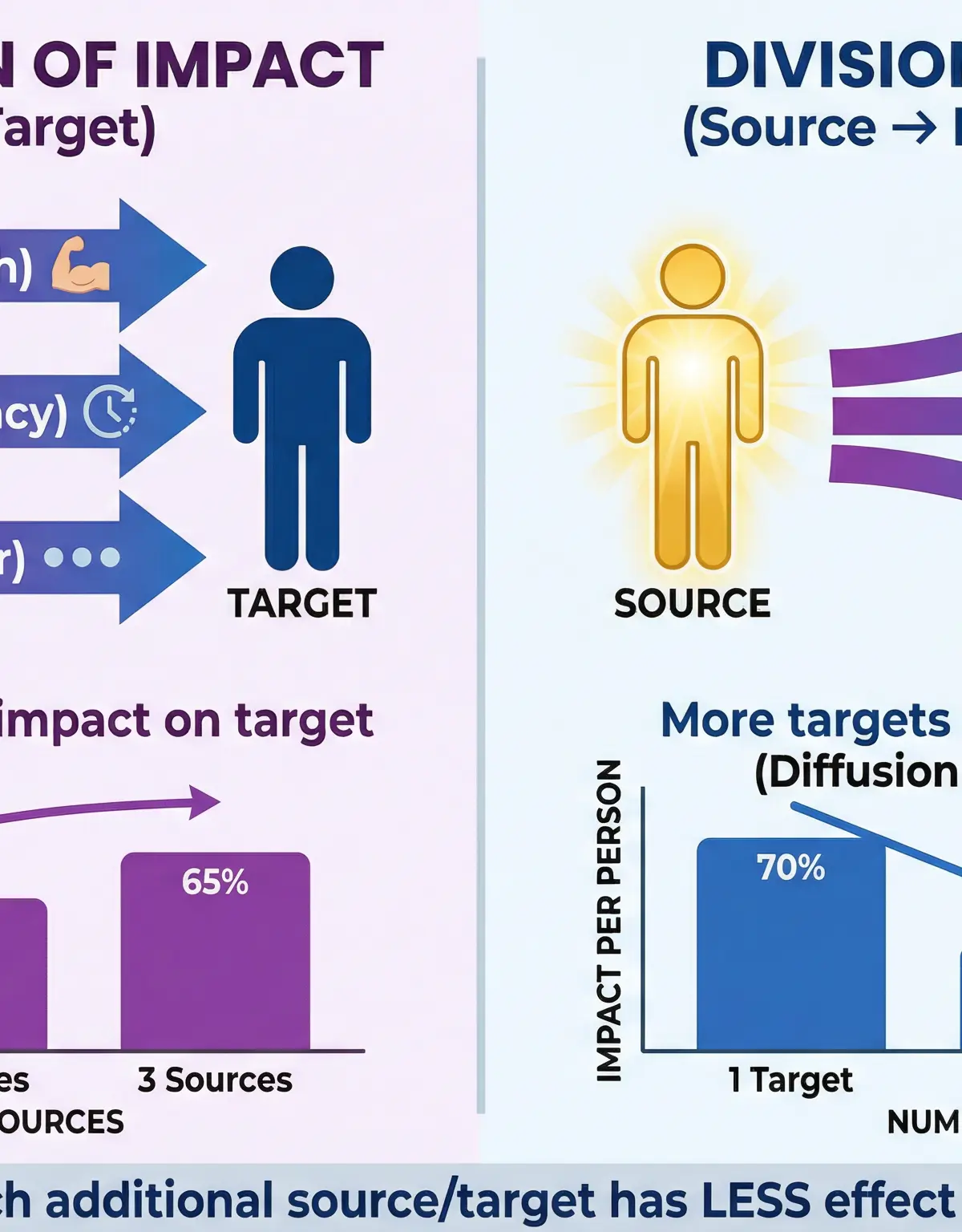
Multiplication of Impact (Sources on Target)
This is the standard application of I = f(SIN), where multiple sources exert influence on a single target. As S, I, and N increase, the impact on the target multiplies. This explains conformity and obedience where a group or authority figure influences an individual.
Division of Impact (Source on Targets)
This concept is crucial for explaining bystander apathy. When one source of influence directs their attention to multiple targets, the impact is divided among the targets. The more targets there are, the less personal responsibility each one feels. This is also known as diffusion of responsibility.
Application: The Bystander Effect
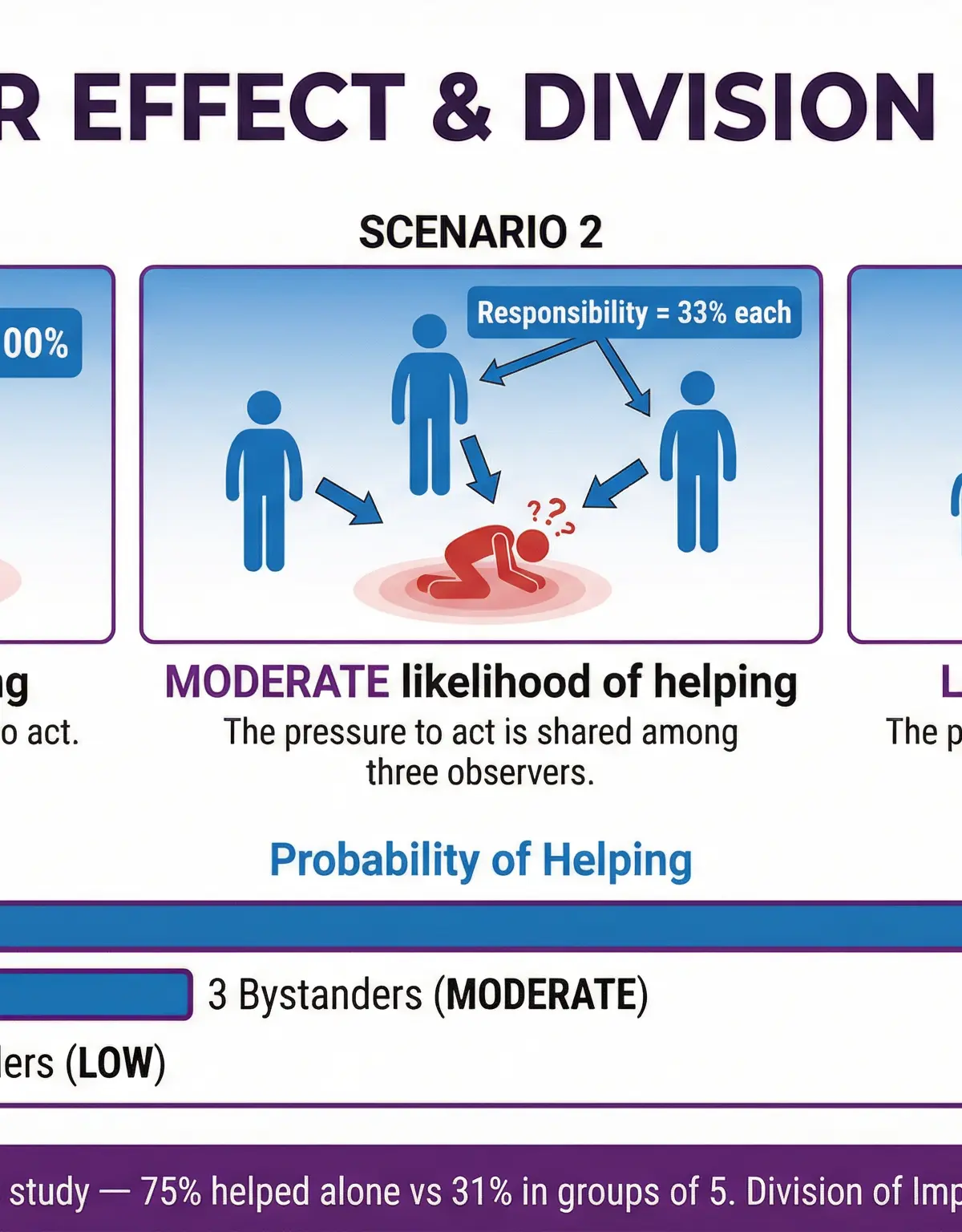
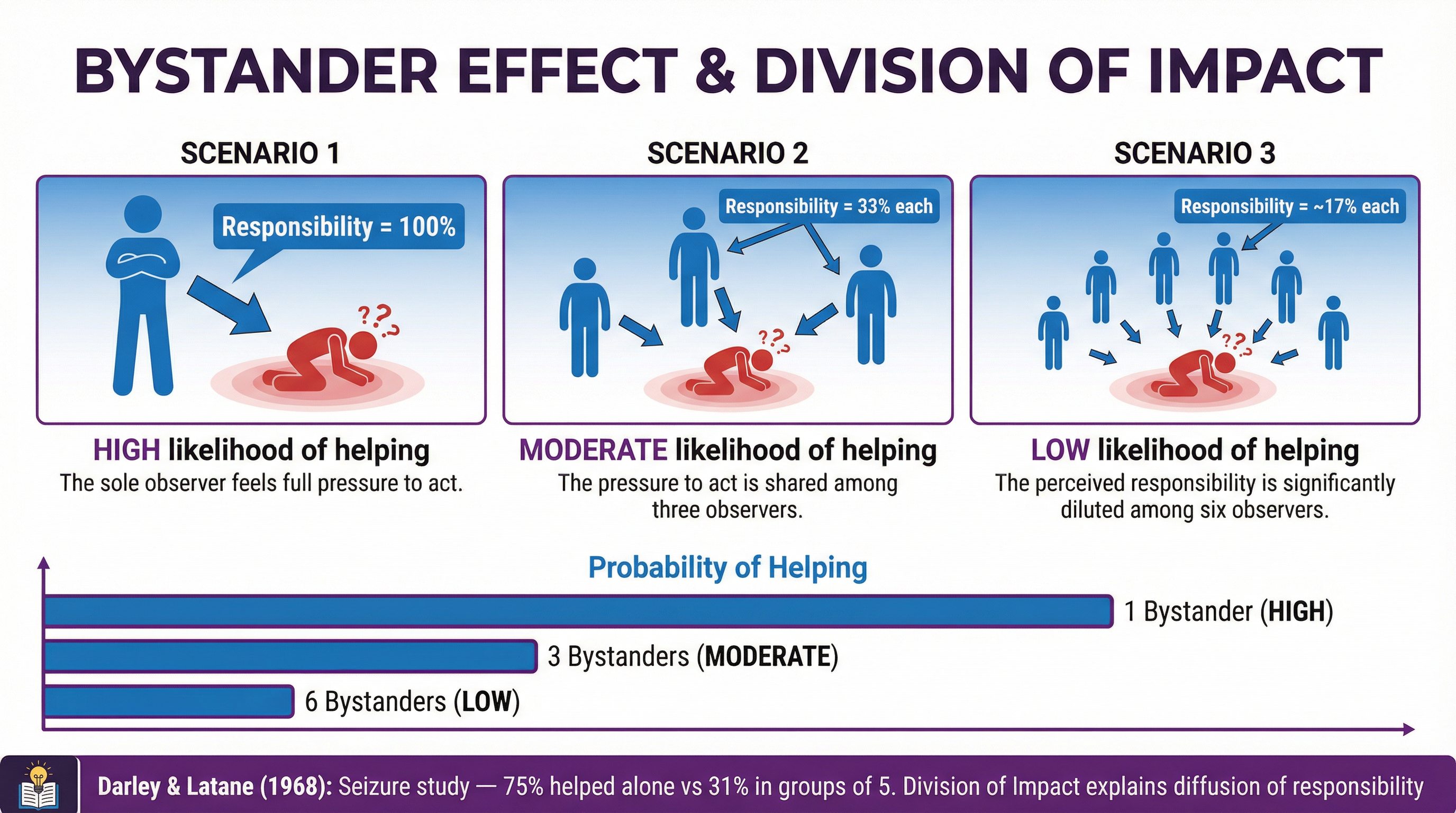
Social Impact Theory provides a powerful explanation for the bystander effect, famously studied by Darley & Latané (1968). In an emergency situation, the person in need is the 'source' and the onlookers are the 'targets'.
- One Bystander: The single target feels 100% of the impact and responsibility. Helping is highly likely.
- Multiple Bystanders: The impact is divided among the group. If there are 10 bystanders, each feels only 1/10th of the responsibility. The likelihood of any single individual helping decreases dramatically.
Candidates should explicitly link the Division of Impact to diffusion of responsibility to gain full credit in scenario questions on this topic.
Key Individual: Bibb Latané
Role: Social Psychologist
Key Actions: Proposed Social Impact Theory (1981); conducted seminal research on the bystander effect with John Darley (e.g., the 1968 'seizure study').
Impact: Provided a quantitative, predictive model for social influence and offered a robust theoretical explanation for diffusion of responsibility. His work is a cornerstone of the social psychology specification.
Key Study: Sedikides & Jackson (1990) - The Zoo Study
Aim: To investigate the effects of Strength and Immediacy on obedience in a real-world setting.
Procedure: Researchers had a confederate dress either as a zoo keeper (high Strength) or in casual clothes (low Strength). The confederate approached visitors in the bird house and told them not to lean on the railings. This instruction was given either when the confederate was in the same room (high Immediacy) or from an adjacent room (low Immediacy).
Findings: Obedience was significantly higher with the uniformed confederate (58% obedience) compared to the casually dressed one (35%). Obedience was also higher when the instruction was given in the same room (61%) compared to the adjacent room (7%).
Conclusion: This study provides strong, ecologically valid support for the roles of Strength (authority of uniform) and Immediacy (physical proximity) in determining social impact. Candidates MUST use this study to support their AO1 descriptions and AO3 evaluations.
Evaluation of Social Impact Theory (AO3)
Examiners expect a balanced evaluation. Candidates should present both strengths and weaknesses.
Strengths:
- Predictive Power: The mathematical formula allows for predictions about behaviour in certain situations. It can predict how much impact a group will have, which is a strength over more descriptive theories.
- Supporting Evidence: Supported by studies like Sedikides & Jackson (1990) for Strength and Immediacy, and Asch's conformity research for the Number factor (with diminishing returns seen after 3 confederates).
- Wide Application: The theory can explain a range of social phenomena, including conformity, obedience, and the bystander effect, giving it high explanatory power.
Weaknesses:
- Reductionist: The theory reduces complex human interactions to a mathematical equation. It ignores the role of cognition, emotions, and individual differences (e.g., personality). It explains what happens, but not why in terms of psychological processes. Credit is given for contrasting this with Agency Theory, which explains the internal 'agentic state'.
- Static, not Dynamic: Social Impact Theory is a snapshot. It doesn't account for how the target and source interact and influence each other over time. It portrays the target as a passive recipient of pressure.
- Issues with Operationalisation: It is difficult to measure Strength and Immediacy in a reliable, quantitative way. How much more 'Strength' does a doctor have than a teacher? The theory doesn't provide a method for this, limiting its practical use as a precise predictive tool.
Visual Resources
3 diagrams and illustrations
Interactive Diagrams
1 interactive diagram to visualise key concepts
Conceptual Flow Outline
A concept map showing the key components and applications of Social Impact Theory.
Worked Examples
3 worked examples — open one to explore the question and available guidance.
Practice Questions
Test your understanding — click to reveal model answers
Outline the effect of Strength and Immediacy in Social Impact Theory. (4 marks)
Hint: Define each term and give an example of how it increases impact.
Using Social Impact Theory, explain why a person might not help someone who has fallen over in a busy street. (6 marks)
Hint: Focus on the 'Division of Impact' and 'Number' of targets.
Evaluate one strength and one weakness of Social Impact Theory. (6 marks)
Hint: For the strength, use a supporting study. For the weakness, consider what the theory ignores.
Distinguish between Social Impact Theory and Agency Theory as explanations of obedience. (4 marks)
Hint: Think about prediction vs. explanation.
Outline the Psychosocial Law. (2 marks)
Hint: Think about what happens when you add more and more people to a group.