Baron-Cohen et al. (1997) - Autism
A deep dive into the classic 1997 Baron-Cohen et al. study, which pioneered the 'Reading the Mind in the Eyes' test. This guide explains how the study provided crucial evidence for Theory of Mind deficits in adults with high-functioning autism and Asperger syndrome, a cornerstone of the OCR A-Level Psychology specification.
Study Notes
Overview
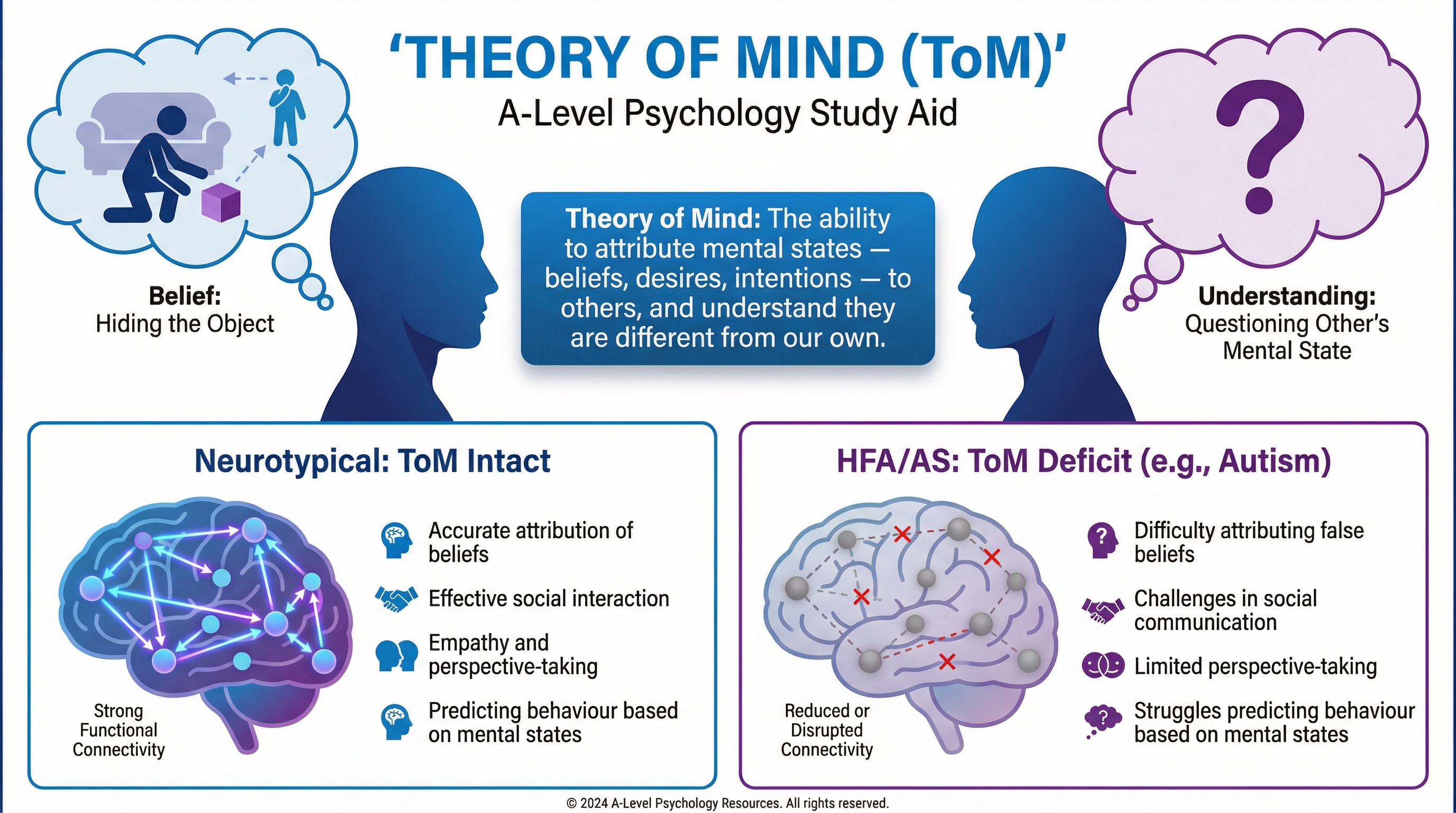
The 1997 study by Baron-Cohen, Jolliffe, Mortimore, and Robertson is a core study within the OCR A-Level Psychology specification, falling under the 'Individual Differences' area. It investigates the subtle social-cognitive deficits in adults with High-Functioning Autism (HFA) or Asperger Syndrome (AS). Before this, it was thought that these adults might have 'outgrown' the Theory of Mind (ToM) deficits seen in childhood. This study challenged that idea by designing a more advanced and sensitive test: the 'Reading the Mind in the Eyes' task. Examiners expect candidates to understand not just the procedure and findings, but the methodological nuances, such as why it is a quasi-experiment and the specific role of the Tourette Syndrome control group. Mastery of this study is crucial for demonstrating an understanding of cognitive deficits, experimental design, and the core assumptions of the individual differences approach.
The Research Method
Experimental Design
Type: Quasi-experiment. This is a critical point that earns marks. The Independent Variable (IV) was the participant's diagnosis (HFA/AS, Normal, or Tourette Syndrome), which is a naturally occurring characteristic and not something the researchers could manipulate or randomly assign. The Dependent Variable (DV) was the score on the Eyes Task.
Groups: Three distinct groups were compared:
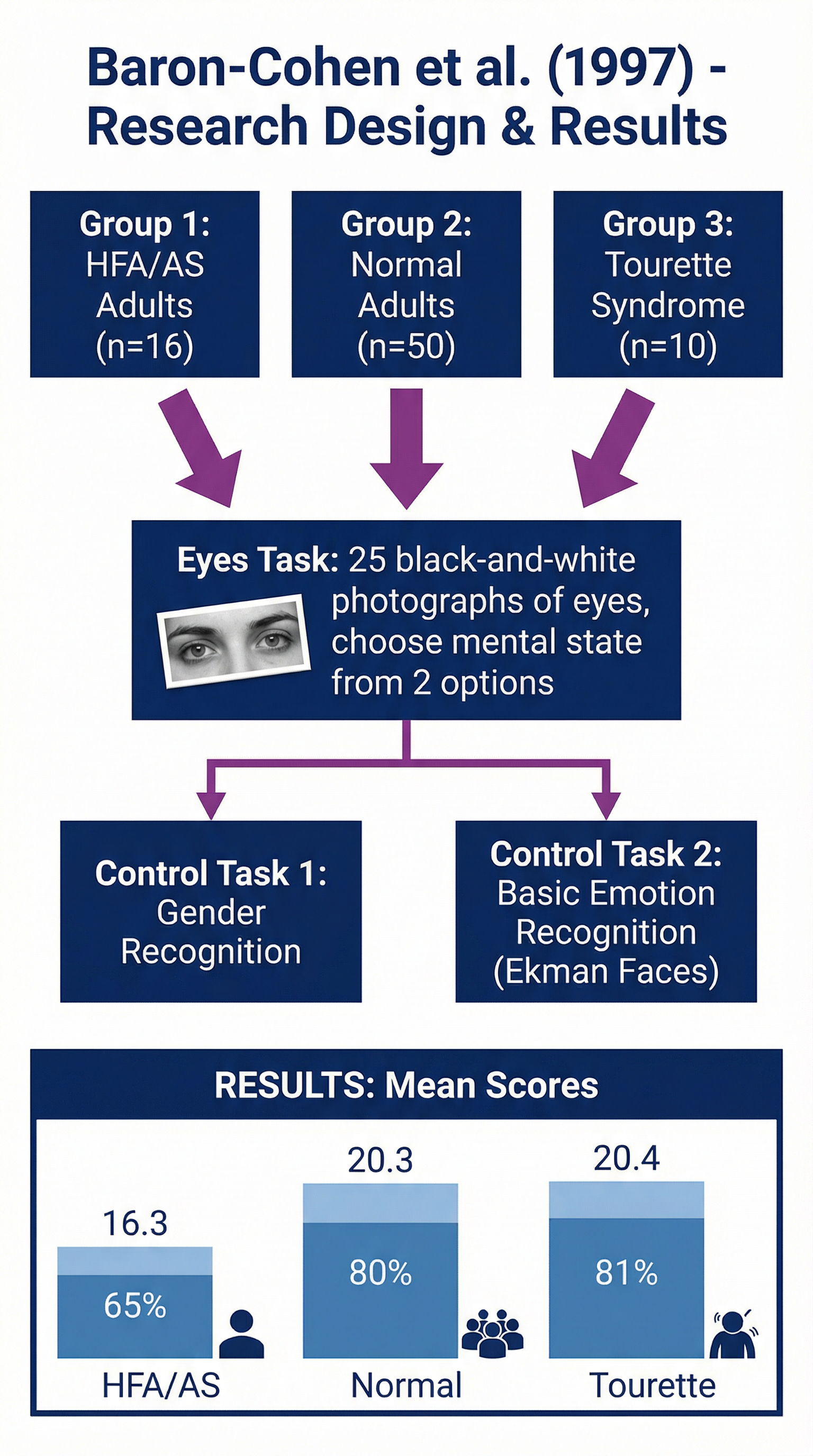
- Group 1: 16 adults (13 male, 3 female) with High-Functioning Autism or Asperger Syndrome. They were of normal intelligence and were recruited via a volunteer sample from an advert in the National Autistic Society magazine and clinical referrals.
- Group 2: 50 normal adults (25 male, 25 female), selected randomly from a subject panel at Cambridge University. They were assumed to be neurotypical.
- Group 3: 10 adults (8 male, 2 female) with Tourette Syndrome (TS), also of normal intelligence. This group was crucial for comparison.
Why the Tourette Syndrome Group?: This is a key evaluation point. TS is a neurodevelopmental disorder also associated with abnormalities in the frontal lobe of the brain. By including this group, Baron-Cohen could test whether deficits on the Eyes Task were specific to autism's unique social-cognitive profile, or simply a result of any frontal lobe abnormality. As the TS group performed well, it provided evidence that the deficit was specific to the autistic condition.
The Tasks
The Eyes Task: This was the main test of Theory of Mind. Participants were shown 25 black-and-white photographs of the eye region of different faces, for about 3 seconds each. For each photo, they had to make a forced choice between two words describing the mental state (e.g., 'concerned' vs 'unconcerned'). The words were always either a basic mental state or its opposite.
Control Tasks: To ensure that poor performance on the Eyes Task wasn't due to more general cognitive problems, two control tasks were used:
- Gender Recognition Task: Participants were shown the same eye photos but had to identify the gender. This controlled for basic face perception.
- Basic Emotion Recognition Task: Participants were shown whole faces displaying six basic emotions (happy, sad, angry, afraid, disgusted, surprised) from Ekman's classic set. This controlled for the ability to recognise basic, non-complex emotions.
Key Findings
Eyes Task Performance
The results provided strong support for the hypothesis. Candidates must know these specific mean scores:
- Group 1 (HFA/AS): Mean score = 16.3 / 25
- Group 2 (Normal): Mean score = 20.3 / 25
- Group 3 (TS): Mean score = 20.4 / 25The HFA/AS group performed significantly worse than both the normal and the Tourette Syndrome groups. There was no significant difference between the normal and TS groups.
Control Task Performance
There were no significant differences between the groups on either the Gender Recognition or the Basic Emotion Recognition tasks. This is a vital finding, as it rules out the possibility that the HFA/AS group's poor performance was due to a failure in basic face perception or emotion recognition. The deficit was specific to understanding complex mental states from the eye region.
Conclusions
The study concluded that even high-functioning adults with autism or Asperger Syndrome have a significant deficit in their Theory of Mind. This deficit is subtle and may not be picked up by simpler, first-order ToM tasks like the Sally-Anne test, but it is revealed by a more advanced and sensitive measure like the Eyes Task. The findings support the idea that the ToM deficit is a core cognitive feature of autism, independent of general intelligence.
Listen to the Podcast
For a full audio breakdown of the study, exam tips, and a quick-fire quiz, listen to our dedicated podcast episode.
Visual Resources
2 diagrams and illustrations
Interactive Diagrams
1 interactive diagram to visualise key concepts
Conceptual Flow Outline
Flowchart of the experimental procedure in Baron-Cohen et al. (1997).
Worked Examples
3 detailed examples with solutions and examiner commentary
Practice Questions
Test your understanding — click to reveal model answers
Outline two findings from the study by Baron-Cohen et al. (1997). (4 marks)
Hint: Be specific. Use the mean scores for at least one of your points.
Explain why the study by Baron-Cohen et al. (1997) is considered a quasi-experiment. (3 marks)
Hint: Focus on the Independent Variable (IV).
To what extent is the 'Reading the Mind in the Eyes' task a valid measure of Theory of Mind? (15 marks)
Hint: This is an essay. You need a balanced argument. Consider different types of validity (ecological, concurrent, construct) and structure your answer with PEEL paragraphs.
Describe the sample used in Group 1 of Baron-Cohen et al.'s (1997) study. (4 marks)
Hint: Include the diagnosis, number of participants, gender split, and recruitment method.
Explain the purpose of including a Tourette Syndrome group in the study. (4 marks)
Hint: Think about alternative explanations for the findings that this group helps to rule out.